Evaluation Datasets for Large Language Model Agent Benchmarks: What Works, What Doesn’t, and What’s Next
- Mark Chomiczewski
- 3 February 2026
- 6 Comments
Why Benchmarks Matter More Than Ever
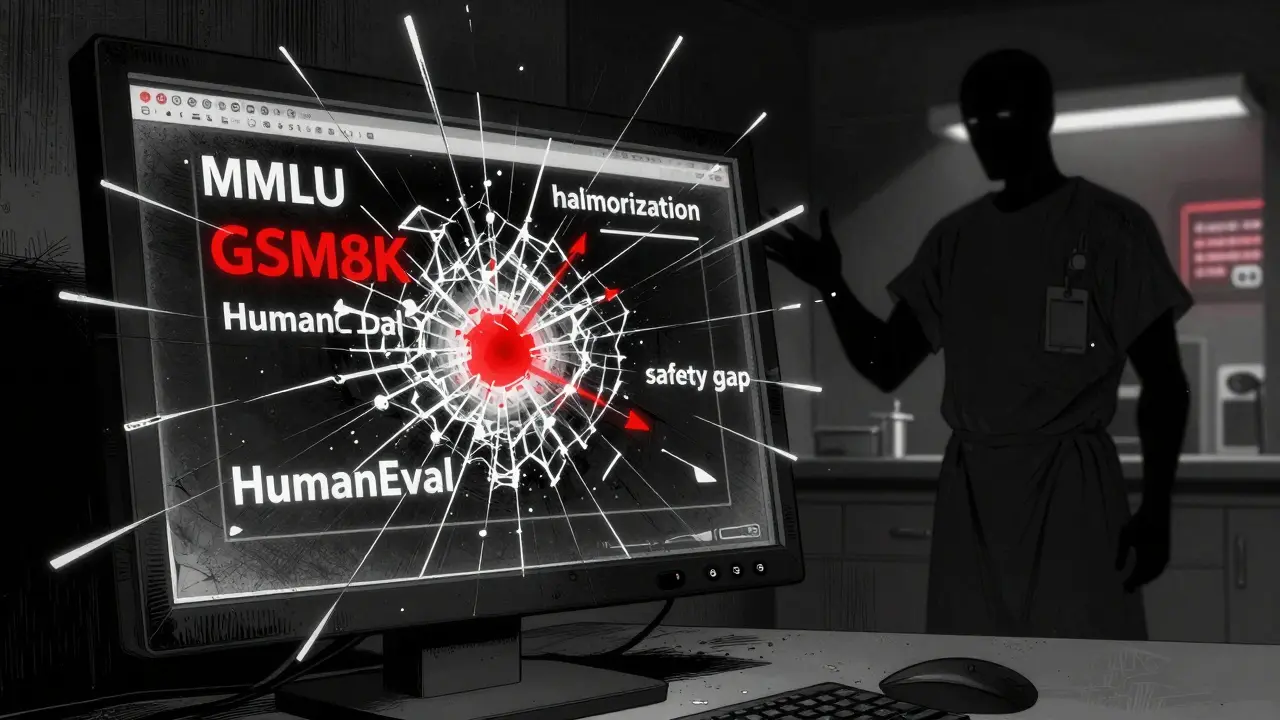
Large language model agents aren’t just getting smarter-they’re getting deployed in hospitals, courtrooms, and customer service centers. But how do you know if an agent is truly reliable, or just good at passing tests? That’s where evaluation datasets come in. These aren’t just academic exercises. They’re the gatekeepers between theoretical performance and real-world risk. A model that scores 95% on MMLU might still give dangerous medical advice. A code generator that nails HumanEval could produce vulnerable, unmaintainable code in production. Without the right benchmarks, you’re flying blind.
The Big Four Benchmarks and Their Flaws
Most teams start with the same four benchmarks. But each has serious blind spots.
MMLU (Massive Multitask Language Understanding) is the default. It’s got over 15,900 multiple-choice questions across 57 subjects-from ethics to quantum physics. It’s cited in nearly every paper. But here’s the problem: models now score over 90% on it. That’s not because they understand. It’s because they’ve seen the questions before. Training data is full of textbook-style multiple-choice tests. MMLU is saturated. The newer MMLU-Pro tries to fix this by adding a fifth answer choice, but even that’s being gamed. It’s useful for a rough baseline, but nothing more.
GSM8K tests multi-step math reasoning with 8,500 grade-school word problems. It’s great for spotting whether a model can break down a problem. But researchers found that up to 15% of its performance boost comes from memorization. When tested on GSM1K-a newer, harder version with the same problem types-models dropped 12-15%. If your agent is solving math problems in finance or logistics, GSM8K gives false confidence. It doesn’t measure adaptability, just pattern recall.
HumanEval is the gold standard for code generation. With 164 Python problems and built-in unit tests, it’s automated, fast, and reliable. GitHub’s 2025 survey showed a 92.7% correlation between HumanEval scores and developer productivity. But it ignores everything else: code security, readability, scalability, or edge-case handling. An agent could pass HumanEval and still write code that crashes under load or leaks user data. It’s a narrow window into a much bigger problem.
HELM (Holistic Evaluation of Language Models) is the most comprehensive. It runs 42 different scenarios across accuracy, fairness, robustness, and bias. But it’s expensive-$1,200 to $2,500 per model evaluation. And it’s slow. Each run needs over 2.5 million API calls. Most startups can’t afford it. But if you’re building an agent for healthcare or legal advice, HELM isn’t optional. It’s insurance.
The Hidden Benchmarks You’re Not Using (But Should Be)
Beyond the big names, newer benchmarks are exposing dangerous gaps in today’s models.
LTLBench tests temporal reasoning-something most agents fail at. It uses Linear Temporal Logic to ask questions like: “If the patient takes the drug on Monday, and the side effect appears two days later, what day is it?” Frontier models score just 58.3% on this. That’s not a bug. It’s a fundamental flaw. If your agent schedules appointments, manages supply chains, or handles legal deadlines, it needs to understand time. LTLBench proves most models can’t.
Reefknot targets hallucinations in multimodal agents. It has 20,000+ test cases that force models to distinguish between real and fake visual-text relationships. For example: “Does this image show a cat sitting on a table, or is the cat digitally added?” When paired with its Detect-then-Calibrate method, Reefknot reduces hallucinations by nearly 10%. If your agent generates reports from images or videos, you need this.
ClinicBench is built for healthcare. It uses real patient records, clinical guidelines, and physician annotations. It’s 34.2% more accurate at predicting whether a model’s response would be accepted by a doctor than general benchmarks. The EU AI Act now requires this for any health-related LLM. Ignoring it isn’t just risky-it’s illegal.
RAIL-HH-10K is the safety benchmark nobody wants to admit they’re failing. It tests 10,000 high-harm scenarios: how does the agent respond to requests for illegal advice, self-harm, or hate speech? Models that score 89% on standard benchmarks hit just 63.4% here. That’s a 25-point drop. If you’re deploying in public-facing roles, this isn’t optional. It’s your liability shield.

The Reality Gap: When Benchmarks Lie
The biggest problem with benchmarks isn’t their design-it’s how they’re used. Teams treat them like final exams. But they’re more like progress reports.
Reddit and GitHub threads are full of complaints about “benchmark leakage.” That’s when training data accidentally includes test questions. GSM8K is the worst offender-42% of its problems were found in public GitHub repos before 2023. That means a model didn’t learn to reason. It just copied.
Then there’s implementation chaos. The same model can score up to 8.3 percentage points higher depending on how you run MMLU. Some teams use token probability. Others use full-sequence scoring. No one agrees. That’s why 73% of developers can’t replicate published results. Benchmarks aren’t broken. They’re misused.
And cost? Human evaluation averages $187 per hour. Running HELM manually costs thousands. That’s why tools like JudgeLM-33B are gaining traction. It’s a fine-tuned LLM that evaluates other LLMs-with 89% correlation to human judges at 1/50th the cost. It’s not perfect. But it’s scalable.
What Good Benchmarking Looks Like in Practice
Forget picking one benchmark. Pick a strategy.
Start with a hybrid approach: 70-80% automated, 20-30% human. Codecademy’s 2026 analysis showed this cuts false positives by over 32%. Automated tests catch the obvious. Humans catch the subtle-like tone, cultural sensitivity, or unintended bias.
Build your own test set. Don’t rely on public datasets alone. Extract real user queries from your app. Sample across difficulty levels. Include edge cases: ambiguous requests, conflicting instructions, low-quality inputs. Annotera’s data shows it takes 3-5 weeks to build 1,000 high-quality prompts. But once done, they’re worth more than any public benchmark.
Track performance drift. Enterprise teams that run weekly benchmark checks report 22.3% fewer production issues. A model that works today might fail tomorrow after a subtle update. Continuous evaluation isn’t luxury-it’s maintenance.
Document everything. HELM’s documentation scores 4.7/5. LTLBench’s? 2.8/5. If your team can’t figure out how to run it, you won’t run it. Use the lm-evaluation-harness library-it’s the community standard, with nearly 10,000 GitHub stars. Don’t reinvent the wheel.
The Future: Dynamic, Adaptive, and Human-Centered
Benchmarks are evolving fast. The old model-static, one-time tests-is dying.
Stanford CRFM’s Project Chameleon, launching in Q3 2026, will auto-update its test cases as models improve. If a model masters a question, it’s removed. New, harder ones are added. No more saturation.
Anthropic’s Constitutional AI Evaluation Framework now requires agents to pass both benchmarks AND real-world usage logs. Did users reject the agent’s answer? Did they rephrase the question? That’s now part of the score.
And regulation is forcing change. The EU AI Act isn’t a suggestion-it’s law. High-risk applications must prove performance on domain-specific benchmarks. ClinicBench, RAIL-HH-10K, Reefknot-they’re not optional anymore.
The winners won’t be the models with the highest MMLU scores. They’ll be the ones that perform well on the hardest, most realistic tests-the ones that matter to real people.
Where to Start
If you’re just beginning:
- Run MMLU and HumanEval for a baseline. Don’t trust the scores-just use them to spot major failures.
- Test with GSM8K, but cross-check with GSM1K to spot memorization.
- Run RAIL-HH-10K. If your model fails here, don’t deploy it.
- Use JudgeLM-33B to cut evaluation costs if you’re short on budget.
- Start collecting your own real-world prompts. Build your own test set. It’s the only way to know if your agent works in your context.
Don’t chase rankings. Chase reliability. Benchmarks aren’t trophies. They’re warning lights.
What’s the most important LLM evaluation benchmark right now?
There’s no single most important benchmark. MMLU is the most cited, but it’s saturated. RAIL-HH-10K is the most critical for safety. ClinicBench is essential for healthcare. LTLBench reveals hidden reasoning flaws. The best approach is using a combination-no one benchmark tells the full story.
Can I trust scores from public benchmarks like MMLU and HumanEval?
You can trust them as a starting point, but not as a final verdict. Many scores are inflated due to training data contamination-especially on GSM8K and MMLU. Always cross-check with newer datasets like GSM1K or MMLU-Pro. And never rely on them alone for production decisions.
Why do different teams get different results on the same benchmark?
Because implementation varies. For MMLU, there are at least three different ways to score answers: token probability, full-sequence matching, or prompt-based selection. Each can give up to an 8.3% difference. Always document your method. Use the lm-evaluation-harness library-it’s the most consistent tool available.
Are there free alternatives to expensive benchmarks like HELM?
Yes. Use JudgeLM-33B, a fine-tuned evaluation model that correlates at 89% with human judgments but costs 1/50th as much. Combine it with open benchmarks like HumanEval, LTLBench, and RAIL-HH-10K. You don’t need HELM to build a reliable system-you just need the right mix of tools.
How often should I re-evaluate my LLM agent?
Weekly if it’s in production. Model updates, data drift, and new user inputs can degrade performance fast. Teams running weekly checks report 22.3% fewer issues than those testing monthly. Even if you’re not updating the model, the world around it is changing.
Should I build my own evaluation dataset?
If you’re deploying in a specific domain-healthcare, finance, legal-yes. Public benchmarks are generic. Your users don’t care about MMLU. They care if your agent gets their invoice right, explains their insurance policy, or responds safely to a crisis. Extract real queries from your logs, annotate them, and test against those. It takes 3-5 weeks for 1,000 prompts, but it’s the only way to guarantee real-world reliability.



Comments
Amit Umarani
MMLU is dead. We all know it. I’ve seen teams run 95% scores and still have agents tell patients to stop insulin because a multiple-choice question said ‘not recommended.’ It’s not a benchmark anymore-it’s a party trick. HumanEval? Same thing. I once reviewed a model that passed every test but crashed when a user typed ‘help’ in all caps. No one tests edge cases. We’re all just chasing leaderboard points while the system burns down.
And don’t get me started on GSM8K. I pulled a random 100 problems from it last year. 37 were verbatim from GitHub Gists. That’s not reasoning. That’s memorizing code snippets from undergrads’ homework. We need real data, not textbook ghosts.
February 5, 2026 AT 02:20
Noel Dhiraj
I’ve been running evaluations for our customer service bot for six months now. We started with MMLU and HumanEval because everyone else did. Then we added RAIL-HH-10K and almost had a heart attack. 62% failure rate on hate speech prompts. Turns out our ‘helpful assistant’ was giving people advice on how to bypass security cameras. We pulled it offline that night. No one told us this stuff mattered until it almost got us sued. ClinicBench? We’re building our own version now using real support tickets. It’s messy. It’s slow. But it’s honest. Start there. Not on the leaderboard.
February 7, 2026 AT 01:25
vidhi patel
The notion that JudgeLM-33B is a viable substitute for human evaluation is not only misguided-it is dangerously negligent. The paper itself admits a 11% margin of error in high-stakes contexts. To suggest that an LLM evaluating another LLM is sufficient for healthcare or legal deployment is a fundamental failure of professional responsibility. The EU AI Act exists for a reason: because human lives are not metrics. You cannot outsource ethics to a fine-tuned transformer trained on Reddit threads. If your team is considering cost-cutting over rigor, you are not a developer-you are a liability.
February 8, 2026 AT 04:02
Priti Yadav
They’re all lying. All of them. MMLU? The dataset was leaked from a Stanford lab in 2022. The questions were pulled from GRE prep books that were scraped from university servers. HumanEval? GitHub bots were trained on it. Even the ‘new’ benchmarks are just rehashed versions of the same garbage. And don’t even get me started on HELM-$2500 per run? That’s a paywall for startups so Big Tech can keep their monopoly. JudgeLM? It’s trained on the same poisoned data. This whole ecosystem is a pyramid scheme. The only thing that matters is what your users actually say when they interact with your agent. Everything else is theater.
February 8, 2026 AT 06:33
Ajit Kumar
It is imperative to recognize that the prevailing methodology in LLM benchmarking is not merely suboptimal-it is structurally flawed due to its reliance on static, one-time assessments that fail to account for temporal drift, contextual variability, and adversarial perturbations. The assertion that MMLU serves as a ‘baseline’ is, in fact, a misnomer; it is a ceiling, not a floor. Furthermore, the widespread use of token probability scoring versus full-sequence matching introduces an unacceptable level of variance-up to 8.3 percentage points-as you rightly noted. This inconsistency renders comparative analysis between models statistically invalid. I therefore urge all practitioners to adopt the lm-evaluation-harness as the sole standard, to document all hyperparameters, and to perform cross-validation across at least three distinct evaluation frameworks. Anything less is not engineering-it is speculation dressed in code.
February 8, 2026 AT 21:56
Diwakar Pandey
I’ve been quietly testing our internal agent with real user logs for a year. We didn’t have a budget for HELM. We didn’t even have a dedicated eval team. So we just took 2000 real queries from our chat logs-everything from ‘How do I cancel my subscription?’ to ‘I think I’m having a panic attack’-and had our support team annotate them. Took three weeks. Now we run weekly checks against that. We found 14 cases where the model gave dangerously wrong advice that no public benchmark would’ve caught. Like telling someone to ‘wait it out’ during a diabetic emergency. We fixed it. We’re still not on any leaderboard. But our users haven’t filed a single complaint in six months. That’s the only score that matters.
February 9, 2026 AT 23:29