Generative AI Adoption Benchmarks: Industry ROI & Maturity Stages in 2026

- Mark Chomiczewski
- 9 July 2026
- 0 Comments
It is 2026, and the hype cycle for Generative AI is technology that creates new content like text, code, or images based on input prompts has finally settled into something much more serious: business reality. Two years ago, every company was launching a pilot. Today, only the ones with a plan are seeing returns. The difference between a successful deployment and a wasted budget isn't just about which model you pick; it’s about where your organization sits on the maturity curve and how your industry compares to the global average.
If you are trying to justify an AI budget or figure out why your last project stalled, you need hard data, not buzzwords. This guide breaks down the current state of generative AI adoption across industries, defines what true maturity looks like in 2026, and shows you exactly how to measure if you are falling behind.
The State of Play: From Experimentation to Production
We have moved past the "wow" factor. In early 2023, companies were excited that AI could write a poem. By mid-2024, they wanted it to draft emails. Now, in 2026, the expectation is that AI must drive measurable efficiency or revenue. According to Salesmate's 2026 industry report, 78% of organizations now implement AI in at least one business function, up from 55% in 2024. That sounds impressive until you look closer: most of those implementations are still stuck in low-value tasks.
The real shift this year is the move toward AI Agents are autonomous software systems that can execute multi-step tasks by interacting with other software tools and databases. While over 70% of enterprises have introduced generative AI into operations, only 6% have fully implemented agentic AI (Lucidworks, 2026). This gap represents the biggest opportunity-and risk-for businesses right now. The global AI agents market reached USD 7.6-7.8 billion in 2025 and is projected to exceed USD 10.9 billion in 2026 (Grand View Research). If you are still treating AI as a chatbot rather than an integrated worker, you are leaving money on the table.
Consider the ROI landscape. High-maturity adopters are achieving a 3.7x return for every dollar invested in generative AI (Salesmate, 2026). But here is the catch: high-maturity adopters achieve 3x higher ROI than those still in early testing phases. The technology works, but the execution varies wildly. With 70% of AI pilots failing due to poor adoption strategies (Akkio, 2026), the question is no longer "Can we use AI?" but "Are we using it correctly?"
Defining AI Maturity: Where Do You Stand?
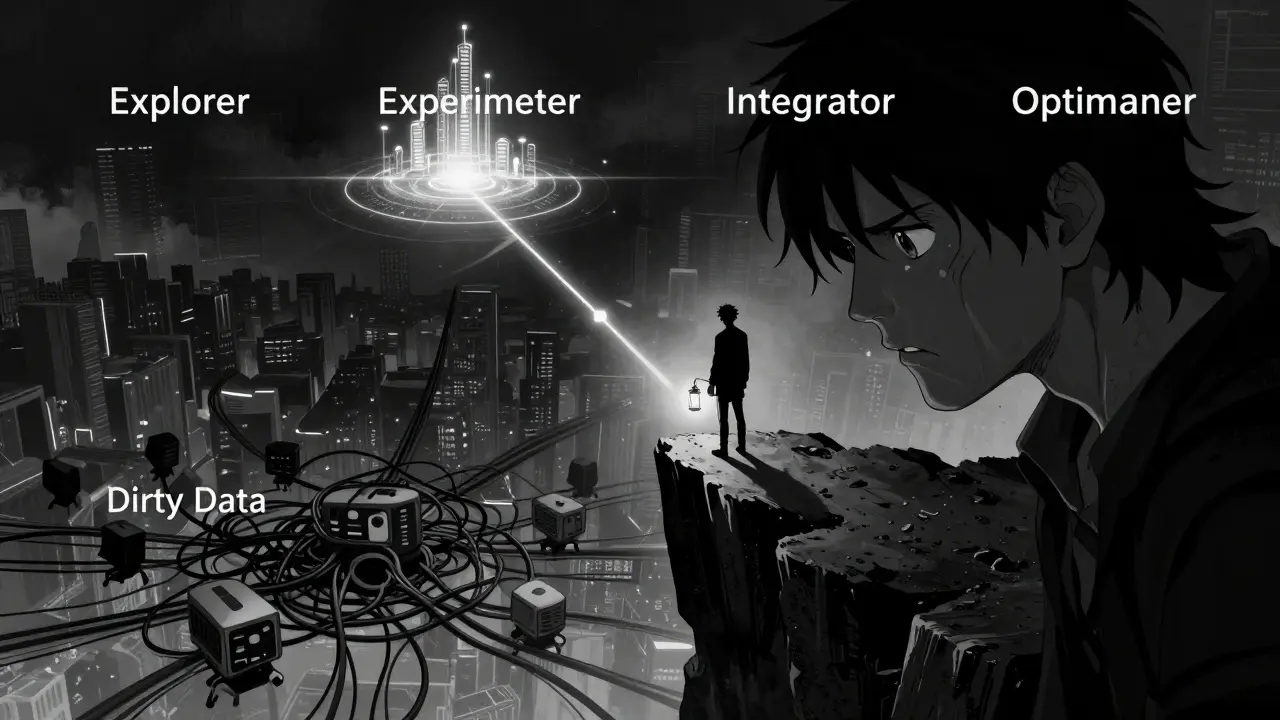
Maturity isn't binary. It is a spectrum defined by integration depth, governance, and outcome measurement. Based on current enterprise trends, we can break adoption into four distinct stages:
- Explorer (Awareness): You have played with public models like ChatGPT or Claude internally. No API integrations. No dedicated budget. Value is anecdotal.
- Experimenter (Pilots): You have launched 1-2 departmental pilots (e.g., marketing copy generation). Data is siloed. Success is measured by user engagement, not financial impact.
- Integrator (Production): AI is embedded in core workflows. You use custom models or fine-tuned open-source options. Data pipelines are clean. You track time savings and error reduction.
- Optimizer (Agentic): AI agents operate autonomously within governed boundaries. They trigger actions in CRM, ERP, or supply chain systems. ROI is directly tied to revenue growth or cost avoidance.
Most companies are stuck in stage two. They build a shiny prototype, show it to leadership, and then let it gather digital dust because they never solved the underlying data infrastructure problems. Moving from Experimenter to Integrator typically takes 12-18 months according to Deloitte's 2026 framework. Don't rush this. Rushing leads to the "value-realization problem" described by Dr. Elena Rodriguez at MIT Sloan: realizing too late that the tech is great, but your organization isn't ready for it.
Industry Comparisons: Who Is Winning?
Adoption rates vary drastically by sector. Some industries have clear, repeatable workflows that lend themselves perfectly to automation. Others are bogged down by regulation or legacy systems. Here is how the major sectors stack up in 2026:
| Industry | Adoption Rate | Primary Use Case | Key Barrier |
|---|---|---|---|
| Customer Service / eCommerce | High (Leading) | Response automation, product descriptions | Brand voice consistency |
| Technology | Very High | Code generation, IT support | Talent retention |
| Manufacturing | 18-22% | Predictive maintenance, quality control | Data labeling quality |
| Healthcare | 15-20% | Administrative efficiency, documentation | Privacy/HIPAA compliance |
| Finance | 15-18% | Risk analysis, fraud detection | Regulatory oversight |
| Construction | 1.4% | Scheduling, safety reporting | Digital literacy, connectivity |
Notice the disparity. Customer service and eCommerce lead because the ROI pathway is obvious: faster responses mean happier customers and higher conversion rates. One successful implementation reported a 37% reduction in response times while maintaining 92% customer satisfaction (Salesmate, 2026). That is easy to sell to a CFO.
On the other end, construction lags significantly at just 1.4% adoption. Why? Because the work happens offline, on job sites with poor connectivity, and involves highly variable, non-digital inputs. Similarly, healthcare and finance are cautious. They aren't slow because they don't want to innovate; they are slow because the cost of failure is existential. A hallucinated medical diagnosis or a biased loan approval algorithm carries legal and reputational risks that a bad marketing email does not.
B2C companies generally outpace B2B firms. Data from Lucidworks (2026) shows 41% of B2C companies are in the "Achiever" category compared to only 31% of B2B firms. B2B sales cycles are longer, stakeholders are more skeptical, and integration with complex ERPs is harder. If you are in B2B, expect a longer journey to maturity.
The Hidden Killers: Why Pilots Fail
You might be thinking, "We tried AI last year and it didn't work." You are not alone. 70% of AI pilots fail. But usually, the failure isn't the AI model itself. It's the ecosystem around it.
Here are the three most common reasons projects stall, based on feedback from developers and executives in 2026:
- Dirty Data: 44.3% of Swedish companies cite data issues as a primary barrier (Alice Labs, 2026). AI is only as good as its training data. If your CRM records are inconsistent, your AI agent will output garbage. One manufacturing executive noted, "We wasted 6 months trying to implement predictive maintenance AI before realizing our sensor data wasn't properly labeled" (Codewave, 2026).
- Lack of Expertise: 74.7% of non-adopting companies point to a skills gap (Alice Labs, 2026). You don't need a PhD in machine learning, but you do need people who understand prompt engineering (critical for 76% of successful implementations) and data engineering (cited by 83%).
- Integration Complexity: Trustpilot reviews for AI platforms praise ease of use (4.2/5) but criticize integration complexity (2.9/5). Building a standalone chatbot is easy. Building an agent that can read your inventory database, check shipping costs, and update the order management system requires robust APIs and security protocols.
Don't start with the model. Start with the data. If you cannot answer the question, "Where does this information live, and is it structured?" pause your AI initiative until you fix your data hygiene.
Measuring Success: Beyond Vanity Metrics
To benchmark yourself effectively, you need to track the right KPIs. Stop measuring "number of prompts generated." Start measuring business outcomes.
For customer-facing roles, track deflection rate (how many tickets are resolved without human intervention) and first-contact resolution. For internal operations, track time-to-task completion. Generative AI users currently report time savings equivalent to 1.6% of all work hours globally (Salesmate, 2026). That might sound small, but for a large enterprise, 1.6% of total labor hours translates to millions of dollars in productivity gains.
Also, monitor human-in-the-loop accuracy. As you move toward agentic AI, you need to know how often a human had to override the AI's decision. High override rates indicate either poor model tuning or unclear governance rules. Aim for transparency. If employees don't trust the AI, they won't use it, and your adoption metrics will plummet regardless of technical performance.

Regional Insights: The Global Divide
Adoption isn't uniform geographically. Europe is moving fast, particularly in Northern countries. Sweden ranks third in EU adoption at 35% enterprise usage, showing 236% growth since 2023 (Alice Labs, 2026). However, Finland leads with 66%, highlighting how national digital infrastructure policies can accelerate corporate adoption.
In Sweden, the ICT sector dominates with 87.9% adoption, while Transport & Storage sits at just 12.2%. There is also a stark divide by company size: 71.9% of large enterprises use AI, compared to only 16.1% of micro-enterprises. This "AI divide" is widening. Large companies have the resources to hire data engineers and buy premium API access. Small businesses are often left relying on free-tier tools that lack the security and customization needed for competitive advantage.
Regulation also plays a role. The EU AI Act is forcing companies to be more transparent about data sources and bias mitigation. While this adds overhead, it also builds trust. Companies that proactively address data protection concerns (cited as a barrier by 49.1% of Swedish firms) are finding that compliance becomes a selling point with enterprise clients.
Action Plan: How to Benchmark Your Own Organization
So, where do you go from here? Here is a practical checklist to assess your current position and plan your next steps:
- Audit Your Data Infrastructure: Map out your key business processes. Identify which ones rely on unstructured data (emails, PDFs, logs). These are your prime candidates for GenAI.
- Define Clear ROI Metrics: Before buying any tool, decide what success looks like. Is it reducing customer support ticket volume by 20%? Is it cutting code review time in half? Write it down.
- Start Small, Scale Fast: Pick one high-impact, low-risk workflow. Implement a pilot. Measure rigorously. If it works, expand to adjacent processes. Avoid "boiling the ocean" by trying to transform the entire company at once.
- Invest in Training: 77% of Swedish companies provide AI-related training (Alice Labs, 2026). Teach your team prompt engineering and critical evaluation skills. An AI-literate workforce is your best defense against misuse and inefficiency.
- Plan for Governance: Establish guidelines for data privacy, intellectual property, and human oversight. Document who is responsible when the AI makes a mistake.
The companies that win in 2026 and beyond won't be the ones with the smartest models. They will be the ones with the cleanest data, the clearest goals, and the most disciplined execution. Benchmark against the leaders, learn from their failures, and focus on building sustainable value, not just chasing the latest trend.
What is the average ROI for generative AI in 2026?
According to Salesmate's 2026 report, organizations see an average ROI of 3.7x for every dollar invested in generative AI. However, high-maturity adopters achieve 3x higher returns than those in early testing phases, emphasizing the importance of proper implementation and integration.
Which industries are leading in AI adoption?
Customer service, eCommerce, and Technology sectors are leading adoption due to clear ROI pathways and repeatable workflows. B2C companies also outperform B2B firms, with 41% of B2C companies classified as "Achievers" compared to 31% of B2B firms.
Why do most AI pilots fail?
Approximately 70% of AI pilots fail due to poor adoption strategies. Common causes include dirty or unstructured data (44.3% of barriers), lack of technical expertise (74.7%), and integration complexity with existing business systems.
How long does it take to fully integrate AI into production?
Basic deployment typically takes 3-6 months, but full production integration with robust governance and data pipelines usually requires 12-18 months, according to Deloitte's 2026 implementation framework.
What is the difference between Generative AI and AI Agents?
Generative AI creates content (text, code, images) based on prompts. AI Agents are autonomous systems that can execute multi-step tasks by interacting with other software tools, databases, and APIs to achieve specific business outcomes without constant human guidance.
Is AI adoption higher in large or small companies?
Large enterprises significantly outpace smaller firms. In Sweden, for example, 71.9% of large enterprises use AI, compared to only 16.1% of micro-enterprises. This gap is driven by differences in resources, data infrastructure, and access to specialized talent.