How Generative AI Solves Note Drafting, Prior Authorizations, and Care Plans in Healthcare

- Mark Chomiczewski
- 20 May 2026
- 0 Comments
You spend more time typing into your electronic health record (EHR) than you do talking to patients. If you are a clinician in 2026, this is not just a complaint; it is the reality of modern practice. Administrative burnout has reached a breaking point, with studies showing that nearly half of a physician's day is consumed by paperwork rather than patient care. But something is changing fast. Generative AI is no longer a futuristic concept-it is here, sitting on your desktop, listening to your consults, and drafting notes before you even leave the exam room.
This technology is reshaping three critical pillars of healthcare operations: clinical note drafting, prior authorizations, and personalized care plans. For providers, this means reclaiming hours every week. For patients, it means faster approvals for necessary treatments and more thoughtful, individualized care strategies. Let’s look at how these tools actually work in the wild, what they cost, and where the real risks lie.
The End of After-Hours Charting?
Clinical documentation is the most mature application of generative AI in medicine. Remember the days when you had to dictate notes or manually transcribe encounter details? Those days are fading. Modern systems use large language models (LLMs) fine-tuned specifically on medical datasets. They listen to the doctor-patient conversation in real-time, filter out small talk, and structure the data into a SOAP note format instantly.
Take Abridge, for example. Their platform processes documentation in real-time with an average turnaround of just 45 seconds per clinical note. Or look at Ambience Healthcare, which helped Alpine Physician Partners slash daily charting time by 74%. When Nuance’s DAX Copilot reports 98.5% accuracy in voice-to-text conversion, you can see why adoption is skyrocketing. As of early 2025, 22% of healthcare organizations had already implemented domain-specific AI tools-a tenfold increase from just two years prior.
But it is not magic. These tools rely on cloud infrastructure with strict HIPAA-compliant security protocols. They integrate directly with major EHR systems like Epic, Cerner, and Meditech using HL7 FHIR standards. The goal is seamless interoperability. You shouldn’t need a specialized computer to run them; they should work on the hardware you already have.
- Speed: Real-time processing reduces post-shift documentation from hours to minutes.
- Accuracy: High precision for common conditions, though rare diseases may require manual verification.
- Integration: Direct push to existing EHR workflows without double-entry.
Taming the Beast of Prior Authorizations
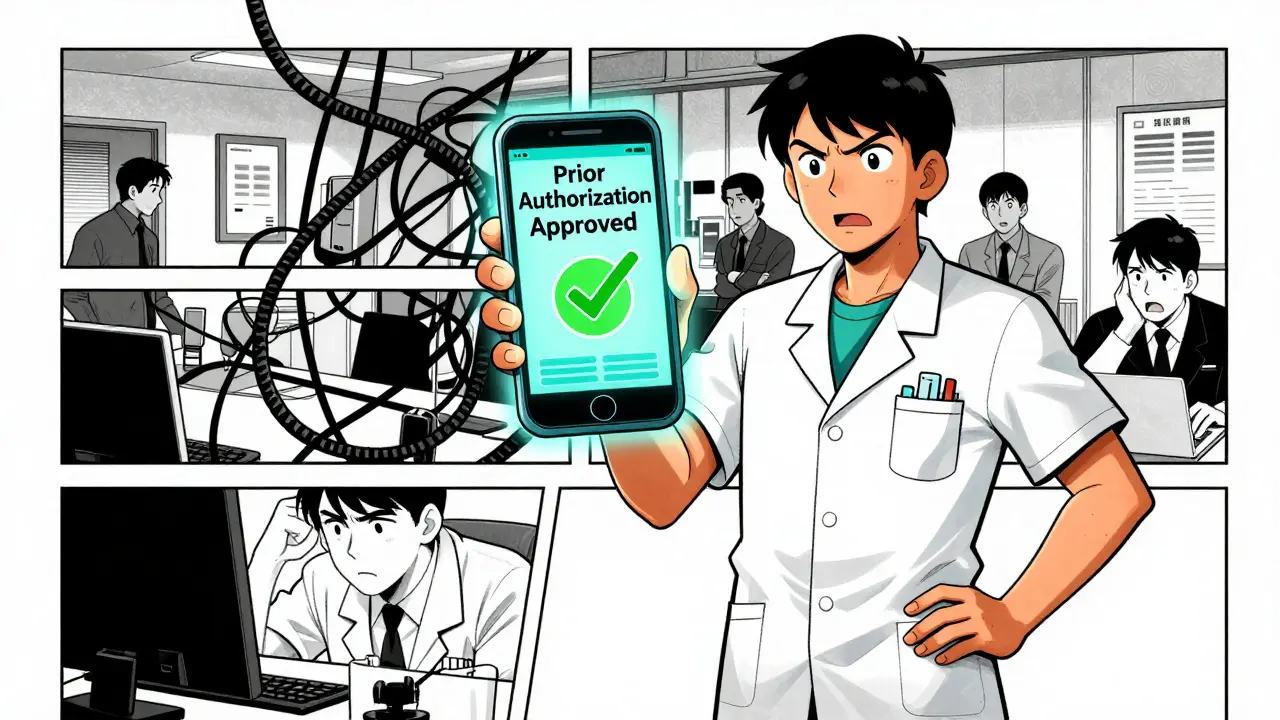
If charting is painful, prior authorizations are often infuriating. Insurance denials delay treatment, frustrate patients, and bog down administrative staff. This is where generative AI shows its teeth. Instead of a nurse spending four hours gathering records and filling out forms, AI agents can automate the entire request process.
Consider the partnership between Abridge and Highmark Health. By deploying real-time prior authorization processing, they achieved approval rates 63% faster than traditional methods. In another case, Olive AI reduced authorization denial rates by 41%, according to a Johns Hopkins study in 2025. These aren't marginal gains; they are operational game-changers.
How does it work? The AI scans the patient's history, cross-references payer-specific criteria, and generates the required justification letters automatically. It then submits the request and tracks the status. For routine authorizations, some platforms now handle 85% of the process without human intervention. This frees up medical assistants to focus on patient intake and education rather than phone tag with insurance companies.
Smarter, Faster Care Plans
Beyond administration, generative AI is entering the realm of clinical decision support. Creating a comprehensive care plan requires synthesizing lab results, genetic markers, social determinants of health, and latest treatment guidelines. Humans are great at empathy, but we struggle with volume. AI excels at synthesis.
Platforms like Nabla are generating personalized treatment recommendations with 89% clinical accuracy, significantly higher than legacy clinical decision support systems which hovered around 76%. These tools analyze vast amounts of evidence-based research instantly, giving doctors immediate access to the latest guidelines during a consultation. However, there is a crucial caveat: AI does not replace the doctor. It augments them.
The FDA has established new clearance pathways for AI clinical decision support tools, with 510(k) submissions increasing by 220% year-over-year. Yet, the American Medical Association insists on mandatory human oversight. Every high-risk treatment plan must still have a "human-in-the-loop" validation. The AI suggests; the physician decides.
| Provider | Primary Focus | Key Metric/Benefit | Estimated Annual Cost Per Provider |
|---|---|---|---|
| Abridge | Documentation & Auth | 45-second note turnaround; 63% faster auths | $1,200 - $2,500 |
| Ambience Healthcare | Voice Documentation | 74% reduction in charting time | $1,200 - $2,500 |
| Olive AI | Prior Authorization | 41% reduction in denial rates | $800 - $1,500 |
| Nabla | Care Planning | 89% clinical accuracy in recommendations | $2,000 - $4,000 |

The Human Element: Risks and Realities
We need to be honest about the limitations. Dr. Eric Topol, Founder of the Scripps Research Translational Institute, warns that hallucination rates of 5-7% in clinical documentation AI remain unacceptable for autonomous use. What does this mean in practice? Occasionally, the AI might misinterpret a complex clinical scenario or attribute a symptom to the wrong cause. That is why 100% of notes still require physician sign-off.
There are also integration hurdles. Legacy EHR systems account for 37% of implementation delays. If your hospital runs on outdated software, getting these tools to talk to your database will take time and money. Furthermore, bias remains a concern. Accuracy drops by 12-15 percentage points for underserved populations due to gaps in training data. Vigilance is required to ensure equitable care.
User feedback reflects this mixed bag. On Reddit’s r/HealthIT, a veteran physician noted that while Abridge cut his documentation time from two hours to 20 minutes, the initial setup required three weeks of workflow adjustments. At Mass General Brigham, 89% of physicians reported reduced burnout, but 63% noted a steep learning curve. Success depends heavily on change management. Hospitals with dedicated physician AI leads see an 83% adoption rate compared to just 54% without them.
Implementation: What You Need to Know
So, how do you get started? Implementation typically takes 8-12 weeks from contract signing to full deployment. It is not a plug-and-play solution. You need resources. Accenture’s benchmarks suggest dedicating 1.5 full-time equivalents per 100 clinicians for change management. Training varies by role: physicians need 15-20 hours, nurses 8-10 hours, and scribes only 4-6 hours.
Cost is another factor. Clinical documentation tools generally run $1,200-$2,500 per provider annually. Prior authorization solutions are cheaper, around $800-$1,500, while comprehensive care planning platforms can cost $2,000-$4,000. Enterprise contracts often include implementation fees ranging from $50,000 to $250,000. Given the staffing shortage-projected to hit 124,000 physicians by 2030-the ROI on retaining current staff through burnout reduction is often the strongest business case.
To succeed, secure physician champions early. Conduct thorough workflow analysis before buying software. And establish clear metrics beyond simple time savings, such as patient satisfaction scores and denial rate reductions. The World Economic Forum forecasts that AI-assisted care planning will reduce diagnostic errors by 28% by 2027, but only if integrated correctly.
Is generative AI replacing doctors?
No. Generative AI is designed to augment clinicians, not replace them. While it handles administrative tasks like note drafting and prior authorizations efficiently, all clinical decisions and high-risk care plans require mandatory human oversight and physician sign-off to ensure safety and accountability.
How accurate are AI-generated clinical notes?
For common conditions, accuracy is very high, often exceeding 95%. However, accuracy can drop to around 82% for rare diseases. Additionally, hallucination rates of 5-7% exist, meaning physicians must review and edit all AI-generated content before finalizing it in the medical record.
What is the cost of implementing AI for prior authorizations?
Prior authorization solutions typically cost between $800 and $1,500 per provider annually. Enterprise contracts may also include one-time implementation fees ranging from $50,000 to $250,000, depending on the size of the organization and complexity of integration.
How long does it take to train staff on generative AI tools?
Training requirements vary by role. Physicians typically need 15-20 hours of training, nurses require 8-10 hours, and medical scribes need only 4-6 hours due to their existing documentation expertise. Full organizational deployment usually takes 8-12 weeks.
Are AI healthcare tools HIPAA compliant?
Yes, reputable generative AI healthcare applications operate on cloud infrastructure with strict HIPAA-compliant security protocols. They are designed to integrate securely with major EHR systems like Epic and Cerner without requiring specialized hardware, ensuring patient data privacy.
Which AI tool is best for clinical documentation?
Leading options include Abridge and Ambience Healthcare. Abridge offers real-time processing with quick turnarounds, while Ambience has shown significant reductions in charting time (up to 74%). Choice depends on specific workflow needs, EHR compatibility, and budget constraints.