LLMOps for Generative AI: Build Reliable Pipelines, Monitor Performance, and Stop Drift Before It Breaks Your App

- Mark Chomiczewski
- 1 September 2025
- 5 Comments
Generative AI isn’t just a buzzword anymore-it’s running customer service bots, drafting legal briefs, writing marketing copy, and even advising patients in hospitals. But here’s the problem: LLMOps is what keeps these systems from falling apart. If you’re deploying LLMs without it, you’re flying blind. And sooner or later, your AI will give you garbage answers, cost you a fortune, or worse-break compliance rules.
Why LLMOps Isn’t Just MLOps With a New Name
MLOps worked fine for traditional machine learning models. You trained them on clean data, tested accuracy, deployed them, and checked performance weekly. Simple. LLMs? Not even close. A large language model doesn’t just predict outcomes-it generates human-like text on the fly. That means its behavior changes not just from data drift, but from subtle shifts in user prompts, tone, context, and even how you phrase your instructions. A prompt like “Summarize this” can return wildly different results depending on the model version, temperature setting, or even the time of day. That’s where LLMOps steps in. It’s not about training models. It’s about managing them in production-day after day, request after request. It’s the discipline of keeping your LLM accurate, fast, safe, and affordable. And according to IBM’s 2023 technical guide, it’s built on collaboration between data scientists, DevOps engineers, and IT teams. No one person can do it alone.LLM Pipelines: Connecting the Dots Between Prompts and Results
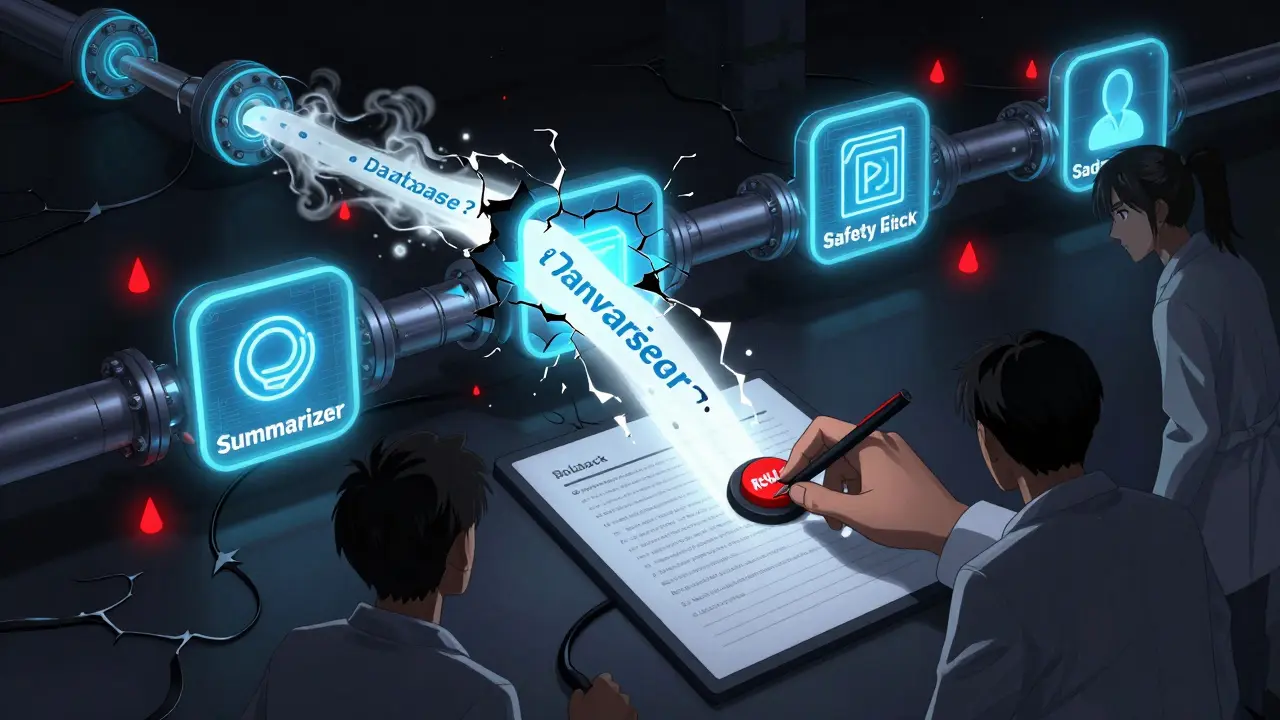
An LLM isn’t a standalone tool. It’s a component in a chain. You might start with a user question, pull data from a database, run it through a summarization model, then send the output to a safety filter, and finally deliver it to the user. That’s a pipeline. Frameworks like LangChain and LlamaIndex make building these chains easier. They let you link multiple LLM calls, external APIs, and logic steps together. But here’s the catch: every link is a failure point. A 2024 case study from a Fortune 500 company showed that after implementing Databricks’ LLMOps framework, deployment time dropped from three weeks to four days. But they hit a wall with prompt versioning. One team changed a prompt without telling anyone else. The chatbot started giving outdated medical advice. The fix? A centralized prompt registry-like Git for instructions. Your pipeline needs:- Prompt version control (track every change)
- Input sanitization (block malicious or malformed queries)
- Output validation (check for hallucinations, bias, or unsafe content)
- Automated testing (simulate edge cases before deployment)
Observability: You Can’t Fix What You Can’t See
Traditional ML monitors accuracy, recall, and F1 scores. LLMOps? It needs to track things no one talked about two years ago.- Token usage: How many tokens per request? Are you burning through your API budget?
- Latency: Is each response under 500ms? If it’s over a second, users bounce.
- Perplexity scores: A 15% increase over baseline? That’s a sign your model is losing coherence.
- Safety guardrail triggers: How often is your content filter kicking in? Why?
- User satisfaction: Are people upvoting or downvoting answers? Track it.
Drift Management: When Your AI Forgets How to Be Useful
Drift isn’t just about data changing. With LLMs, it’s about everything changing. - User questions evolve. “Explain quantum computing” becomes “Explain quantum computing like I’m 12 and want to build a robot.” - Model weights get updated. You’re using GPT-4-turbo today. Tomorrow, it’s GPT-5. Your prompts break. - The world changes. A new law passes. A disease emerges. Your model doesn’t know unless you tell it. Drift detection in LLMOps means watching three things:- Input drift: Are users asking new types of questions? Cluster them. Look for outliers.
- Output drift: Are answers getting longer, vaguer, or more repetitive? Track metrics like entropy and repetition rate.
- Performance drift: Is accuracy dropping? Use human eval panels. Automated metrics only catch 65-75% of issues, according to Stanford HAI’s 2024 research.
Costs, Tools, and the Real Price of Getting It Wrong
LLMOps isn’t cheap. Gartner estimates enterprise implementations start at $250,000 in infrastructure. Monthly costs can hit $100,000 for high-volume apps. But here’s what’s worse: the cost of not doing it. - A financial services firm lost $4.2 million in regulatory fines after their AI gave incorrect investment advice. The drift went unnoticed for six months. - A retail chatbot started recommending expired coupons. Revenue dropped 18% in one quarter. - A legal tech startup had to shut down after an LLM generated fake case law. They weren’t monitoring output safety. Tools are evolving fast:- Open-source: Langfuse, PromptLayer, Weights & Biases (W&B) - great for startups, but hit scaling limits fast.
- Cloud-native: AWS SageMaker LLM JumpStart, Google Vertex AI, Azure ML - integrated, secure, expensive.
- Specialized: Databricks MLflow 2.10, Prompt Studio - built for enterprise prompt management.

Who Needs LLMOps? (And Who’s Just Wasting Time)
Not every company needs a full LLMOps stack. You need it if:- You’re deploying LLMs in production for customers or internal users
- Outputs affect decisions (health, finance, legal, HR)
- Costs are rising faster than value
- You’ve had one bad incident and don’t want a second
- You’re using LLMs for internal brainstorming or personal use
- Your app has fewer than 100 daily requests
- You’re okay with manual monitoring and occasional outages
The Future: Automation, Regulation, and the End of Guesswork
The next wave of LLMOps won’t be about dashboards. It’ll be about automation. Google’s 2025 roadmap includes automated prompt optimization. Microsoft is building dynamic safety guardrails that adjust based on content risk. AWS is testing real-time drift compensation-where the system auto-corrects outputs when it detects degradation. Regulation is catching up too. The EU AI Act (effective February 2025) requires full documentation and monitoring for high-risk AI systems. Non-compliance means fines up to 7% of global revenue. And here’s the truth: the half-life of an LLMOps setup is now less than 18 months. New models, new architectures, new evaluation methods-everything changes fast. But the discipline won’t. As IBM’s Raghu Murthy said: “LLMOps isn’t a trend. It’s the foundation for enterprise-grade generative AI.” You don’t need to build the perfect system today. You need to build a system that can evolve. Start small. Track your prompts. Monitor your costs. Watch for drift. Set alerts. Document everything. And don’t wait until your AI breaks before you care.What’s the difference between MLOps and LLMOps?
MLOps manages traditional machine learning models that make predictions based on structured data-like fraud detection or demand forecasting. LLMOps handles large language models that generate text, code, or responses. The key differences? LLMOps must manage prompts, handle unstructured inputs, track token usage, monitor hallucinations, and deal with rapidly changing models. MLOps focuses on data drift and model accuracy; LLMOps adds safety, cost control, and prompt versioning.
How do I know if my LLM is drifting?
Look for these signs: user complaints about answer quality, rising token usage without increased traffic, longer response times, increased safety filter triggers, or a 10-15% drop in human-rated accuracy. Use automated metrics like perplexity and repetition rate as early warnings, but always validate with human reviewers. If your model’s output starts sounding vague, repetitive, or overly generic, it’s drifting.
Can I use open-source tools for LLMOps?
Yes-for testing, small apps, or proof-of-concepts. Tools like Langfuse, PromptLayer, and Weights & Biases are great for startups under 1,000 daily requests. But once you scale beyond 500 concurrent users, most open-source tools hit performance limits. Commercial platforms offer better reliability, support, and enterprise features like RBAC, audit logs, and integration with SIEM systems. Plan to migrate before you outgrow your tools.
How much does LLMOps cost monthly?
It depends. A small app with 10,000 monthly requests might cost $1,000-$3,000 in API fees and basic monitoring. An enterprise system with 5 million monthly requests, custom guardrails, and 24/7 monitoring can cost $50,000-$150,000 per month. Infrastructure (GPU clusters) adds another $100,000+ upfront. The biggest cost isn’t software-it’s labor. You need data scientists, prompt engineers, and DevOps specialists working together.
Do I need to retrain my LLM all the time?
No. Most LLMs are fine-tuned or adjusted via prompts, not retrained. Retraining from scratch is expensive and rarely needed. Instead, use retrieval-augmented generation (RAG) to inject fresh data, update prompt templates, or add new safety rules. Retrain only if your accuracy drops below 80% over 30 days and you have enough labeled feedback data. For most companies, prompt updates and RAG are enough.
Is LLMOps required by law?
Not directly-but regulations like the EU AI Act require you to monitor, document, and mitigate risks for high-risk AI systems. If your LLM is used in healthcare, hiring, credit scoring, or public safety, you’re legally required to have observability, audit trails, and drift detection. Failing to do so can result in fines up to 7% of global revenue. LLMOps isn’t optional for regulated industries-it’s compliance.



Comments
Liam Hesmondhalgh
LLMOps? More like LLM-oh-my-god-this-is-a-nightmare. I just wanted my chatbot to tell me jokes, not write legal briefs while burning through my API budget. Now I gotta version prompts like they're nuclear codes? Fuck that. I'll just pray and hope it doesn't hallucinate a lawsuit.
December 22, 2025 AT 19:53
Patrick Tiernan
Ugh i swear every tech blog these days is just marketing fluff dressed up as wisdom. LLMOps? You mean like MLOps but now you gotta babysit every fucking prompt like it's a toddler with a caffeine problem? And dont even get me started on the $12k/month tools. My startup runs on free tier langfuse and a prayer. If your AI breaks because someone changed a prompt without a meeting then thats your team problem not the techs
December 23, 2025 AT 04:07
Patrick Bass
I think the real issue is that people treat LLMs like magic boxes instead of complex systems. The drift problems aren't new-anyone who's worked with statistical models knows outputs change with inputs. What's new is the scale and the lack of oversight. Tracking token usage and perplexity is basic hygiene. If you're not doing it, you're not serious about deployment. And yes, prompt versioning is non-negotiable. It's not overengineering-it's basic software practice.
December 23, 2025 AT 22:33
Tyler Springall
You people are missing the forest for the trees. This isn't about tools or pipelines or token counts-it's about the fundamental delusion that language can be engineered. You think you can control meaning with guardrails and thresholds? Language is chaos. Human interaction is chaos. You're building cathedrals on sand and calling it 'observability.' The EU AI Act won't save you. No dashboard will. Your AI will always break. The only question is whether you'll admit it before someone gets hurt.
December 25, 2025 AT 15:07
Colby Havard
While the preceding comments reflect a spectrum of pragmatic and emotional responses, it is imperative to recognize that the foundational premise of LLMOps is not merely operational-it is epistemological. The assumption that language models can be reliably monitored, controlled, or optimized through metric-driven frameworks presupposes a deterministic model of human language, which is demonstrably false. The very notion of 'drift' implies a stable baseline, yet language evolves, context shifts, and meaning is inherently unstable. To treat LLMs as systems requiring 'pipeline management' is to engage in a technocratic fantasy. The real solution is not more monitoring, but less reliance: human oversight, not algorithmic governance. Until we acknowledge that no amount of prompt versioning can substitute for ethical judgment, we are merely automating our ignorance-with regulatory fines as the only consequence we seem to fear.
December 26, 2025 AT 18:12