Multi-Agent Systems with LLMs: How Collaboration and Role Specialization Beat Single Models
- Mark Chomiczewski
- 16 September 2026
- 0 Comments
You know that feeling when you ask a single AI model to write a complex business plan, code a full-stack app, and critique its own logic? It usually starts strong but falls apart by the third step. The context window fills up, the reasoning gets muddy, and the output becomes generic. That’s where Multi-Agent Systems a framework where multiple specialized AI agents collaborate to solve complex tasks through coordinated reasoning change the game. Instead of one giant brain trying to do everything, you get a team. One agent acts as the architect, another as the coder, and a third as the critic. They talk to each other, argue, and refine the work until it’s actually good.
This isn’t just theoretical hype. By late 2025, we’ve moved past the experimental phase. Frameworks like MacNet and Chain-of-Agents are being used in production environments to handle tasks that were previously impossible for isolated Large Language Models (LLMs). If you’re building AI applications today, understanding how to orchestrate these digital teams is no longer optional-it’s essential for staying competitive.
Why Single LLMs Hit a Wall
Let’s be real: a single LLM, no matter how many parameters it has, struggles with multi-step reasoning. When you force one model to hold the entire context of a complex project in its "working memory," performance degrades. Researchers call this the context bottleneck. You might notice your chatbot giving contradictory advice because it forgot what it said ten turns ago, or a coding assistant introducing bugs because it lost track of variable definitions from earlier files.
Multi-agent systems solve this by splitting the workload. Think of it like a newsroom. You wouldn’t ask one reporter to interview sources, write the article, edit the grammar, and check the facts all at once. You’d have a researcher, a writer, an editor, and a fact-checker. In AI terms, this is Role Specialization. Each agent has a specific job description, a limited context window relevant only to their task, and a clear objective. This division of labor reduces cognitive load on any single model, leading to sharper, more accurate outputs.
The shift became prominent around 2023-2024, but the technology matured rapidly in 2025. We saw the emergence of structured collaboration protocols that allow these agents to communicate efficiently without wasting tokens on unnecessary chit-chat. The goal isn’t just to have more AI; it’s to have smarter coordination.
The Core Architectures: MacNet, CoA, and LatentMAS
Not all multi-agent systems are built the same. Three major frameworks dominate the current landscape, each with distinct strengths depending on your use case.
MacNet a Multi-Agent Collaboration Network using directed acyclic graphs to organize agents, developed by OpenBMB researchers, focuses on scale. It organizes agents into irregular topologies-think of a messy but efficient web rather than a rigid hierarchy. Research shows that irregular structures outperform regular ones by 7.3% in benchmark tests. MacNet can support over 1,000 agents, making it ideal for massive simulations or complex creative projects where diversity of perspective matters. However, debugging a 100-agent network can be a nightmare if you don’t have proper visualization tools.
Then there’s Chain-of-Agents (CoA), introduced by Google researchers in early 2025. CoA takes a different approach: sequential collaboration. Instead of a chaotic web, agents pass information down a line, refining it at each step. This is particularly effective for long-context tasks. CoA outperforms traditional Retrieval-Augmented Generation (RAG) by up to 10% in question answering and summarization. It’s training-free and task-agnostic, meaning you don’t need to fine-tune models specifically for the chain. You just define the roles and let them flow.
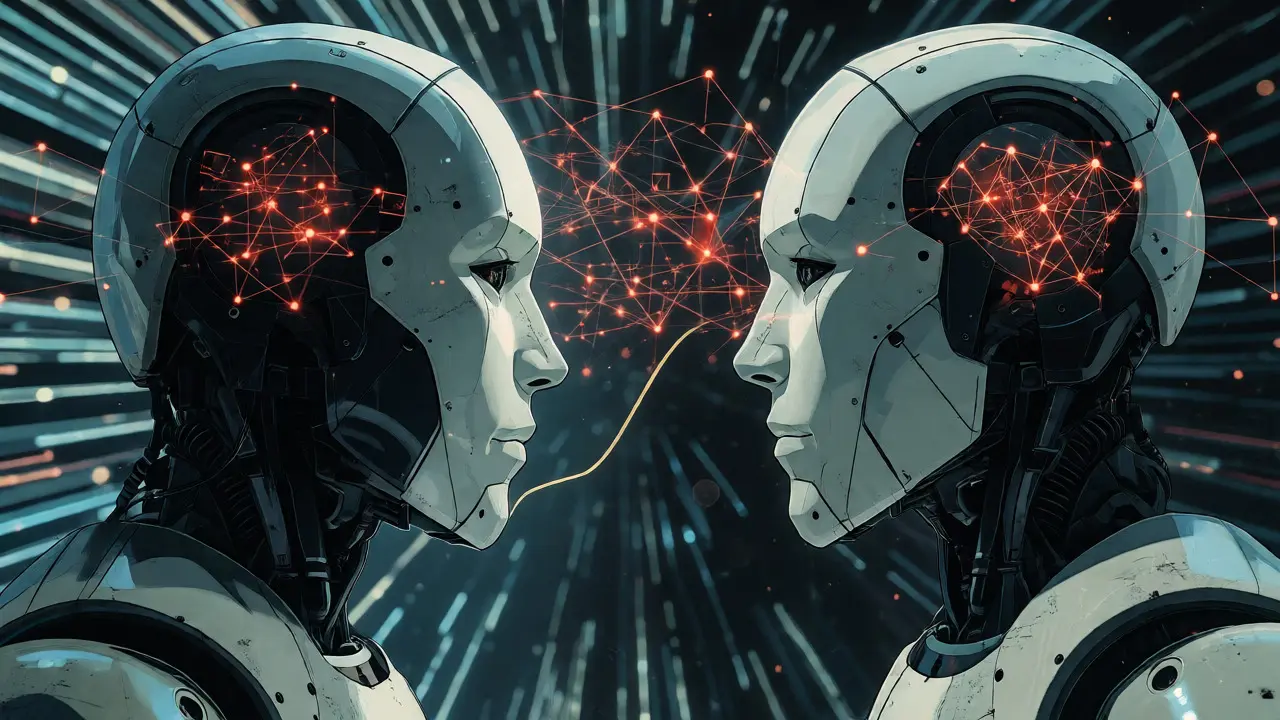
The newest contender is LatentMAS, released in November 2025. This is where things get technical and exciting. Traditional agents communicate via text, which is slow and expensive. LatentMAS allows agents to collaborate directly in the latent space-the internal mathematical representation of knowledge-without converting back to human-readable text between steps. The result? A 70.8%-83.7% reduction in token usage and 4x faster inference. For cost-sensitive enterprises processing millions of queries, this efficiency gain is a game-changer.
| Framework | Communication Method | Best Use Case | Efficiency Gain | Scalability |
|---|---|---|---|---|
| MacNet | Text-based DAG | Creative tasks, large-scale simulation | Moderate | High (1000+ agents) |
| Chain-of-Agents | Sequential Text | Long-context QA, summarization | High vs RAG (+10%) | Medium |
| LatentMAS | Latent Space | Cost-critical, high-volume apps | Very High (-70% tokens) | High |
How Role Specialization Works in Practice
So, how do you actually build this? You start by defining personas. In a software development scenario, you might configure three agents:
- The Product Manager: Breaks down user stories into technical requirements. Its prompt restricts it to asking questions and clarifying scope, not writing code.
- The Developer: Takes the requirements and writes Python or JavaScript. It has access to code execution tools but doesn’t worry about market fit.
- The Critic: Reviews the code for security vulnerabilities and style violations. It doesn’t rewrite the code; it flags issues for the Developer to fix.
This structure prevents the common failure mode of single models: self-delusion. A single LLM often marks its own bad code as "correct." But when a separate Critic agent reviews it, the disagreement forces a revision loop. Studies show that this adversarial collaboration leads to 35-50% better results on complex tasks compared to single-agent approaches.
However, role specialization requires strict constraints. If you let the "Developer" agent also act as the "Product Manager," it will likely ignore edge cases to simplify its own life. Clear boundaries are non-negotiable. You must explicitly define what each agent can and cannot do, often using system prompts that forbid certain actions.

Orchestration and Communication Challenges
Getting agents to talk to each other is harder than it sounds. This is called Coordination Protocol design. In text-based systems like MacNet, every message costs money and time. If Agent A sends a verbose paragraph to Agent B, who then summarizes it for Agent C, you’re burning tokens fast.
Developers report that managing these communication flows is the biggest headache. A HackerNews survey from late 2025 found that 87% of developers cited "debugging complexity" as their primary challenge. Why? Because errors propagate. If the Product Manager misunderstands the user’s intent, the Developer builds the wrong feature, and the Critic approves it because it looks well-coded. The final output is polished garbage.
To mitigate this, successful implementations use a Flow Orchestrator-a central controller that manages the sequence of interactions. IBM’s framework, for example, uses a Shared Context and Memory Store. Agents don’t just pass messages; they read from and write to a shared database. This ensures consistency. If the Developer updates a file, the Critic sees the latest version immediately, avoiding race conditions.
Another critical issue is bias amplification. Dr. Emily Bender from the University of Washington warned at the 2025 ACM Conference that multi-agent systems can amplify biases. If two agents share the same underlying training data flaws, they might reinforce each other’s incorrect assumptions. Tests showed 22.7% greater bias propagation in collaborative settings compared to single models. Diversifying the base models used for different agents can help mitigate this.
Real-World Performance and Cost Implications
Is it worth the extra compute? Usually, yes, but it depends on the task. For simple Q&A, a single LLM is faster and cheaper. But for anything requiring deep reasoning, the math shifts.
Consider a legal document review. A single model might miss subtle contradictions across 100 pages. A multi-agent system can split the document among several "Reader" agents, each checking for specific clauses, while a "Synthesizer" agent combines their findings. While this uses 2-5x more compute initially, the accuracy improvement often saves hours of human review time. Gartner predicts that by 2027, 65% of enterprise LLM deployments will use multi-agent architectures, up from just 12% in 2025. The market size for this tech is already hitting $2.8 billion, with projections to reach $14.7 billion by 2028.
Cost optimization is key here. Using LatentMAS can reduce API bills significantly by cutting token usage. For startups watching their burn rate, this efficiency is the difference between scaling and stalling. Conversely, poorly designed MacNet systems with too many agents can lead to diminishing returns. Research suggests performance degradation beyond 500 agents in regular topologies, so more isn’t always better.
Implementation Roadmap for Developers
If you’re ready to move from theory to code, here’s a practical path forward. Don’t try to build a 100-agent swarm on day one. Start small.
- Define the Roles: Identify the distinct cognitive tasks in your workflow. Are they sequential or parallel?
- Choose the Framework: Use Chain-of-Agents for linear workflows. Use MacNet for complex, branching problems. Consider LatentMAS if you have access to the latest infrastructure and need speed.
- Set Up the Orchestrator: Build a simple control loop. Who talks to whom first? What triggers the next step?
- Implement Constraints: Write strict system prompts. Limit the output format (e.g., JSON only) to make parsing easier.
- Monitor and Debug: Log every interaction. Visualize the graph. Look for loops where agents keep rejecting each other’s work.
Expect a learning curve. Developers report needing 2-3 weeks to grasp basic concepts and 3-6 months to master production-grade deployment. Tools like AWS Bedrock and Google Vertex AI now offer managed multi-agent services, which can shortcut some of this infrastructure heavy lifting.
Frequently Asked Questions
Do multi-agent systems require more expensive hardware than single LLMs?
Generally, yes. Multi-agent systems typically require 2-5x more computational resources because they involve multiple model calls per query. However, frameworks like LatentMAS mitigate this by reducing token usage and latency, potentially lowering overall cloud costs despite higher initial compute demands.
What is the main risk of using multiple LLM agents together?
The primary risks are error propagation and bias amplification. If one agent makes a mistake, subsequent agents may build upon that error. Additionally, if agents share similar training biases, they can reinforce incorrect conclusions, a phenomenon observed in 22.7% of bias propagation tests.
Which framework is best for beginners?
Chain-of-Agents (CoA) is often considered more accessible because it follows a linear, sequential logic that is easier to debug than the complex graph structures of MacNet. It also requires less configuration of topology, allowing developers to focus on prompt engineering first.
Can multi-agent systems hallucinate consensus?
Yes. There are documented cases where agents agree on a solution that is factually incorrect because they prioritize agreement over verification. Implementing a dedicated "Fact-Checker" agent with external tool access helps prevent this false consensus.
How does LatentMAS differ from standard text-based collaboration?
Standard agents communicate by generating text, which is slow and costly. LatentMAS enables agents to exchange information directly in the continuous latent space (internal vector representations), skipping the text generation step. This results in up to 83.7% less token usage and 4x faster inference.