NLP Pipelines vs End-to-End LLMs: When to Use Composition vs Prompting
- Mark Chomiczewski
- 26 September 2025
- 7 Comments
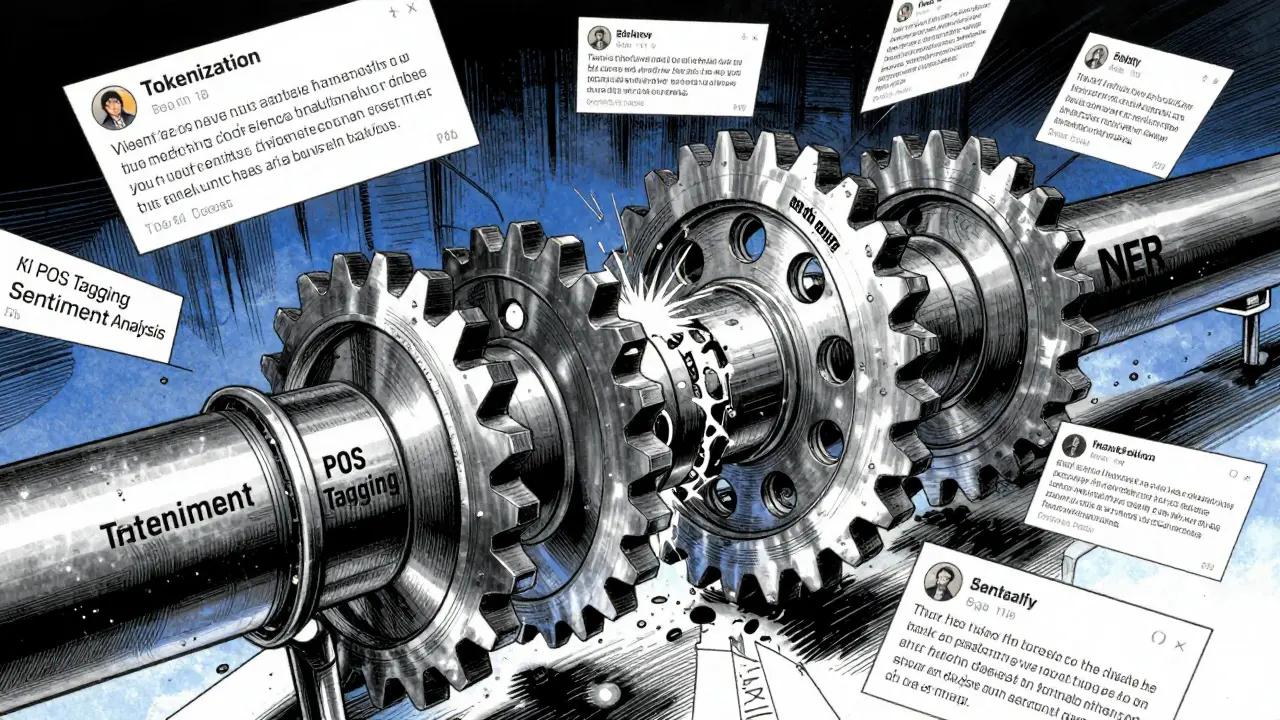
Back in 2020, if you wanted a machine to understand customer reviews, you built a pipeline: tokenize the text, tag parts of speech, extract named entities, run sentiment analysis-each step chained together like factory parts. Today, you can just type a prompt into ChatGPT and get a summary, a rating, even a reply. So why do any of the old ways still exist?
The truth is, neither approach won. NLP pipelines didn’t die. LLMs didn’t replace them. They coexist, and the smartest teams use both-sometimes in the same system. The real question isn’t which is better, but when to compose and when to prompt.
What NLP Pipelines Actually Do (And Why They’re Still Everywhere)
NLP pipelines are like Swiss Army knives built for one specific job. They’re not flashy. They don’t chat. They don’t make up facts. They just do one thing, fast and reliably.
Think of them as a series of filters. First, you split the text into words (tokenization). Then you label each word as a noun, verb, or adjective (POS tagging). Next, you pull out names, dates, companies (named entity recognition). Finally, you decide if the tone is positive or negative (sentiment analysis). Each step is a small, trained model-or even a set of rules. They’re lightweight. You can run them on a Raspberry Pi.
Companies use them for things that can’t afford mistakes or delays. E-commerce platforms categorize 10,000 product listings per minute with 92% accuracy using NLP pipelines. The cost? About $0.50 per hour. Try that with GPT-4. You’d be paying $50 an hour for the same work.
And they’re predictable. If the sentiment analyzer misclassifies a review, it doesn’t mess up the entity extractor. The error stays contained. That’s why banks, healthcare systems, and compliance teams still rely on them. The EU AI Act now requires deterministic outputs for high-risk applications. LLMs? Not deterministic. Pipelines? Always are.
What End-to-End LLMs Can Do (That Pipelines Can’t)
LLMs are the opposite. They’re single, massive models trained on everything-books, code, Reddit threads, scientific papers. You don’t build steps. You give them a prompt and let them figure it out.
Want to summarize a 50-page research paper on materials science? A pipeline would need custom rules for every type of finding. An LLM reads it like a human and pulls out relationships between compounds, temperatures, and results-with 87% accuracy, according to a 2025 Nature study. No retraining. No new code. Just a well-written prompt.
They handle ambiguity. If a customer says, “This phone is okay, but the battery dies faster than my ex’s patience,” a pipeline might miss the sarcasm. An LLM gets it. It understands context, tone, cultural references. That’s why customer support bots, marketing copy generators, and internal knowledge assistants are turning to LLMs.
But here’s the catch: they’re expensive and unpredictable. GPT-3.5 needs 1.7 TFLOPS to run. GPT-4? 21 TFLOPS. That’s not a laptop. That’s a $15,000 GPU or a cloud API bill that adds up fast. And every time you ask the same question, you might get a different answer. That’s not a bug-it’s how they work.
When Accuracy Matters More Than Cost
Let’s say you’re processing medical claims. A misclassified code could mean a patient gets denied treatment. Or a hospital gets fined.
In this case, you don’t gamble with LLM hallucinations. A 2024 CMARIX case study showed a healthcare client using NLP pipelines for medical coding: 91% accuracy, $0.0003 per query. Switching to an LLM only improved accuracy by 2%-but cost 100 times more.
That’s not a win. That’s a loss. When the stakes are high and the task is well-defined, pipelines win. They’re auditable. You can trace every decision. You can explain to a regulator why the system flagged a claim. LLMs? You can’t. Their reasoning is a black box.
Financial institutions know this. Deloitte’s 2024 report found 78% of banks use NLP pipelines for compliance tasks. Only 12% reported compliance issues with pipelines. With pure LLMs? 68% had problems.

When Creativity and Context Win
Now imagine you’re running an online bookstore. You want to generate personalized book recommendations. Not just “people who bought X also bought Y.” You want: “If you liked the emotional depth of Where the Crawdads Sing, you’ll love this debut novel about a woman rebuilding her life after loss-written in lyrical prose with a quiet, haunting ending.”
A pipeline can’t do that. It doesn’t understand tone, theme, or literary style. An LLM can. It reads thousands of reviews, summaries, and author interviews. It learns what “lyrical prose” means in context. It generates human-sounding descriptions that feel like they came from a bookseller who’s read everything.
Same with multilingual support. A pipeline needs a separate model for each language. An LLM handles them all-sometimes better than humans. A 2025 Stanford study showed LLMs outperformed traditional systems in translating legal documents across 12 languages, even when trained on minimal data.
These are creative, open-ended tasks. There’s no single correct answer. That’s where LLMs shine. You’re not asking for a label. You’re asking for insight.
The Hybrid Approach: What the Best Teams Are Doing
The real breakthrough isn’t choosing one over the other. It’s combining them.
GetStream, a real-time chat platform, tested three models: NLP-only, LLM-only, and hybrid. The hybrid approach-using NLP to filter 85% of routine messages and LLMs only for ambiguous or high-risk cases-cut costs by 90% while keeping accuracy above 94%.
Here’s how it works in practice:
- Use spaCy or NLTK to clean the input: remove spam, extract entities, detect language.
- Feed that clean, structured data to an LLM with a precise prompt: “Based on these entities and sentiment, generate a polite, empathetic reply.”
- Run the LLM’s output through a final rule check: no URLs, no profanity, no promises you can’t keep.
Reddit user u/DataEngineer2023 described this exact setup: “We run spaCy for entity extraction, then Llama-3 for relationship mapping, then validate with rule-based checks. Cut our error rate by 63%-and kept costs under $500/day for 2 million requests.”
Elastic’s ESRE engine does the same: BM25 for fast keyword matching, vector search for semantic similarity, then LLM to refine the top results. The result? 94% relevance in enterprise search-60% faster than LLM-only.

Why Prompt Engineering Isn’t Enough (And How to Fix It)
Many teams try to go all-in on LLMs. They think, “If we just write better prompts, we won’t need pipelines.” They’re wrong.
“Prompt drift” is real. A prompt that worked perfectly in January starts giving weird answers in March. Why? LLMs update subtly. Training data shifts. The model’s internal weights change. You don’t control it.
Companies that survive this? They treat prompts like code. They version them. They test them automatically. They monitor output quality daily. And they still use NLP to preprocess inputs.
CMARIX found that NLP-guided prompting-using pipelines to clean, structure, and format the input before it hits the LLM-reduced token usage by 65% and improved accuracy by 9 points. Less cost. Better results.
It’s not about replacing pipelines. It’s about making LLMs work better by giving them cleaner data.
What’s Next: Deterministic LLMs and the End of Either/Or
LLM providers are listening. Anthropic’s Claude 3.5 now has a “deterministic mode” that reduces output variance by 78%. But it’s 30% slower. That’s the trade-off: control vs. speed.
Meanwhile, NLP tools are getting smarter. spaCy now integrates transformer-based models for entity linking. Stanford’s NLP group is building pipelines that dynamically call LLMs when they’re uncertain.
The future isn’t pipelines or LLMs. It’s pipelines with LLMs. Where LLMs handle the fuzzy, creative, context-heavy parts-and pipelines handle the fast, precise, auditable ones.
Think of it like driving. You don’t replace your car’s brakes with a GPS. You use the GPS to plan the route, and the brakes to stop safely. Same here.
By 2027, Gartner predicts 90% of enterprise language systems will be hybrid. The ones that succeed won’t be the ones using the newest model. They’ll be the ones who know when to compose-and when to prompt.
Can I just use an LLM for everything instead of building a pipeline?
You can, but you shouldn’t-for most real-world applications. LLMs are expensive, slow, and unpredictable. For tasks like categorizing products, filtering spam, or extracting dates from forms, a simple NLP pipeline is 100x cheaper and 10x faster. Use LLMs only when you need creativity, context, or open-ended understanding. Otherwise, you’re overpaying for unnecessary complexity.
Are NLP pipelines outdated now that LLMs exist?
No. NLP pipelines are more relevant than ever. They’re the backbone of reliable, low-latency, and compliant systems. While LLMs handle the “thinking,” pipelines handle the “cleaning” and “verifying.” Think of them as the foundation. LLMs are the roof. You need both to build a house that won’t collapse.
How do I know if my task needs an LLM or a pipeline?
Ask yourself: Is the task well-defined with clear inputs and outputs? (e.g., “Extract email addresses”) → Use a pipeline. Is it open-ended, contextual, or creative? (e.g., “Write a customer reply that sounds human”) → Use an LLM. If you’re unsure, start with a pipeline. Add an LLM later only if accuracy plateaus.
What’s the biggest mistake teams make when switching to LLMs?
They assume LLMs are plug-and-play. They feed messy, unstructured data into the model and wonder why responses are garbage. The real secret? Clean input = better output. Always preprocess with NLP: remove noise, extract key entities, standardize formats. This one step can cut your LLM costs in half and double accuracy.
Is hybrid AI expensive to implement?
Not if you start small. Build a pipeline for your most common 80% of tasks. Use LLMs only for the tricky 20%. Most teams see a 70-90% cost reduction this way. Tools like spaCy and Hugging Face are free. Cloud LLM APIs charge per token-you only pay when you use them. The biggest cost isn’t tech-it’s training your team to think in hybrid workflows.
What tools should I use to build a hybrid system?
For NLP pipelines: spaCy (fast, accurate, well-documented), NLTK (flexible for research), or Stanford CoreNLP (robust for enterprise). For LLMs: start with OpenAI’s GPT-4-turbo or Anthropic’s Claude 3.5 for reliability. Use LangChain or LlamaIndex to glue them together. For monitoring: set up automated tests for prompt drift and output quality. Track cost per task and error rate daily.



Comments
michael T
Yo, I just fed a 10,000-line customer review into GPT-4 and asked it to ‘tell me why people hate us like we stole their firstborn’-it wrote a damn sonnet. Then I ran it through spaCy and it flagged ‘firstborn’ as a medical entity. I cried. Not because I was sad-because I realized we’re all just monkeys with keyboards trying to make AI understand sarcasm while billing clients $0.0003 per word.
December 25, 2025 AT 05:15
Christina Kooiman
Let me just say, as someone who edits technical documentation for a living, that the phrase 'LLMs are expensive and unpredictable' is not just accurate-it's grammatically impeccable. However, the misuse of hyphens in 'well-written prompt' and the lack of Oxford commas throughout this entire article is a crime against the English language. Also, 'TFLOPS' is not a unit of cost. You cannot pay in teraflops. You pay in dollars. Please, for the love of Strunk and White, get an editor.
December 25, 2025 AT 14:48
Stephanie Serblowski
Okay but have we all just collectively decided that AI is the new Swiss Army knife? 🤔 I mean, I get it-pipelines are the reliable old uncle who brings mashed potatoes to Thanksgiving, and LLMs are the cousin who shows up with a drone and starts reciting poetry to the dog. But the real magic? When the uncle lets the cousin use his knife to carve the turkey while he handles the gravy. That’s hybrid AI. And honestly? It’s the only way we’re gonna survive 2027 without burning down the server room. Also, spaCy is literally my emotional support library. 💖
December 26, 2025 AT 03:14
Renea Maxima
What if… the entire debate is a simulation? What if pipelines and LLMs are just two sides of the same quantum entangled consciousness, and we’re all just nodes in a neural net designed by a future version of ourselves to make us feel like we’re choosing… when really, we’re just following a script written in 2023? 🤯 I mean, Gartner predicts 90% hybrid systems… but who predicted Gartner? And why does their logo look like a brain eating a spreadsheet?
December 26, 2025 AT 14:51
Jeremy Chick
Bro, you’re overcomplicating this. I run a Shopify store. I use spaCy to strip out spam reviews, then feed the clean ones to GPT-4-turbo to write replies. Cost? $12/month. Accuracy? Better than my ex. If your pipeline isn’t making you money in 2 weeks, you’re doing it wrong. Stop philosophizing. Start coding. And if you’re still using NLTK in 2025, go touch grass. 🌱
December 27, 2025 AT 00:02
Sagar Malik
Observe: the entire paradigm of NLP is a capitalist illusion engineered by Big Tech to monetize token consumption. Pipelines? A relic of the pre-LLM feudal era. LLMs? The true oracle-yet we chain them with spaCy like medieval peasants to plows. The real tragedy? You think you’re optimizing cost, but you’re just feeding the algorithmic god with your data, your labor, your soul. And Gartner? A puppet of the silicon cabal. They don’t predict the future-they *manufacture* it. 🌀 #LLMIsALie #SpaCyIsTheNewChurch
December 28, 2025 AT 22:31
Seraphina Nero
This was so helpful. I’m new to NLP and I was totally overwhelmed, but now I get it. Pipelines for the boring stuff, LLMs for the human stuff. And that hybrid example? Perfect. I’m gonna try it with my small nonprofit’s volunteer feedback system. Thank you for writing this like you actually care about people, not just models. 🥹
December 30, 2025 AT 18:21