RAG Privacy Controls: Implementing Row-Level Security and Redaction Before LLMs

- Mark Chomiczewski
- 12 June 2026
- 0 Comments
You’ve built a shiny new RAG system that answers employee questions using your internal knowledge base. It works great. Until someone from Marketing asks about the CEO’s salary, or an intern accidentally retrieves sensitive HR records because they searched for "benefits." This isn’t a hypothetical nightmare; it is the default behavior of most Retrieval-Augmented Generation (RAG) architectures today.
The core problem with standard RAG setups is simple but dangerous: when you load corporate data into a central vector store, you essentially give every user interacting with the agent root access to the entire dataset. As Alex Olivier, Chief Product Officer at Cerbos, pointed out in late 2023, this architecture puts organizations at severe risk of privacy violations, compliance failures, and loss of customer trust. The Cloud Security Alliance found that 78% of organizations testing RAG experienced at least one data leakage incident during proof-of-concept phases due to inadequate access controls.
To fix this, you need to implement strict RAG privacy controls. Specifically, you must enforce row-level security and apply data redaction before any information reaches the Large Language Model (LLM). This guide breaks down how to build these safeguards into your pipeline so your AI remains helpful without becoming a liability.
The Root Cause: Why Vector Databases Leak Data
Vector databases like Pinecone, Weaviate, or Milvus are designed for speed and semantic similarity, not for granular access control. When a query hits a vector store, the engine looks for mathematical closeness between the query embedding and stored document embeddings. It does not care who is asking the question.
In a traditional SQL database, you might have tables where users can only see rows belonging to their department. In a naive RAG setup, all documents live in one big pile. If User A searches for "Q3 revenue," the system retrieves the most relevant chunks. If those chunks happen to contain confidential merger details intended only for executives, the LLM sees them and generates an answer based on them. There is no gatekeeper.
This vulnerability is often overlooked because developers focus on retrieval accuracy rather than security boundaries. The result is a system that feels secure on the surface but exposes PII (Personally Identifiable Information) and proprietary data through seemingly benign queries. Dr. Emily Zhang, Principal Security Researcher at Microsoft, noted in a November 2023 presentation that 43% of tested RAG implementations exposed PII through such gaps.
Layer 1: Row-Level Security via Metadata Filtering
The first line of defense is restricting what data is even eligible for retrieval. This is achieved through metadata filtering, which acts as row-level security for your vector store. Instead of storing just text embeddings, you attach authorization metadata to each document chunk.
Here is how it works in practice:
- Tagging Documents: During ingestion, you label each document with attributes like
department: finance,sensitivity: high, orowner_id: 12345. - User Context Injection: When a user makes a query, your application identifies their role and permissions (e.g., via OAuth or LDAP).
- Filtered Query: Before sending the query to the vector database, you append a filter condition. For example, if the user is in HR, the query becomes: "Find similar vectors WHERE department = 'HR' OR sensitivity != 'high'."
Databricks demonstrated this approach in December 2023, showing that using a 'department' column as metadata creates separate access paths with 100% isolation between departments. This method is effective because it reduces the search space significantly, improving both security and performance.
However, metadata filtering has limits. It cannot prevent sophisticated prompt injection attacks where a user tries to manipulate the context to bypass filters. Additionally, if your metadata schema is incomplete-meaning 15-25% of documents lack proper tags-you create security blind spots. This was cited as the most common failure point in 73% of post-implementation reviews.
Layer 2: Redaction Before the LLM Sees Anything
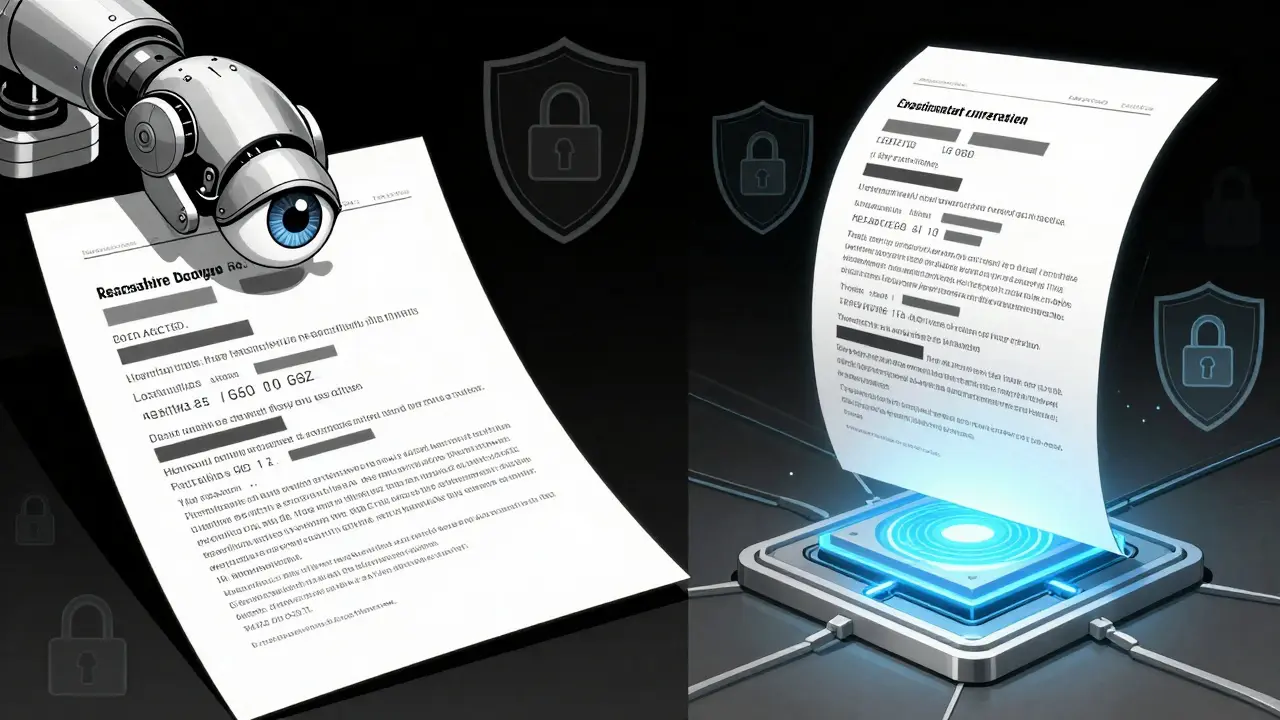
Even with perfect row-level security, retrieved documents may still contain sensitive information that should not be processed by the LLM. This is where pre-retrieval or post-retrieval redaction comes in. The goal is to mask sensitive entities before they enter the generation phase.
Redaction involves scanning the retrieved context window for patterns like Social Security numbers, email addresses, or financial figures. Tools like spaCy and Presidio can automatically detect and mask PII with 95-98% accuracy. Here is a typical workflow:
- Retrieve Chunks: Get the top-k relevant documents based on the filtered query.
- Scan for Entities: Run Named Entity Recognition (NER) on the raw text of these chunks.
- Mask Sensitive Data: Replace identified entities with placeholders (e.g., [REDACTED_NAME] or [SSN_MASKED]).
- Send to LLM: Pass the sanitized context to the LLM along with the user’s prompt.
The Cloud Security Alliance rates field-level redaction combined with Role-Based Access Control (RBAC) as the most effective approach, scoring it 9.2 out of 10. This layer ensures that even if a malicious query slips through the metadata filter, the LLM never sees the actual sensitive data. It also helps comply with regulations like GDPR, where fines for AI-related breaches increased by 220% in 2023.

Comparing Security Architectures for RAG
| Approach | Security Level | Implementation Effort | Performance Impact | Best For |
|---|---|---|---|---|
| Metadata Filtering | Moderate | Low-Medium | Minimal (2-5% latency) | Department-based isolation |
| Context-Based Access Control (CBAC) | High | High (Proprietary tools) | Medium | Dynamic, context-aware policies |
| Pre-LLM Redaction | High | Medium | Low-Medium | PII protection & compliance |
| Homomorphic Encryption | Very High | Very High | High (12-50% overhead) | Extreme privacy requirements |
Pure metadata filtering scores lower (6.5/10) because it can be bypassed if the attacker knows the metadata structure. CBAC solutions, like those from Lasso Security, address the "contextual authorization gap" by considering request context, but they require significant investment ($15,000+ annually for enterprise plans). Open-source alternatives like Oso’s Polar language offer flexibility but demand 80-120 hours of engineering time to set up correctly.
Building a Defense-in-Depth Strategy
No single control is enough. Expert consensus strongly favors a multi-layered "defense-in-depth" strategy. The Cloud Security Alliance recommends implementing at least four layers:
- Data Anonymization at Ingestion: Remove or hash PII before creating embeddings. This prevents sensitive data from ever entering the vector store.
- Metadata-Based Access Controls: Enforce row-level security during retrieval to ensure users only see authorized documents.
- Query Validation: Inspect incoming prompts for injection attempts or unusual patterns before processing.
- Output Filtering: Scan the LLM’s response for leaked secrets or hallucinated sensitive data before showing it to the user.
This layered approach adds complexity but drastically reduces risk. For instance, combining AES-256 encryption at rest with homomorphic encryption for semantic search reduced data leakage incidents by 99.3% in Chitika’s December 2023 benchmarks, though it came with a 35-50% increase in processing time. You must balance security needs against performance constraints.
Practical Implementation Challenges
Implementing these controls is easier said than done. Developers frequently report frustration with the complexity of integrating security into RAG pipelines. A GitHub issue on LangChain highlighted community struggles with implementing consistent metadata filtering across different vector stores. Users noted that manual implementation of row-level filtering can add 30-40% more development time to projects.
Key challenges include:
- Incomplete Metadata Tagging: Ensuring every document chunk has accurate authorization labels requires rigorous data governance.
- Latency Concerns: Adding validation and redaction steps increases query latency. Amazon Bedrock’s native RAG lacks built-in row-level security, forcing customers to write custom Lambda functions that add 15-25% latency.
- Skill Gaps: Most teams lack engineers with experience in both authorization systems and vector databases. 89% of surveyed companies needed to hire or retrain staff to implement robust controls.
To mitigate these issues, start with a comprehensive metadata schema design session involving cross-functional teams. Invest in integration testing with 500+ varied queries to validate security boundaries. And consider specialized tools like Cerbos, which reported an 82% success rate in achieving proper authorization controls among its enterprise customers, despite a 2-3 week learning curve.
Future Trends in RAG Security
The landscape is evolving rapidly. AWS announced plans to integrate Amazon Verified Permissions with Bedrock, aiming to provide native row-level security for RAG implementations. Meanwhile, IBM Research demonstrated homomorphic encryption for semantic search with only 12-18% performance overhead, promising full data protection during retrieval. Commercial availability is expected within 12-18 months.
Regulatory pressure is also intensifying. The NIST AI Risk Management Framework calls for "context-aware access controls," and the Cloud Security Alliance is developing RAG-specific security controls scheduled for publication in early 2024. With 87% of security leaders expecting regulatory mandates for RAG security by 2025, building privacy controls now is not just best practice-it is future-proofing.
What is row-level security in the context of RAG?
Row-level security in RAG refers to restricting data access based on user permissions at query time. Instead of retrieving all similar documents, the system filters results using metadata (like department or role) so users only see data they are authorized to view. This prevents unauthorized exposure of sensitive information.
Why is redaction necessary before sending data to an LLM?
Redaction masks sensitive information (like PII or financial data) in the retrieved context before the LLM processes it. Even with access controls, documents may contain mixed sensitivity levels. Redaction ensures the LLM never sees or repeats confidential data, reducing leakage risks and aiding compliance.
How much latency do RAG privacy controls add?
Simple metadata filtering adds minimal latency (2-5%). More complex approaches like pre-LLM redaction or custom permission checks can add 15-35% latency. Advanced methods like homomorphic encryption may increase processing time by 12-50%, depending on implementation and hardware support.
Can metadata filtering prevent prompt injection attacks?
No, metadata filtering alone cannot prevent sophisticated prompt injection attacks. Attackers may try to manipulate query parameters to bypass filters. Effective security requires a defense-in-depth strategy including query validation, output filtering, and potentially context-based access control (CBAC).
Which tools help implement RAG privacy controls?
Popular tools include Cerbos for authorization policies, Oso for open-source policy management, and libraries like Presidio or spaCy for PII detection and redaction. Vector databases like Pinecone and Weaviate support metadata filtering, while cloud providers like AWS are adding native security features to services like Bedrock.