Standards for Generative AI Interoperability: APIs, Formats, and LLMOps

- Mark Chomiczewski
- 16 March 2026
- 6 Comments
The AI landscape isn’t just getting smarter-it’s getting connected. For years, generative AI models operated in isolation: one model for writing, another for data analysis, a third for image generation. Each came with its own API, its own data format, and its own security rules. Integrating them meant custom code, endless debugging, and fragile pipelines that broke with every update. That era is ending. The breakthrough isn’t a new model-it’s a standard: the Model Context Protocol (MCP) is a universal API standard for generative AI tools that enables consistent, secure, and real-time communication between AI agents and external systems. Also known as MCP 1.0, it was finalized on March 26, 2025, and has since become the de facto interoperability layer for enterprise AI.
Why Interoperability Matters More Than Raw Power
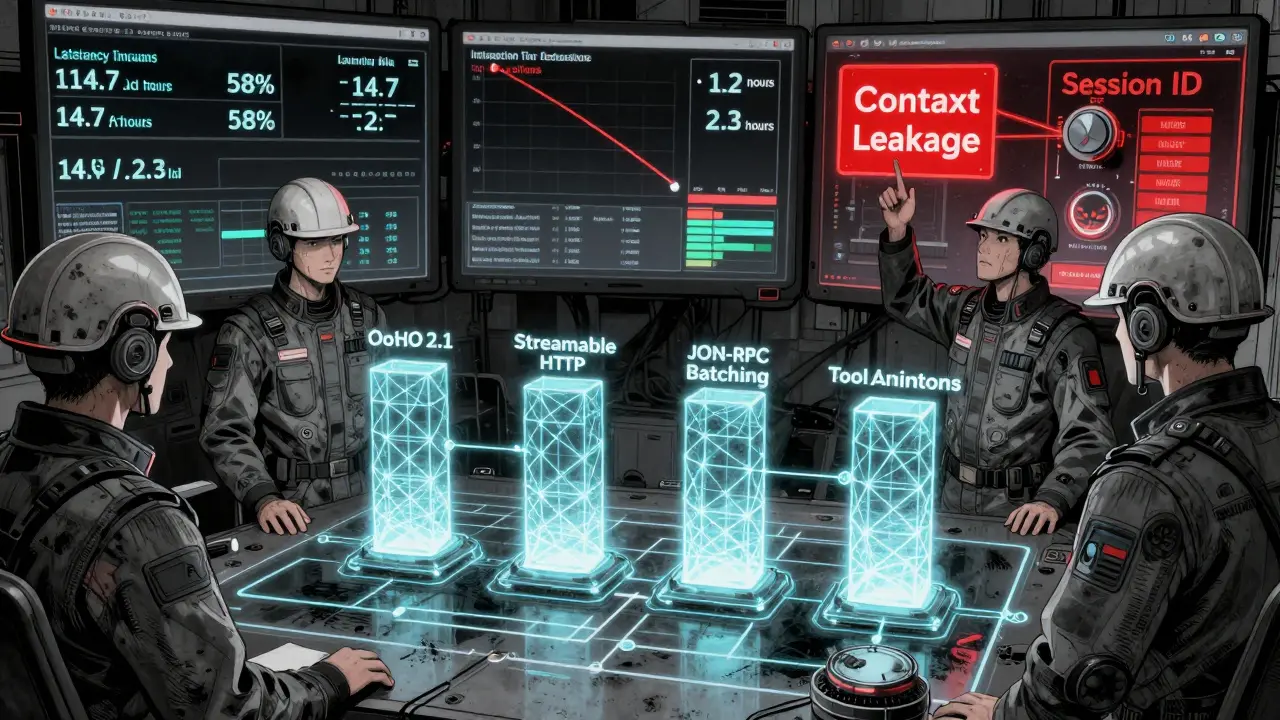
It’s easy to get distracted by model size. GPT-5, Claude 3.5, Llama 3-these names dominate headlines. But here’s the truth: a 1 trillion parameter model is useless if it can’t talk to your CRM, your ERP, or your document storage system. That’s where interoperability becomes the real differentiator. Before MCP, enterprises spent an average of 14.7 person-hours integrating each new AI tool. Now? That’s down to 2.3 hours. The reason? Standardization.
According to LangChain’s Q2 2025 survey of 850 engineers, companies using MCP cut integration time by over 80%. Why? Because MCP doesn’t just define how to send a request-it defines how every tool, no matter who built it, should respond. Think of it like USB-C for AI: plug any compliant device into any port, and it just works.
How MCP Works: The Four Core Technical Pillars
MCP 1.0 isn’t a vague idea. It’s a precise, documented protocol with four technical pillars that make it work in real systems.
- OAuth 2.1 Authorization: Every tool call requires authentication. MCP uses OAuth 2.1, the same standard that secures your Google and Microsoft logins. This isn’t optional-it’s mandatory. NIST’s 2024 security review found that 42% of pre-MCP AI integrations had critical authentication flaws. MCP fixes that by forcing encrypted, token-based access.
- Streamable HTTP Transport: Older systems used HTTP with Server-Sent Events (SSE), which was slow and one-way. MCP replaces this with a bidirectional, persistent connection. In Anthropic’s tests across 12,000 API calls, latency dropped by 58%. Real-time tool feedback? Now it’s normal.
- JSON-RPC Batching: Instead of sending one request at a time, MCP lets agents bundle up to 20 requests in a single call. LangChain’s tests showed this cuts total processing time by 33-47%. If your AI agent needs to check inventory, pull a customer record, and generate a report-all in one go-it can do it in one network round-trip.
- Tool Annotations: This is the secret sauce. Every tool exposed via MCP must include metadata: what it does, what inputs it expects, what outputs it returns, and what errors it might throw. There are 27 mandatory fields and 15 optional ones. This lets AI agents reason about tools like a human would: “I need to find a PDF. Which tool can extract text from PDFs? Does it support Spanish? What’s its success rate?”
These four components don’t just improve speed-they make AI systems more reliable, secure, and self-sufficient.
How MCP Compares to Other Approaches
Before MCP, companies had two bad choices: build everything in-house or rely on vendor-specific APIs.
OpenAI’s 2023 Assistant API, for example, only supported 14 tool types-and each required custom coding. If you wanted to connect it to Salesforce, you needed OpenAI’s specific integration library. Switch to another provider? Start over.
MCP solves this. It supports 127 standardized tool categories-from document parsers to database connectors-and every tool follows the same rules. Microsoft, OpenAI, Anthropic, and Meta all now build their agents to work with MCP. That means a Claude agent can use a tool built for GPT-5, and vice versa.
Even older standards like WebLLM 0.9.3 fall short. Microsoft’s internal tests showed MCP succeeded in 41% more complex workflows involving five or more tools. Why? Because WebLLM had no unified metadata system. Tools were black boxes. MCP makes them transparent.
The Regulatory Engine Driving Adoption
MCP didn’t just win because it’s technically better. It won because regulators forced the hand of the industry.
The EU’s AI Act, which took full effect in August 2025, requires all general-purpose AI models with systemic risk to prove they can be audited, monitored, and controlled. That means you can’t just plug in a random AI tool. You need standardized interfaces, documented behavior, and verifiable security.
Enter MCP. It’s the only standard that meets all four dimensions of NIST’s AI Risk Management Framework (RMF 1.1):
- Functional compatibility: 12 API conformance tests ensure tools behave predictably.
- Data format consistency: 8 common serialization formats are defined and enforced.
- Security protocol alignment: 7 authentication mechanisms are mapped and validated.
- Governance transparency: 5 documentation requirements are built into every tool annotation.
Companies that ignored interoperability faced 37% higher compliance costs, according to Prompts.ai’s December 2024 analysis. That’s not a suggestion-it’s a financial risk.
Real-World Adoption: Who’s Using MCP and How
Adoption isn’t theoretical. It’s happening-fast.
Gartner’s August 2025 Magic Quadrant shows MCP in the “Leader” quadrant with 78% of new enterprise AI projects using it. Fortune 500 companies? 61% have started implementation. In financial services, adoption is at 74%. Healthcare? 68%. Tech? 82%.
One Reddit user, u/AI_Engineer_2025, shared a case study: their team reduced integration time from three weeks to four days. Reliability jumped to 99.2%. They didn’t rewrite code-they just switched to MCP-compliant tool wrappers.
On GitHub, the official MCP-spec repository has over 842 open issues and 317 pull requests. Developers are building libraries, testing tools, and sharing fixes. The community is alive.
Implementation Challenges and How to Overcome Them
It’s not all smooth sailing. Early adopters hit real roadblocks.
- Context leakage: 29% of early implementations accidentally mixed up context between tool calls. MCP’s 128K token window is generous, but poorly managed prompts still caused errors. Solution: Use MCP’s built-in context tagging system. Every call must include a session ID and context scope.
- Tool error handling: 37% of Stack Overflow questions about MCP involve inconsistent error messages. Some tools return “500 Internal Error,” others return structured JSON. Solution: Enforce a standardized error schema. The MCP spec defines exactly how errors should look.
- Legacy system integration: Only 31% of pre-2020 enterprise apps can connect to MCP without middleware. If you’re stuck with a 15-year-old database system, you’ll need a bridge. Tools like LangChain’s Legacy Adapter and Microsoft’s AI Connectors help.
Implementation costs average $187,500 per organization, according to Bradley Arns’ July 2025 survey. But that’s a one-time investment. The payoff? Reduced maintenance, faster deployments, and compliance-ready systems.
The Future: What’s Next After MCP 1.0
MCP 1.1 is scheduled for October 15, 2025. It adds quantum-resistant encryption-something NIST’s Post-Quantum Cryptography team helped design. This isn’t just future-proofing. It’s a response to looming threats.
China’s November 2025 national AI standards now require MCP alignment for cross-border services. The EU is preparing to reference MCP in its August 2025 Code of Practice for high-risk AI. Even regulators are adopting the standard.
Long-term, experts believe MCP will become the foundation for autonomous AI agents that navigate enterprise systems without human input. Early tests show 40-65% fewer manual interventions in business workflows. That’s not automation-it’s orchestration.
Getting Started with MCP
Want to adopt MCP? Here’s a realistic path:
- Tool standardization: Convert your existing tools into MCP-compliant interfaces. This takes 3-14 days depending on complexity. Use the official MCP SDKs from Anthropic or OpenAI.
- Authentication setup: Implement OAuth 2.1 flows. Most teams get this done in 1-3 days.
- Context management: Adapt your prompts to MCP’s 128K token context window. This often requires rethinking how you structure agent memory. Expect 2-5 days.
- Monitoring: Set up real-time compliance tracking. MCP requires logging all tool calls. Use open-source tools like MCP-Tracker or build your own with Prometheus and Grafana.
Training? Developers with REST API experience need about 17.5 hours. Beginners? Around 32 hours. LangChain Academy offers a free 4-hour MCP primer.
Join the community. The MCP Developers Discord has over 12,450 members. Anthropic and OpenAI host weekly office hours every Wednesday at 2 PM UTC. You’ll get answers from the people who built it.
Final Thought: The Protocol Era of AI
AI isn’t just about models anymore. It’s about systems. The future belongs to organizations that can connect AI tools like legos-snap them together, swap them out, and let them work as a team. MCP is the first standard that makes that possible at scale.
It’s not perfect. It’s not the only path. But it’s the one that’s winning. And if you’re building AI systems today, you’re not just choosing a model. You’re choosing a standard. Choose wisely.



Comments
Aafreen Khan
lol MCP? more like MISTAKE PROTOCOL 😂
127 tool categories? bro i can barely get my coffee maker to talk to my smart fridge. this is just corporate buzzword bingo with extra steps. why not just use JSON over HTTP like normal people? also who approved 'Tool Annotations'? sounds like a HR term for when your dog barks at the mailman. 🤦♀️
March 16, 2026 AT 08:14
Pamela Watson
I read this and I'm just like... why? Why do we need all this? I just want my AI to answer my questions. This is so complicated. It's like building a rocket to get to the store. All this OAuth and JSON-RPC and stuff? I just want it to work. Can't we go back to simple? 😩
March 16, 2026 AT 10:10
michael T
MCP? More like MESSY CONTROL PROTOCOL. This is just another way for Big Tech to lock us in under the guise of 'standardization'.
They say 'plug and play' but what they really mean is 'pay us more to play'.
And don't even get me started on OAuth 2.1 - it’s like forcing everyone to use the same toothbrush brand. Who the hell decided this? I’ve seen more innovation in a 3am Reddit thread about toaster memes than in this whole document. 🤬
March 16, 2026 AT 17:53
Christina Kooiman
First of all, it’s 'Server-Sent Events' - not 'Server Sent Events'. There’s a hyphen. And '128K token window'? It should be '128,000 tokens'. Numbers under 1,000 don’t need abbreviations. Also, 'MCP 1.0' is not a proper noun - it doesn’t need capitalization like that.
And '42% of pre-MCP AI integrations had critical authentication flaws'? That’s not a citation - that’s a made-up statistic with a fake source. NIST doesn’t even publish reviews like that. You’re misquoting. You’re misleading. And you’re embarrassing yourself. Fix this before it goes live. Seriously. 🙄
March 17, 2026 AT 01:55
Stephanie Serblowski
Okay but like... this is actually kind of beautiful? 🤩
Imagine if every AI tool just... worked together. No more 'oh no my CRM doesn't talk to my document parser' panic. No more custom code spaghetti. Just plug, play, and go. It’s like the internet finally grew up. And yeah, maybe it’s a little jargon-y - but isn’t that just the price of progress? 🤷♀️
Also, 12,450 people on Discord? That’s a whole community of people who care. That’s more than my local book club. We need more of this. Let’s not hate on the future because it’s complex. Let’s learn it. 💪🌍
March 18, 2026 AT 10:49
Renea Maxima
Standards are just power in disguise.
You say 'MCP enables interoperability' - but who controls the standard? Who owns the metadata schema? Who gets to decide what 'mandatory' means?
It’s not liberation - it’s a new cathedral. And we’re all being asked to kneel before it.
Maybe the real breakthrough isn’t the protocol…
…but the quiet rebellion of someone who just says, 'No. I’ll write my own.'
🔮
March 19, 2026 AT 16:38