Token-Level Logging Minimization for Privacy in LLM Systems: A Complete Guide
- Mark Chomiczewski
- 23 July 2026
- 9 Comments
You just deployed a shiny new customer support chatbot powered by a large language model. It’s fast, it’s smart, and your users love it. But here is the catch: every time a user types their credit card number or social security number into that chat window, it might be sitting in your server logs, plain as day. If a hacker gets in-or if an auditor asks to see those logs-you are in trouble.
This is where token-level logging minimization comes in. It is not just a buzzword; it is becoming the industry standard for keeping personal data out of AI system records. By stripping sensitive information down to the individual word or character level before it ever hits your database, you keep your models useful without turning your servers into a honeypot for identity thieves.
What Is Token-Level Logging Minimization?
To understand this concept, you first need to know how Large Language Models (LLMs) read text. They don’t read words like humans do. They break text into smaller chunks called tokens. A single sentence can contain dozens of these tokens. Traditional logging systems often save the entire conversation history-the whole prompt and the whole response-as one big blob of text. If that text contains a name, an email, or a medical record, it is now stored permanently.
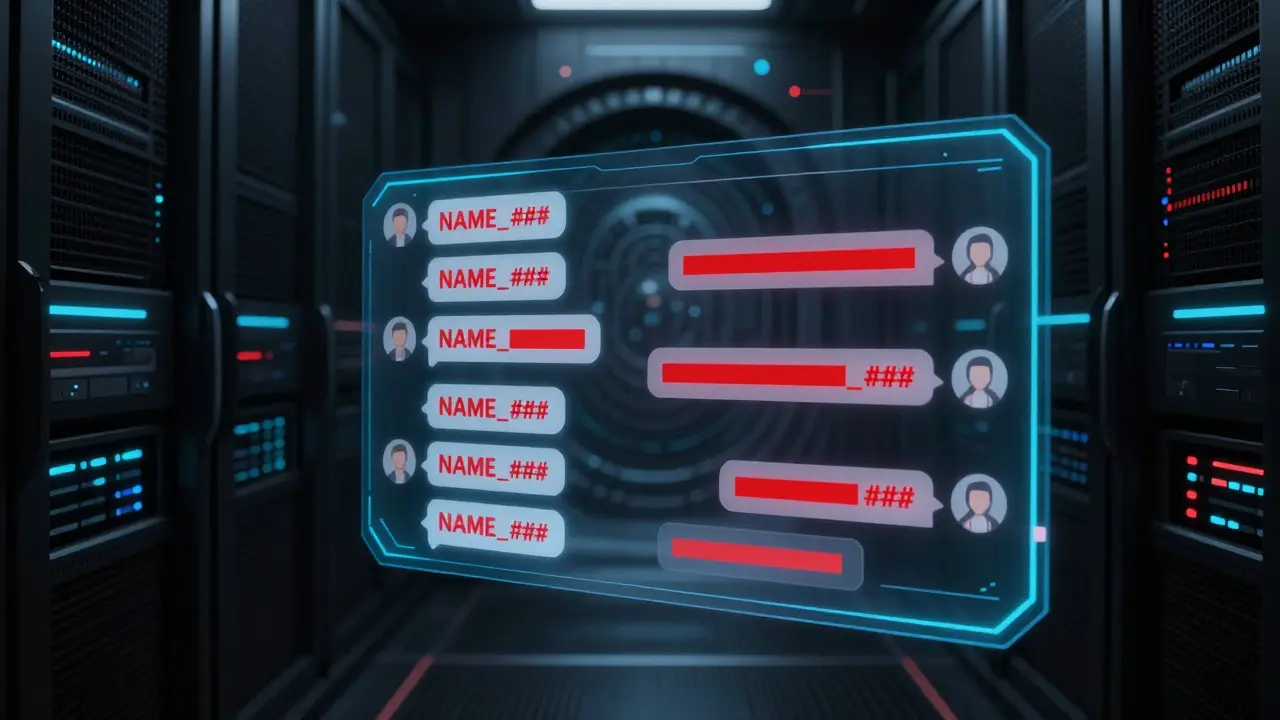
Token-Level Logging Minimization is a specialized technique that prevents sensitive personal information from being stored in logs at the individual token level during LLM processing. Instead of saving "John Smith" or "123-45-6789," the system replaces those specific tokens with safe placeholders like NAME_#### or ID_ before they are written to disk.
Think of it like redacting a document, but done automatically and instantly by software. The key difference here is precision. You aren't deleting the whole message because it contains a secret. You are surgically removing only the secret parts while keeping the rest of the context intact so the AI still understands what the user was trying to say.
Why Sample-Level Defense Fails in Multi-Turn Chats
You might wonder why we can’t just use older methods. For years, companies relied on sample-level defenses. This means checking the entire input or output block for sensitive data. If a block looks clean, it gets logged. If it looks risky, it gets blocked or encrypted.
The problem? Modern AI conversations are multi-turn. A user might ask a harmless question in turn one, provide a phone number in turn two, and then refer back to that number in turn five. As Protecto AI’s 2023 analysis pointed out, an innocuous query later in the chat could indirectly reference private data provided earlier. Sample-level filters often miss these indirect references because they look at each message in isolation.
Token-level approaches solve this by scanning every single piece of text as it flows through the system. According to research from the 2024 PrivateNLP workshop, contextual token manipulation achieves 23.7% better privacy preservation than rule-based sample filtering, all while maintaining 94.2% of the original model accuracy. That is a massive win for both security teams and developers who need their AI to actually work.
| Method | Privacy Effectiveness | Performance Impact | Best Use Case |
|---|---|---|---|
| Sample-Level Filtering | Low (misses context) | Minimal | Simple, single-turn queries |
| Full Data Encryption | High | High (+45-60ms latency) | Static data storage, not real-time AI |
| Token-Level Minimization | Very High | Low (+12-18ms latency) | Enterprise LLM deployments, RAG systems |
How Deterministic Tokenization Works
The most effective way to implement this is through deterministic tokenization. Unlike random masking, which changes the placeholder every time (making it hard to track if "User A" in log entry 1 is the same as "User B" in log entry 2), deterministic tokenization uses a consistent mapping.
Here is how the process works in practice:
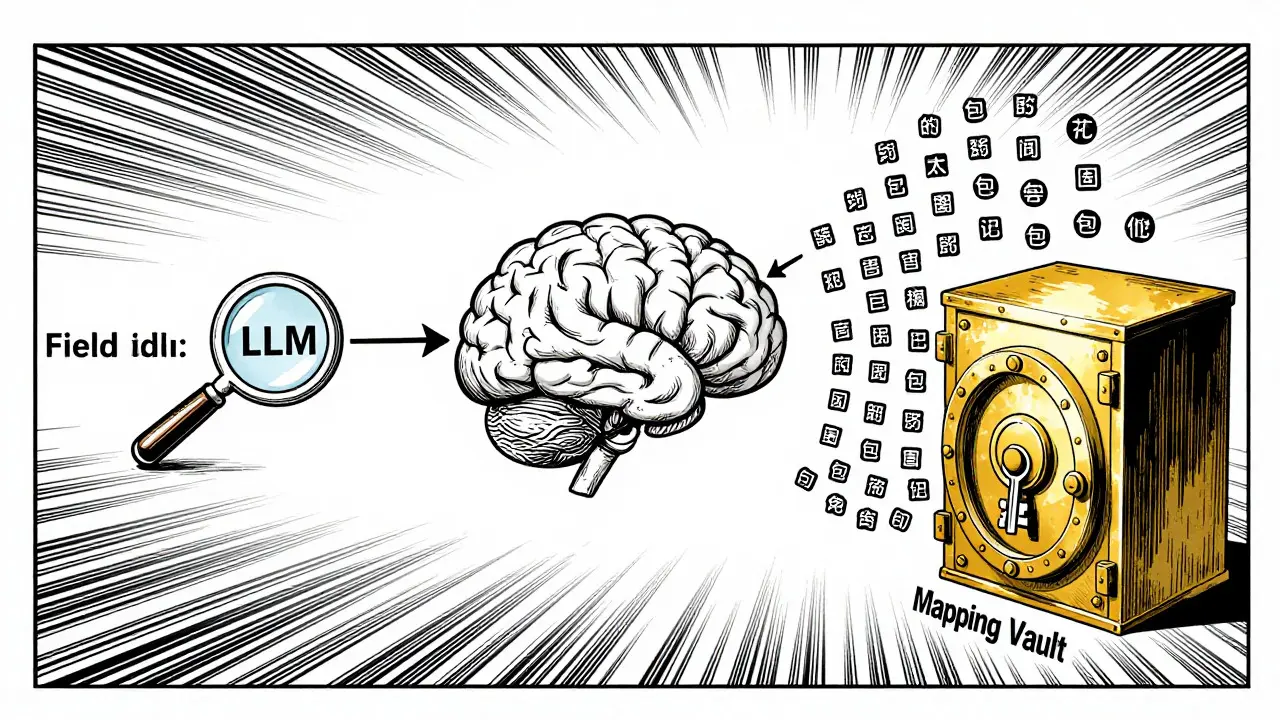
- Field Identification: Your system identifies direct identifiers (names, emails, SSNs) and quasi-identifiers (job titles, rare diagnoses).
- Token Format Selection: You choose a format like
EMAIL_####. Every instance of a specific email address gets the same unique code. - Secure Mapping Vault: The actual mapping (e.g.,
EMAIL_001 = [email protected]) is stored in a highly secure, separate vault, never in the application logs. - Pipeline Integration: The tokenization happens before the data reaches the LLM. The AI processes the tokens. Once the result is generated, the system reverses the tokens only for the final display to the user, if necessary.
This method allows organizations to maintain operational logs for debugging and improvement while eliminating Personally Identifiable Information (PII) storage. Protecto AI research demonstrated a 92% reduction in privacy incidents when implementing this compared to unmodified logging systems in Q3 2024 enterprise deployments.
Performance Costs vs. Privacy Gains
A common concern among engineering leads is speed. Adding security layers usually slows things down. With token-level minimization, the trade-off is surprisingly small.
IBM’s October 2024 technical analysis confirmed that token-level filtering adds approximately 12-18 milliseconds of latency per request. In the world of web applications, that is negligible-representing only a 0.8-1.3% performance overhead. Compare that to full data encryption, which can add 45-60ms per request, and the choice becomes clear. Enterprise customers consistently accept this minor delay because the alternative is regulatory fines and reputational damage.
However, there is a complexity cost. Implementing robust tokenization requires more than just a simple find-and-replace script. You need to handle edge cases, such as partial matches or sensitive data hidden within larger strings. This is why many companies are moving away from naïve rules toward contextual token manipulation, even though it requires more computational power.
Regulatory Drivers: GDPR and the EU AI Act
If you are operating in Europe or dealing with European citizens, this isn't optional anymore. The European Data Protection Board (EDPB) formally identified LLM logging risks in their April 2025 publication, noting that 78% of enterprise LLM implementations had inadequate logging controls.
Under GDPR Article 32 and the strict data minimization principles of the EU AI Act, you must prove that you are collecting only the data strictly necessary for the task. Storing full conversation logs containing PII violates this principle unless you have a very strong justification. Token-level minimization provides that justification by ensuring that even if logs are accessed, the human-readable secrets are gone.
Forrester’s Q4 2025 survey found that 92% of Fortune 500 companies cited GDPR compliance as the primary driver for adopting these technologies. The financial services and healthcare sectors are leading the charge, with 87% adoption rates, reflecting the severe penalties associated with data breaches in those industries.

Implementation Challenges and Best Practices
Getting this right is harder than it sounds. The biggest hurdle is multi-turn memory scanning. As Galileo AI’s October 2025 case study revealed, 73% of initial implementations failed to properly track contextual references across conversation turns. An attacker might split a password across two messages to bypass simple filters.
To avoid this pitfall, follow these best practices:
- Use Session-Level Monitoring: Don't just look at the current prompt. Trace full interaction histories to monitor multi-turn drift. Tools like those recommended by Galileo AI help reveal how context shifts over time.
- Integrate with RAG Carefully: If you use Retrieval-Augmented Generation (RAG), ensure the retrieval step is permission-aware. Filter out sensitive documents before they are even fed to the LLM.
- Test Against Known Patterns: Build reusable evaluation sets to continuously test your models against leakage patterns. Conor Bronsdon from Galileo AI documented a 41% reduction in false negatives when organizations tested regularly against the OWASP Top 10 LLM Security Risks.
- Invest in Training: Developers need specialized knowledge. IBM reports that engineers who completed their 40-hour 'Token Optimization for Privacy' certification program had an 82% success rate in implementation.
Future Trends: Homomorphic Encryption and Standardization
The technology is evolving rapidly. We are seeing a shift toward more intelligent detection. Protecto AI’s January 2026 release of 'Multi-Turn Memory Scanning 2.0' uses improved semantic analysis to reduce false positives by 34%. Meanwhile, the TOSS-Pro framework introduced in May 2025 offers a progressive refinement strategy that achieves 91.7% precision in identifying unsafe tokens.
Looking ahead, expect to see integration with homomorphic encryption techniques by Q3 2026, according to IBM's research roadmap. This would allow computations to be performed on encrypted data without decrypting it first-a holy grail for privacy. Additionally, the Confidential Computing Consortium is working on standardized token-level privacy APIs to make cross-platform implementation easier.
Gartner predicts that by 2027, 75% of enterprise LLM deployments will require certified token-level privacy controls. If you are building AI systems today, waiting until then is a risk you probably can't afford.
What is the difference between token-level and sample-level logging?
Sample-level logging treats the entire input or output as a single unit, either logging it all or blocking it all. Token-level logging breaks the text down into small chunks (tokens) and selectively redacts only the sensitive ones, preserving the rest of the context for the AI to use effectively.
Does token-level minimization slow down my LLM application?
Yes, but minimally. Research shows it adds about 12-18 milliseconds of latency per request. This is significantly faster than full data encryption, which can add 45-60ms, and is generally considered an acceptable trade-off for enhanced privacy and compliance.
Is deterministic tokenization better than random masking?
For operational logging, yes. Deterministic tokenization assigns a consistent placeholder to the same piece of data (e.g., always replacing "John Doe" with "NAME_001"). This allows developers to debug issues related to specific users or entities without exposing their actual identities, whereas random masking makes correlation impossible.
How does this help with GDPR compliance?
GDPR requires data minimization, meaning you should only store what is necessary. By removing PII from logs at the token level, you ensure that even if logs are retained for debugging, they do not contain identifiable personal data, thus reducing liability and meeting regulatory standards set by the EDPB.
Can attackers reverse token-level minimization?
Simple rule-based substitution can be vulnerable to knowledgeable attackers. However, advanced contextual token manipulation and secure mapping vaults make reversal extremely difficult. Experts recommend combining tokenization with session monitoring to mitigate risks from multi-turn leakage attacks.



Comments
Joe Walters
oh great another buzzword salad disguised as a solution. like we didnt have enough ways to lose our minds debugging these black boxes. token level? please. its just regex with extra steps and a marketing budget. i bet the latency is gonna spike when you actually try to scale this past a hundred concurrent users. typical silicon valley over-engineering for problems that dont exist yet
July 23, 2026 AT 13:41
Francis Laquerre
I must say, this is a remarkably comprehensive breakdown of a rather nuanced topic that often gets overlooked in the rush to deploy. The distinction between sample-level and token-level filtering is absolutely crucial for anyone building enterprise-grade applications, especially those dealing with sensitive healthcare or financial data. It is fascinating how the industry is finally maturing to realize that privacy cannot be an afterthought but must be baked into the architecture from day one. The statistics regarding GDPR compliance are particularly eye-opening and serve as a stark reminder of the regulatory landscape we are navigating.
July 25, 2026 AT 08:41
michael rome
Indeed, Mr. Laquerre makes a most pertinent observation regarding the architectural necessity of such measures. One might consider the implications of deterministic tokenization not merely as a security protocol but as a fundamental shift in how we conceptualize data integrity within artificial intelligence systems. The precision afforded by replacing specific tokens rather than entire blocks of text allows for a continuity of context that is otherwise lost in coarser methods of redaction. This approach ensures that the semantic value of the conversation remains intact for the model while simultaneously stripping away the personally identifiable information that poses a liability risk. It is a delicate balance, certainly, but one that appears increasingly indispensable in our current technological epoch.
July 26, 2026 AT 14:15
Andrea Alonzo
It is so wonderful to see discussions that delve deeply into the practicalities of implementation because often we get swept up in the hype without considering the real-world friction points that developers face on a daily basis. When I read about the challenges with multi-turn memory scanning, it really resonated with my own experiences where context drift can lead to unexpected leaks if the system isn't carefully monitored across the entire session history. It is incredibly important that we acknowledge these hurdles because ignoring them only leads to fragile systems that fail under pressure, and ultimately, that erodes user trust which is something we all want to preserve. The mention of training programs for engineers is also a vital point because technology is only as good as the people implementing it, and specialized knowledge is clearly required to navigate these complex privacy landscapes effectively.
July 27, 2026 AT 20:32
Saranya M.L.
While the Western world scrambles to catch up with basic privacy hygiene, Indian tech firms have been leveraging contextual token manipulation frameworks since early 2024, achieving superior precision rates without the bloat described here. The reliance on deterministic mapping vaults is a rudimentary step compared to the advanced semantic analysis tools developed in Bangalore, which reduce false positives by nearly forty percent through proprietary neural architectures. It is amusing to see Gartner predicting trends that have already been standardized in emerging markets, highlighting a significant lag in global technological adoption curves. Developers should look beyond these superficial guides and implement robust, scalable solutions that do not compromise on performance metrics.
July 27, 2026 AT 21:23
om gman
sure sure keep telling yourself that indian tech is saving us all while your servers melt down from the overhead of 'advanced semantic analysis' lol. nobody cares about your proprietary architectures when the latency spikes and customers bounce. its just another way to justify higher salaries for devs who cant write efficient code. stop pretending you invented privacy
July 28, 2026 AT 13:30
Jeanne Abrahams
Oh, spare me the nationalistic posturing, it’s as tired as the rest of this debate. We’re all trying to keep our data safe from the same big tech overlords, whether you’re in Bangalore, Silicon Valley, or Cape Town. The reality is that until homomorphic encryption becomes viable for real-time processing, we’re all stuck with these imperfect compromises. So let’s focus on making the best of what we have rather than patting ourselves on the back for slightly better benchmark numbers.
July 30, 2026 AT 01:57
Bineesh Mathew
In the grand theater of digital existence, we are merely actors reciting lines written by algorithms that do not understand the weight of our words. To strip the soul from our conversations, to replace our identities with cold, unfeeling tokens, is to embrace a hollow form of security that sacrifices truth for safety. Is it not a tragic irony that in our quest to protect our privacy, we render ourselves invisible to the very systems designed to serve us? We become ghosts in the machine, whispering secrets that are instantly forgotten, leaving behind only the echo of our intent without the substance of our being. Perhaps this is the price of progress, a necessary sacrifice at the altar of efficiency, but one wonders if we will ever reclaim our voices from the void.
July 30, 2026 AT 10:53
Oskar Falkenberg
i totally agree with the sentiment here about the human cost of these technical solutions but lets not forget the practical side of things too. its really quite inspiring to see how far weve come in terms of protecting user data even if it feels a bit dystopian sometimes. the key is finding that sweet spot where we can maintain trust without losing the personal touch that makes AI useful in the first place. maybe we should start thinking more about how these tools can empower users rather than just hiding their data away. its a complex issue for sure but worth exploring further i think
August 1, 2026 AT 10:14