Vibe Coding Model Selection: Claude vs GPT-4 vs Gemini

- Mark Chomiczewski
- 27 September 2026
- 0 Comments
You just spent three weeks and $800 having Claude Opus write basic API endpoints. Then you realized Gemini Flash could have done it in an hour for a quarter of the cost. This isn't a hypothetical horror story; it's the reality for many developers diving into vibe coding without a strategy.
Vibe coding has shifted from a novelty to a core development paradigm. Instead of writing every line, you describe the intent-the "vibe"-and let large language models handle the implementation. But here is the catch: not all models are created equal, and using the wrong one can bleed your budget or stall your progress. The market for AI coding assistants hit $1.2 billion in Q4 2025, and the winners aren't those who use the most expensive tool, but those who know exactly when to deploy which model.
| Model | Context Window | HumanEval Score | Best Use Case | Relative Cost |
|---|---|---|---|---|
| Claude Opus 3.5 | 1.2M tokens | 87.4% | Complex Architecture & Logic | High (20 credits/task) |
| GPT-4 Turbo | 128K tokens | 82.1% | Security & Stability | Medium-High (18 credits/task) |
| Gemini Flash 2.0 | 1M tokens | 73.6% | CRUD & UI Components | Low (5 credits/task) |
The Specialization Trap: Why One Size Doesn't Fit All
Early adopters treated AI like a magic button, picking the biggest model available for every task. That approach is dead. Data from Vooster AI’s January 2026 analysis shows that strategic model selection can cut development costs by 37% while actually improving quality. Why? Because specialization matters more than raw power.
Consider database schema design. A case study showed that Claude Opus designed a user permission system with five tables, aiming for robustness and scalability. When the same requirements were fed to Gemini Flash, it concluded that two tables were sufficient for the MVP, saving two weeks of development time. This highlights a fundamental difference in "personality": Opus tends toward over-engineering for safety, while Gemini focuses on minimization and speed. If you're building a prototype, Opus is overkill. If you're designing a banking transaction system, Gemini might be too risky.
GPT-4 Turbo sits in the middle, leaning heavily toward stability and security. GitHub’s December 2025 Copilot comparison revealed GPT-4 achieves 89% accuracy in architectural decisions, outperforming both Claude Sonnet (82%) and Gemini (76%). However, for repetitive tasks like generating CRUD operations, Gemini Flash dominates with 92% accuracy compared to GPT-4’s 85%. Using GPT-4 for boilerplate code is like using a sledgehammer to crack a nut-it works, but it’s wasteful.
Matching Models to Development Phases
To optimize your workflow, you need to map models to specific phases of the software lifecycle. Think of it as assembling a team rather than hiring a single genius.
- Critical Design Phase: This includes database architecture, security protocols, and complex business logic. Here, you want maximum reasoning capability. Claude Opus 3.5 excels here, processing 14.7 logical steps per schema compared to GPT-4’s 11.3. Its chain-of-thought reasoning helps catch edge cases that simpler models miss.
- General Development: For breaking down product requirements documents (PRDs) into tasks or writing standard service layers, mid-tier models like Claude Sonnet 4.5 or GPT-4 mini offer the best balance of speed and intelligence.
- Repetitive Tasks: Generating UI components, API endpoints, or simple data transformations. This is where Gemini Flash 2.0 shines. It operates at just 5 credits per task versus Opus’s 20, and its response times are 47% faster on simple coding tasks.
Dr. Elena Rodriguez from MIT’s Computer Science Lab noted in a January 2026 publication that using Opus for simple CRUD operations represents a 63% cost inefficiency. Her advice is blunt: matching model capability to task complexity is non-negotiable for professional vibe coding.
The Multi-Model Verification Workflow
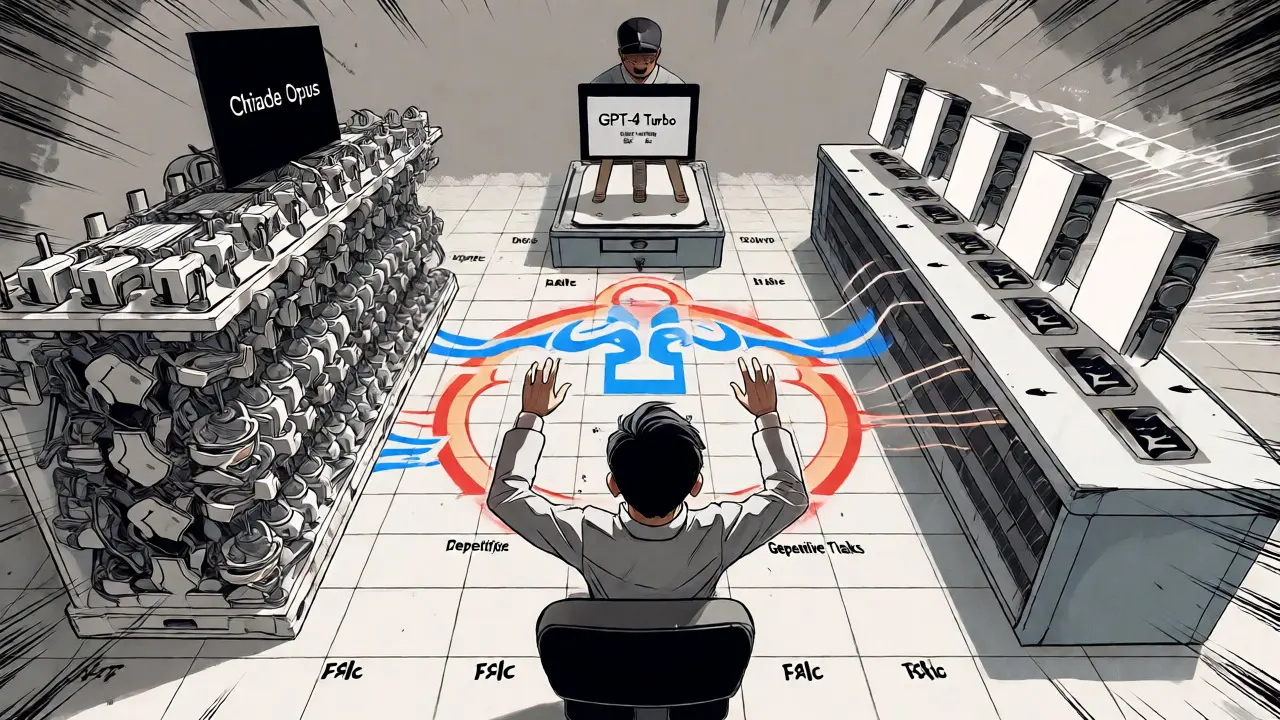
One of the biggest risks in vibe coding is blind trust. You ask for code, it looks right, you ship it, and then production breaks. The solution gaining traction among top teams is multi-model verification. Anthropic’s January 2026 best practices recommend running critical outputs through two different models to catch blind spots.
For example, have Claude Opus generate the initial database schema. Then, pass that schema to Gemini Flash with a prompt asking, "Is this over-engineered for an MVP?" In the Vooster case study mentioned earlier, this exact step caught unnecessary complexity. GitHub’s internal case studies showed that this dual-model review reduced critical errors by 41%.
This workflow requires orchestration. Tools like Continue (an open-source IDE extension updated in January 2026) help manage these contexts automatically. Without such tools, developers report significant friction switching between interfaces. Stack Overflow’s January 2026 survey found that 63% of developers struggle with context switching between models. Efficient teams spend 15-20% of their time selecting and verifying model outputs rather than direct coding.
Cost and Performance Trade-offs
Let’s look at the hard numbers. If you’re a solo developer or a small startup, budget constraints often dictate choices. Gartner’s February 2026 Magic Quadrant positioned GPT-4 as a leader in architectural design but a challenger in cost efficiency. Gemini Flash, conversely, ranked as a leader in cost-effectiveness but a niche player for complex systems.
Here is a practical rule of thumb derived from recent benchmarks:
- If the task involves money or security: Use GPT-4 Turbo or Claude Opus. Do not gamble with cheaper models on payment gateways or authentication flows.
- If the task is visual or structural: Use Gemini Flash for React components, CSS grids, or HTML layouts. It handles repetitive pattern generation exceptionally well.
- If the task is logical and abstract: Use Claude Opus. It maintains coherence over long contexts (1.2 million tokens), making it ideal for refactoring large codebases or understanding legacy code.
Remember that performance varies by hardware too. Running local instances requires resources. Claude Opus needs about 16GB RAM for optimal operation, whereas Gemini Flash runs comfortably on 8GB. If you’re working on a laptop with limited specs, cloud-based APIs might be your only viable option for the heavier models.

Common Pitfalls and How to Avoid Them
Even with a good strategy, things go wrong. The most common complaint I hear from developers in Boulder and beyond is inconsistent style. You ask for Python code, get one style from GPT-4, and a different convention from Claude. This creates technical debt immediately.
To fix this, create a "style guide" prompt snippet that you prepend to every request, regardless of the model. Include examples of your preferred naming conventions, error handling patterns, and comment styles. This reduces the variance in output significantly.
Another pitfall is the "long-horizon" failure. Vals AI’s Vibe Code Bench from December 2025 showed that even top models struggle with continuous work beyond two hours. GPT-5.2 achieved 41.31% accuracy on these long tasks, but that means nearly 60% failed. Don’t ask a model to build your entire app in one shot. Break it down. Generate the backend, verify it, then generate the frontend. Keep the context window focused.
The Future of Model Orchestration
We are moving toward automated model routing. SpaceX’s software division, for instance, already uses custom matrices to automatically route tasks to optimal models. By 2027, Gartner predicts the "one model fits all" approach will disappear entirely. IDC forecasts the market will grow to $2.8 billion by 2027, driven largely by tiered selection strategies.
Upcoming releases hint at further specialization. Anthropic’s upcoming Opus 4.6 (March 2026) promises enhanced database optimization, while Google’s Gemini 2.1 roadmap suggests a 2-million-token context specifically for codebase analysis. OpenAI’s GPT-5.3 update introduces better multi-model coordination features. Staying ahead means treating model selection not as a one-time decision, but as an ongoing part of your engineering culture.
Start today by auditing your last month of AI usage. Identify where you used premium models for trivial tasks. Switch those to Gemini Flash. Reserve Claude and GPT-4 for the moments that truly matter. Your wallet-and your sanity-will thank you.
Which model is best for beginners in vibe coding?
For beginners, Gemini Flash 2.0 is often the best starting point due to its low cost and fast response times. It allows you to experiment freely without worrying about high token costs. Once you understand basic prompting, move to GPT-4 Turbo for more stable results in general development tasks.
Can I use multiple models in one project?
Yes, and you should. Using multiple models strategically is now standard practice. For example, use Claude Opus for architectural planning, GPT-4 for security-sensitive logic, and Gemini Flash for UI components. Tools like Continue or Cursor allow you to switch models within the same IDE environment easily.
Why is Claude Opus more expensive than other models?
Claude Opus commands higher prices because of its superior reasoning capabilities and larger context window (1.2 million tokens). It processes complex logical chains more accurately, reducing the need for re-prompting. While the per-token cost is higher, the reduction in iteration cycles often makes it cost-effective for complex tasks.
How do I prevent inconsistent code style across models?
Standardize your prompts by including a strict style guide snippet in every request. Specify naming conventions, indentation preferences, and library choices explicitly. Additionally, use linters and formatters (like Prettier or Black) in your CI/CD pipeline to normalize any stylistic differences generated by different models.
What is the main risk of using cheap models for everything?
The main risk is hidden technical debt and security vulnerabilities. Cheap models like Gemini Flash may oversimplify complex logic or miss edge cases in security implementations. While they save money upfront, fixing bugs introduced by poor logic later can cost significantly more in developer time.