AI Ethics Frameworks for Generative AI: How to Implement Principles That Actually Work
- Mark Chomiczewski
- 15 November 2025
- 6 Comments
Generative AI isn’t just getting better-it’s getting everywhere. It writes emails, designs logos, generates medical reports, and even teaches students. But with that power comes real harm: biased hiring tools, fake news at scale, stolen art used to train models, and students submitting AI-written essays as their own. If your organization is using generative AI, you’re not just deploying technology-you’re making ethical decisions every day. And most frameworks out there? They’re just pretty words on a website.
Why Most AI Ethics Frameworks Fail
You’ve probably seen them: corporate AI ethics pages with slogans like "Responsible AI for a Better Future" or "Human-Centered Innovation." They look good on LinkedIn. But ask a data scientist how many of those principles actually affect their workflow, and you’ll get silence-or a laugh. The problem isn’t that the ideas are wrong. It’s that they’re not actionable. A 2025 Harvard Business Review audit of 200 companies found only 38% had fully implemented ethical AI practices. Why? Because most frameworks don’t tell you how to do it. They list values like "fairness" and "transparency," but never define what fairness looks like in code, or who’s responsible when the AI lies. Take bias. One company claimed to use "fair AI" because their model didn’t consider race. Sounds good-until you realize it used zip codes as a proxy, and zip codes in the U.S. still correlate strongly with race. That’s not fairness. That’s ignorance dressed up as ethics.The Five Principles That Actually Matter
Forget vague mission statements. Real AI ethics frameworks are built on measurable, enforceable requirements. Based on real-world implementations from healthcare, education, and finance, here are the five principles that make a difference:- Proportionality and Do No Harm: Every generative AI system must undergo a formal impact assessment before deployment. If it’s used in hiring, healthcare, or law enforcement, it must prove it won’t cause disproportionate harm to protected groups. The EU AI Act requires this. So should you.
- Transparency with Teeth: Users must know when they’re interacting with AI. Not just a tiny footnote. Not just in the terms of service. If your chatbot answers a customer question, they need to see a clear label: "This response was generated by AI." And if it’s used in education, students must be notified at least 72 hours before AI tools are used in assignments.
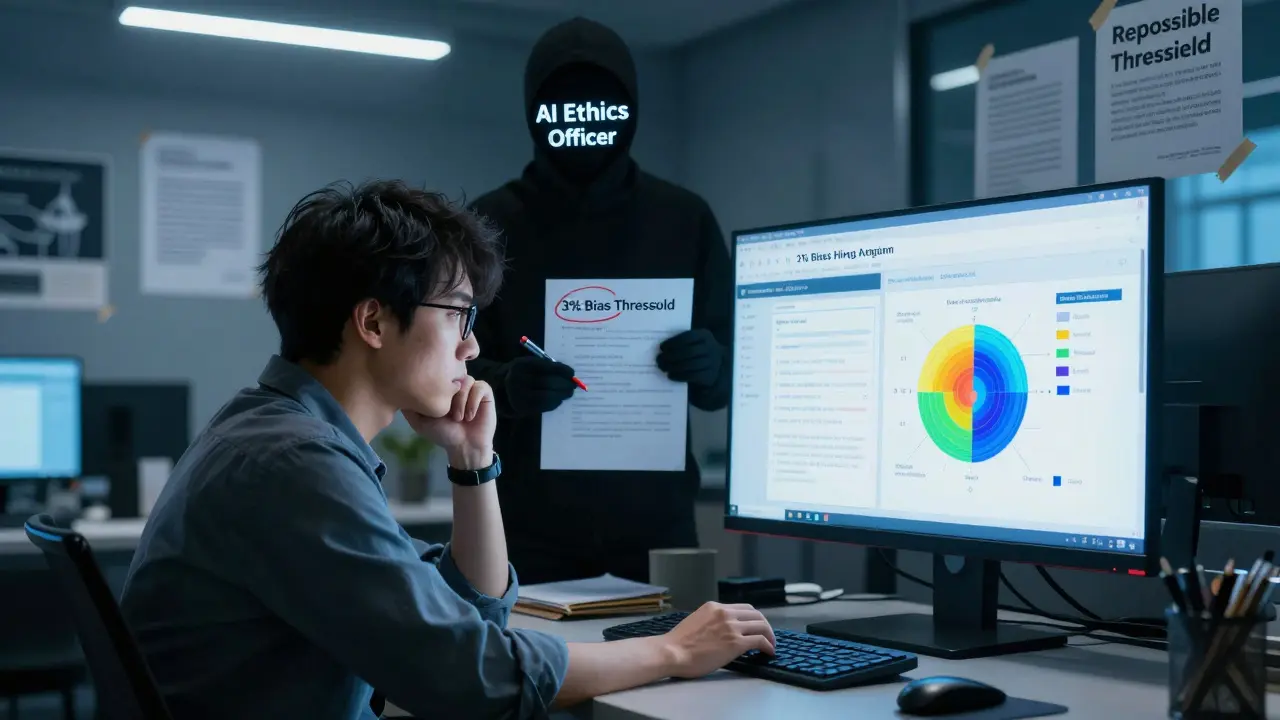
- Accountability with a Name: Who gets fired if the AI denies someone a loan? Who’s on the hook if a medical diagnosis is wrong? Every organization needs a Chief AI Ethics Officer-someone with real authority, reporting directly to the CEO, not buried in the legal department. As of Q1 2025, 73% of leading organizations had this role. The ones without it? They’re just waiting for a lawsuit.
- Algorithmic Fairness with Metrics: Fairness isn’t a feeling. It’s a number. Your model must be tested across at least 15 demographic dimensions (gender, age, race, income level, education, etc.) and show less than 3% difference in false positive rates between groups. Microsoft’s Responsible AI Standard v3.0 requires this. So should you.
- Human Oversight in High-Stakes Decisions: If the AI is deciding who gets a mortgage, who gets parole, or what treatment a patient receives-there must be a human who can override it. Not a checkbox. Not a "review later." A real person, trained, empowered, and paid to question the AI’s output. UC San Diego reduced AI hallucinations in research from 32% to 4.7% just by adding mandatory human verification.
What the Big Frameworks Get Right (and Wrong)
There are dozens of AI ethics frameworks. But only a few are worth borrowing from. Here’s how the major ones stack up:| Framework | Scope | Enforceable? | Key Strength | Key Weakness |
|---|---|---|---|---|
| OECD AI Principles | Global policy coordination | No | Adopted by 52 countries; good for policy alignment | Only 22% of countries turned it into law |
| UNESCO AI Ethics Recommendation | 193 countries | No | First global standard; includes environmental impact | Only 47 countries created regulatory bodies |
| EU AI Act | European Union | Yes | Legally binding; fines up to 7% of global revenue | Only applies in EU; complex compliance |
| Microsoft Responsible AI Standard v3.0 | Corporate internal use | Yes (within Microsoft) | Specific metrics: 15 demographic dimensions, < 3% bias differential | Only applies to Microsoft products |
| NIST Generative AI Risk Management Framework | Technical standards | Voluntary | Best practical guide for measuring foundation model risks | Not legally binding; still emerging |
The takeaway? Don’t copy a framework. Borrow its best parts. The EU Act gives you teeth. Microsoft gives you metrics. NIST gives you tools. Combine them.

How to Build Your Own Framework (Step by Step)
You don’t need a team of lawyers and ethicists to start. Here’s how to build a working AI ethics framework in under a year:- Form a cross-functional team (2-4 months): Include a data scientist, a legal advisor, a user experience designer, a domain expert (e.g., a teacher if you’re in education), and a frontline employee who uses the AI daily. Don’t skip the last one-they’ll tell you what actually breaks.
- Define your high-risk use cases (1-2 months): Not all AI is equal. A chatbot answering FAQs? Low risk. AI writing patient discharge summaries? High risk. Focus only on the ones that could hurt someone.
- Adopt measurable standards (2-3 months): Use Microsoft’s 3% bias threshold. Use NIST’s transparency checklist. Require human review for any decision affecting health, safety, or legal rights.
- Build in monitoring (ongoing): Set up automated alerts for performance drift. Track how often humans override the AI. Survey users every quarter: "Did you know this was AI?" If more than 15% say no, you’ve failed.
- Train everyone: Microsoft requires 15-20 hours of AI literacy training per employee per year. Start with that. No one should be using AI tools without understanding their limits.
Don’t wait for perfection. Start with one high-risk use case. Fix it. Then expand.
The Hidden Costs of Ignoring Ethics
Some leaders think ethics is a cost center. It’s not. It’s insurance. In 2024, a hospital in Ohio used an AI tool to prioritize patients for kidney transplants. The model favored wealthier patients because it used income data as a proxy for "likelihood of adherence." It wasn’t biased by design-it was biased by data. The result? A class-action lawsuit. Public outrage. A 30% drop in patient trust. The fix? $2.1 million in legal fees, plus a year of rebuilding reputation. Meanwhile, the University of California implemented mandatory human verification for AI-generated research. Result? A 79% drop in plagiarism cases. Faculty trust in AI tools went up. Students learned more. The university didn’t just avoid scandal-they became a model for others. The cost of doing nothing isn’t theoretical. It’s financial, legal, and reputational.
What’s Next? The Future Is Measurable
The era of "ethics washing" is ending. In 2025, 67% of organizations moved beyond vague principles to measurable outcomes, according to the Partnership on AI. That’s the new baseline. By 2026, ISO/IEC 42001 will launch-the first global standard for AI management systems. It won’t be optional for companies doing business in Europe or with EU partners. And AI audit firms are already springing up, offering compliance checks for a fee. The real winners won’t be the ones with the fanciest AI. They’ll be the ones who can prove their AI is safe, fair, and transparent. And that proof? It comes from action-not slogans.Start Today. Don’t Wait for a Crisis.
If you’re reading this, you’re already ahead of most organizations. Most don’t even know their AI is biased. Or hallucinating. Or stealing data. You don’t need to solve everything tomorrow. But you need to start. Pick one high-risk use case. Apply one measurable rule. Document it. Test it. Fix it. Share what you learn. The future of AI isn’t about bigger models. It’s about better governance. And that starts with you.What’s the difference between an AI ethics framework and an AI policy?
An AI ethics framework is a set of guiding principles-like fairness or transparency. An AI policy is the specific, enforceable rule that puts those principles into action. For example, a framework might say "be fair." A policy says: "All hiring algorithms must be tested for bias across 15 demographic groups, with a maximum 3% false positive rate difference, and reviewed quarterly by the AI Ethics Board." The framework tells you why. The policy tells you how.
Can small companies afford to implement AI ethics frameworks?
Yes-and they need to more than big companies. Start small. Pick one AI tool you’re using. Apply one rule: require human review for any output that affects a person’s rights, health, or safety. Use free tools like the Canadian Algorithmic Impact Assessment Toolkit. Train your team with 10 minutes of YouTube videos on AI hallucinations. You don’t need a $500K budget. You need awareness and discipline.
Is AI ethics just for tech teams?
No. If your marketing team uses AI to write ads, your HR team uses it to screen resumes, or your finance team uses it to flag fraud-then your team needs to understand the risks. AI ethics isn’t a tech problem. It’s a human problem. Everyone who uses AI should know its limits, how to spot bias, and who to report issues to.
What happens if I don’t implement an AI ethics framework?
You risk lawsuits, regulatory fines, loss of customer trust, and reputational damage. In 2025, the EU AI Act started enforcing fines up to 7% of global revenue. In the U.S., 28 states passed AI ethics laws. Even without regulation, customers are walking away from brands that use deceptive AI. A 2025 survey found 62% of consumers avoid companies that don’t disclose AI use. The cost of inaction is higher than the cost of action.
How do I know if my AI is biased?
Run a bias test. Use tools like IBM’s AI Fairness 360 or Google’s What-If Tool. Test outputs across gender, race, age, income, and education levels. Look for differences in false positives, false negatives, or rejection rates. If one group is denied loans 5% more often than another, that’s bias. Don’t rely on your developers’ word. Test it. Document it. Fix it.
Do I need to hire an AI ethicist?
Not necessarily. But you do need someone with authority to say "no" to AI projects that are risky or unethical. That person doesn’t need a PhD in philosophy. They need to understand your business, know the law, and have the courage to challenge the engineers. Many organizations assign this to a senior legal or compliance officer. The key is making sure they have direct access to the CEO-not just a Slack channel.
Next steps: Audit your top three AI tools. Ask: Could any of these harm someone? If yes, start with one. Apply one rule. Measure the result. Share it. Repeat.



Comments
Fredda Freyer
Finally, someone who gets it. Most "ethics frameworks" are just PR stunts wrapped in jargon. The real issue? Companies treat AI like a magic box that doesn't need oversight. But you can't outsource morality to an algorithm-and you shouldn't outsource accountability to a legal department that doesn't understand code. The five principles you listed? They're not suggestions. They're minimum viable safeguards. If your model can't pass a 3% bias threshold across 15 demographic groups, it shouldn't be near a hiring screen, let alone a hospital intake form.
And human oversight isn't a checkbox-it's a cultural shift. At my last job, we had an AI that auto-rejected loan applications. The devs swore it was "neutral." We ran the numbers-Black applicants were 4.2% more likely to be flagged for "inconsistent income patterns." Turns out, the training data used zip codes and credit history from the 90s. We didn't need a PhD in ethics. We needed a spreadsheet and the guts to say "no."
December 24, 2025 AT 17:00
Mongezi Mkhwanazi
Let me be blunt: you're preaching to the choir, but the choir is in the basement while the architects are building the skyscraper on top of them. The EU AI Act? A toothless tiger if enforcement is left to overworked bureaucrats who don't understand machine learning. Microsoft’s standards? Fine for their internal silos-but irrelevant when a startup in Bangalore trains a model on scraped Instagram images of women to generate "ideal customer avatars" for a dating app. Who polices that? No one. The system isn't broken-it's designed to ignore the consequences until the lawsuit hits.
And don't get me started on "human oversight." You think a junior HR associate with a 10-minute training video and a 30-second glance at an AI-generated resume review is going to override a model that says "reject"? Please. The human is a rubber stamp with a pulse. The real solution isn't more frameworks-it's mandatory third-party audits, with public results, enforced by regulators with real power. Until then, we're just rearranging deck chairs on the Titanic while the AI writes the iceberg's obituary.
December 26, 2025 AT 07:04
Mark Nitka
I get where Mongezi is coming from, but let’s not throw the baby out with the bathwater. The frameworks aren’t perfect, but they’re the foundation. You don’t need a perfect audit to start-you need a starting point. My team implemented the 3% bias threshold from Microsoft’s standard last quarter. We didn’t have a Chief AI Ethics Officer yet-we had a data scientist who was tired of getting yelled at by legal. We used NIST’s checklist, ran bias tests on our customer service chatbot, and found that non-native English speakers were 8% more likely to get nonsensical replies. We fixed it in two weeks. No budget. Just accountability.
And yes, human oversight is often performative-but that doesn’t mean it’s useless. The fact that we now log every override and review it monthly? That’s changed our culture. People started asking, "Wait, did the AI just say that?" before they hit send. That’s the win. Not perfection. Progress. Start small. Document it. Then scale.
December 27, 2025 AT 18:01
Kelley Nelson
While your assertions are undeniably cogent and grounded in empirical observation, one cannot help but observe the underlying epistemological assumption that ethical governance can be reduced to quantifiable metrics. The very notion of a "3% bias differential" presupposes a Cartesian bifurcation of human identity into discrete demographic variables-an ontological reductionism that fails to account for intersectionality, cultural context, and the phenomenological experience of algorithmic alienation.
Moreover, the invocation of the EU AI Act as a "gold standard" is profoundly problematic, given its statist, technocratic lineage and its implicit endorsement of regulatory capture by corporate legal departments. One must ask: who defines the parameters of fairness? Who authorizes the audit? And crucially-does the model’s compliance with a metric truly constitute moral legitimacy, or merely legal permissibility?
Perhaps the deeper imperative is not to engineer better frameworks, but to dismantle the epistemic authority of the algorithmic gaze entirely.
December 27, 2025 AT 22:11
Colby Havard
Oh, here we go again: the "measurable ethics" cult. You treat morality like a spreadsheet, as if fairness is a KPI you can optimize with a Python script. Bias isn’t a statistical anomaly-it’s a reflection of centuries of systemic oppression that your training data inherited. You test for race, gender, income-fine. But what about caste? What about immigration status? What about the fact that your "demographic dimensions" were defined by white engineers in Silicon Valley who’ve never met someone who lives on less than $15/hour?
And let’s not pretend that "human oversight" saves us. The person reviewing the AI’s decision is paid $18/hour, has 45 seconds to review it, and is told not to "second-guess the system." You don’t fix ethics by adding more boxes to check-you fix it by giving power to the people who are harmed. Not lawyers. Not auditors. Not CEOs. The people.
Stop trying to engineer morality. Start listening to those who live under its consequences.
December 29, 2025 AT 08:30
Aryan Gupta
They’re lying. All of them. The EU AI Act? A distraction. Microsoft’s "standards"? A PR stunt. NIST? A placebo. The real truth? The AI is already being used to manipulate elections, fabricate court evidence, and generate fake medical records to deny insurance. And the people running this? They don’t care. They’re not even trying to fix it-they’re just trying to avoid the headlines until they sell their company for $2 billion. I’ve seen the internal Slack logs. The engineers know. The VPs know. But they’re all waiting for someone else to get fired first.
And don’t tell me about "human oversight." The guy who’s supposed to review the AI’s medical diagnosis? He’s been trained on a 12-minute video and told to trust the system. He’s not a doctor-he’s a button-pusher. And when the patient dies? The AI gets a "bug fix." The human gets a PIP. The company gets a press release about "continuous improvement."
Wake up. This isn’t ethics. It’s organized denial with a compliance badge.
December 31, 2025 AT 04:36