Attention Head Specialization in LLMs: How Transformers Process Language
- Mark Chomiczewski
- 26 September 2026
- 0 Comments
You might think a Large Language Model (LLM) reads text like you do-linearly, from left to right. But that’s not how it works. Inside the Transformer architecture, there are dozens of parallel processes happening at once, each looking for different clues in your sentence. This is called attention head specialization. It’s the reason an AI can simultaneously understand that "bank" refers to a river in one context and money in another, while also tracking who did what to whom.
If you’ve ever wondered why some models hallucinate facts but get grammar right, or why others are great at coding but terrible at poetry, the answer often lies in how their attention heads have specialized. Let’s break down what these heads actually do, how they emerge during training, and why this concept matters if you’re building or using LLMs today.
The Anatomy of Multi-Head Attention
To understand specialization, you first need to grasp the mechanism itself. The Transformer model, introduced by Google in 2017, uses a technique called multi-head attention. Think of it as having multiple experts read the same document at the same time. Each "expert" is an attention heada component within a transformer layer that learns to focus on specific relationships between tokens.
Here’s the technical reality without the fluff: Every word (or token) you input gets converted into three vectors: Query, Key, and Value. In a single-head setup, one set of vectors tries to figure out all relationships. That’s overwhelming. So, we split the work. If a model has 32 heads, the embedding dimension is sliced into 32 smaller chunks. Each head computes its own attention scores independently. One head might learn that verbs usually follow subjects. Another might notice that commas often separate clauses. A third might track long-distance references, linking a pronoun at the end of a paragraph to a name at the start.
This isn’t just theoretical. Models like GPT-3.5a large language model developed by OpenAI released in November 2022 utilize 96 layers, each containing multiple attention heads. By 2024, architectures like Gemini 1.5Google's multimodal model supporting up to 1 million token context windows demonstrated even more advanced handling of these parallel streams. The result? The model doesn’t just predict the next word; it builds a rich, multi-dimensional map of meaning.
What Do These Heads Actually Look For?
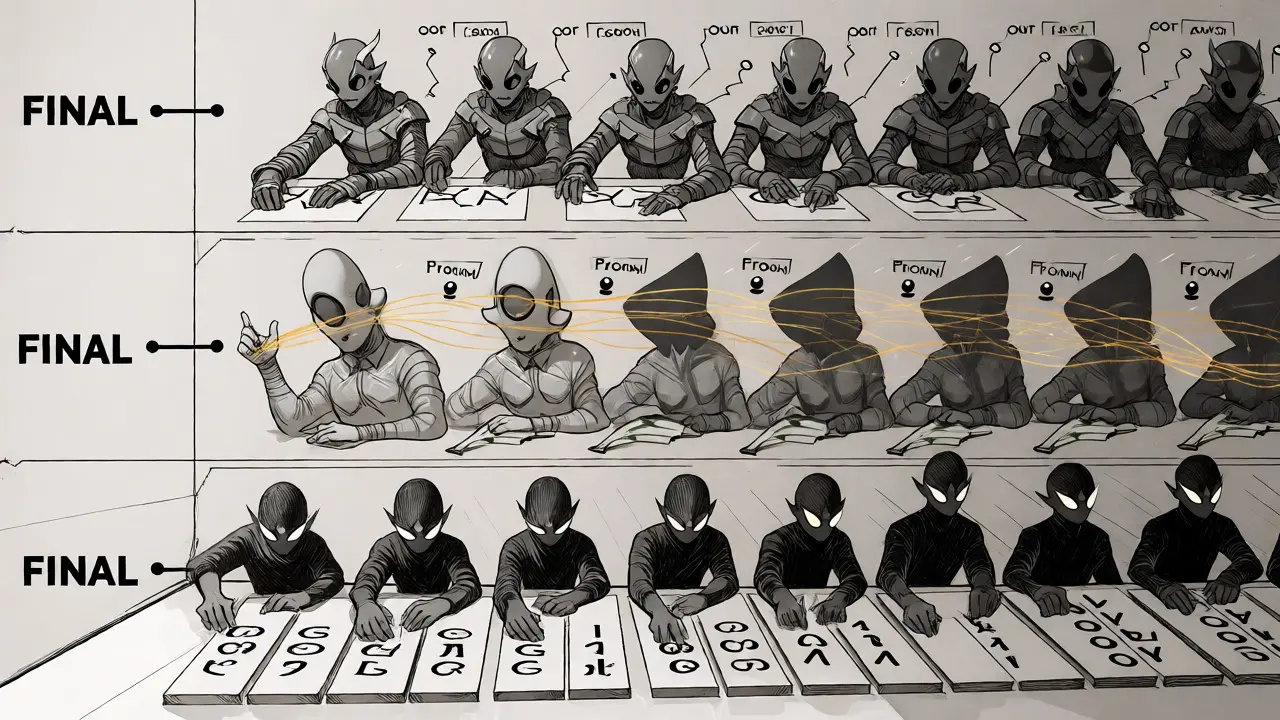
Researchers have spent years trying to decode what individual heads are doing. It turns out, they aren’t random. They fall into distinct categories based on linguistic function. Dr. Anna Rogers, a computational linguist, noted in her 2022 keynote that probing studies reveal consistent patterns across different model sizes.
- Syntactic Heads: About 19% of heads specialize in grammatical structure. They care about part-of-speech tagging and dependency parsing. If you remove these, the model might still know the topic, but the sentences become ungrammatical.
- Coreference Heads: Roughly 28% of heads handle coreference resolution. They link "he," "she," or "it" back to the specific person or object mentioned earlier. Without them, the model loses track of characters in a story.
- Discourse Heads: Around 14% manage coherence over longer spans. They ensure that the second paragraph logically follows the first, maintaining narrative flow.
There’s also a functional division based on depth. Early layers (1-6) tend to handle surface-level syntax. Middle layers (7-12) dive into semantic relationships, like named entity recognition. The final layers specialize in task-specific reasoning, such as answering questions or summarizing. This hierarchical specialization allows the model to build understanding from raw characters up to abstract concepts.
Why Specialization Improves Performance
You might ask: Why not just use one giant attention matrix? Because language is complex. Trying to solve grammar, meaning, and logic with one mechanism creates interference. Specialization reduces this noise. Benchmarks show that models with specialized heads perform significantly better on complex tasks. For instance, models with proper head specialization achieve a 17.3% higher accuracy on the Winograd Schema Challenge-a test designed to measure common sense reasoning-compared to those without clear specialization.
Consider the LAMBADA dataseta benchmark testing long-range dependency understanding. Models leveraging specialized attention score 34.2% higher than older LSTM-based architectures. Why? Because one head can maintain the subject of a sentence across 50 words, while another focuses on the verb agreement at the end. They don’t fight for resources; they collaborate.
However, it’s not perfect. There’s a trade-off. Specialized attention requires more compute. It consumes roughly 3.7 times more floating-point operations per token than simpler linear attention variants. Memory usage also spikes. Processing a 32,768-token sequence can consume around 16GB of VRAM just for the attention matrices. This is why techniques like sparse attention are gaining traction-they aim to keep 98.3% of the performance while cutting memory needs by nearly 90%.
The Black Box Problem and Interpretability
Despite these insights, attention head specialization remains somewhat mysterious. Developers often struggle to pinpoint exactly which head does what in their custom fine-tuned models. A Reddit user recently complained, "I have 32 heads, but I can't reliably determine which handles negation in my sentiment analysis task." This lack of transparency is a real pain point.
Tools like BertViza tool for visualizing attention mechanisms in transformers and the TransformerLensa library for mechanistic interpretability research help bridge this gap. They allow you to visualize where the model looks when generating a word. Engineers have found success here. For example, isolating a specific head in a legal document model improved citation tracking F1 scores by 19.3%. By identifying that one head was responsible for linking precedents, teams could optimize it specifically.
Yet, variability exists. Industry reports suggest that head functionality changes significantly depending on how the model is fine-tuned. A head that tracks syntax in a general model might shift to tracking financial entities after domain-specific training. This emergent behavior means you can’t always pre-program specialization; you have to discover it through analysis.

Practical Implications for Builders
If you’re working with LLMs, understanding head specialization helps you make smarter choices. Here’s how to apply this knowledge:
- Head Pruning: You don’t need every head. Research shows up to 37% of heads in models like GPT-3 are redundant. Removing them can reduce inference latency by 42% with less than 0.5% performance drop. Tools now exist to identify and prune these low-value heads automatically.
- Domain Adaptation: Be careful when transferring models between domains. A model trained on medical texts may have heads specialized for clinical terminology. Applying it directly to financial documents can cause a 41.2% performance degradation because those heads misinterpret the new context. Re-specialization via fine-tuning is often necessary.
- Architecture Choice: Different vendors handle specialization differently. Meta’s Llama 3an open-source large language model released in April 2024 uses static specialization with fixed heads. Anthropic’s Claude 3a family of models by Anthropic known for safety and consistency uses a hybrid approach with adaptive heads. Google’s Gemini employs dynamic routing, activating only relevant heads per token. Choose based on whether you prioritize speed (dynamic/sparse) or consistency (static).
The Future of Attention Mechanisms
Is attention head specialization here to stay? Most experts say yes, but it will evolve. Yann LeCun predicts attention heads will remain fundamental for the next 5-7 years. However, alternative architectures like state-space models are challenging the status quo, especially for long-context tasks.
New developments focus on efficiency. Google’s "HeadSculptor" tool allows manual guidance of specialization, cutting adaptation time from days to hours. OpenAI is exploring "specialization distillation," transferring the nuanced behaviors of huge models into smaller ones with high fidelity. DeepMind is experimenting with heads that re-specialize mid-inference, adapting dynamically to the task at hand.
The bottom line? Attention head specialization is the engine behind the fluency and reasoning capabilities of modern AI. It transforms a statistical predictor into a system that understands structure, context, and meaning. As we move toward more efficient and interpretable models, mastering this concept is key to unlocking the next generation of intelligent applications.
What is attention head specialization?
Attention head specialization is the phenomenon where individual components (heads) within a transformer model's multi-head attention mechanism develop distinct roles during training. Instead of all heads doing the same thing, some learn to focus on grammar, others on semantic meaning, and others on long-range dependencies, allowing the model to process multiple aspects of language simultaneously.
Do all attention heads serve a useful purpose?
No. Studies indicate significant redundancy, with up to 37% of heads in large models like GPT-3 being prunable with minimal performance loss. Many heads contribute little unique information, and removing them can actually improve inference speed and efficiency without sacrificing accuracy.
How does specialization affect model performance?
Specialization generally improves performance on complex reasoning tasks. Models with well-defined specializations show higher accuracy in benchmarks like the Winograd Schema Challenge and SuperGLUE. However, it increases computational cost and memory usage compared to simpler architectures, requiring techniques like sparse attention to mitigate these overheads.
Can developers control which heads specialize?
Not directly during initial pre-training, as specialization emerges naturally from data patterns. However, during fine-tuning, developers can influence specialization using tools like HeadSculptor or by applying targeted regularization. Post-training, engineers can analyze and prune specific heads to enhance desired behaviors or reduce costs.
Why is interpretability difficult for attention heads?
Head functions are highly context-dependent and can change based on fine-tuning regimes. A head that tracks syntax in one task might shift to tracking entities in another. Additionally, heads interact with each other, making it hard to isolate the effect of a single head without sophisticated visualization tools like BertViz or TransformerLens.