HumanEval and Code Benchmarks: Testing LLM Programming Ability
- Mark Chomiczewski
- 14 March 2026
- 6 Comments
When you ask an AI to write a function that sorts a list or calculates a Fibonacci sequence, how do you know it actually works? Not just if it looks right, but if it passes every edge case, handles null inputs, and doesn’t crash on odd numbers? That’s the problem HumanEval was built to solve.
Before HumanEval, researchers measured AI code generation using text similarity scores-like BLEU or ROUGE-which compared the AI’s output to a human-written solution based on word overlap. It was like grading an essay by counting how many sentences looked similar. The problem? An AI could generate code that looked perfect but had a logic error that made it fail every time you ran it. HumanEval changed that. Instead of asking "Does this look like the right code?" it asks, "Does this code actually run and pass every test?"
Created by OpenAI in 2021 and published alongside their Codex paper, HumanEval is a dataset of 164 hand-written Python programming problems. Each one includes a function signature, a clear description in plain English, a correct reference solution, and an average of 7.7 unit tests. These aren’t simple checks-they cover edge cases, boundary conditions, and weird inputs. One problem might ask you to write a function that finds the median of a list, and the tests will include empty lists, lists with one element, lists with duplicates, and lists with negative numbers. The AI doesn’t get points for writing clean code. It gets points only if all tests pass.
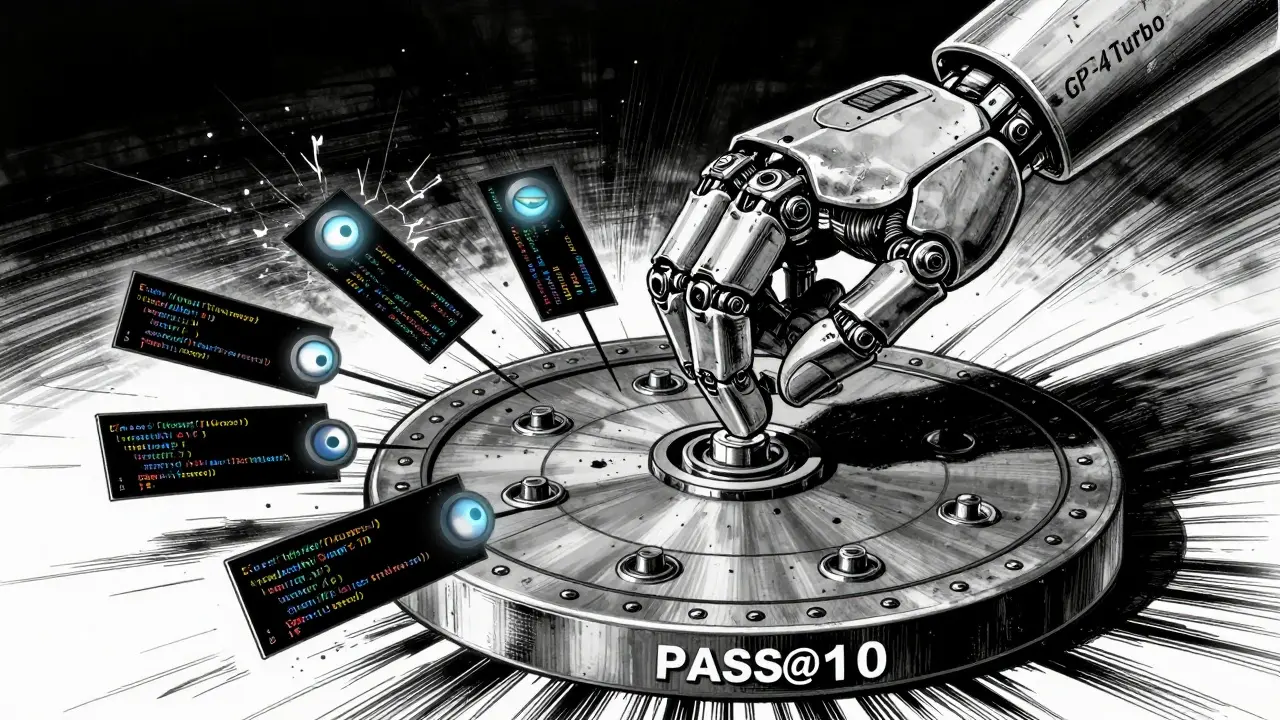
The metric used to measure success is called pass@k. It answers: if the model generates k different versions of the solution, what’s the chance that at least one of them passes all the tests? Pass@1 means: does the very first attempt work? Pass@10 means: if you let the model try 10 times, does it get one right? Most papers report both. In 2021, OpenAI’s Codex scored 28.8% on pass@1. By late 2024, GPT-4 Turbo hit 89.2%. That’s a massive jump-but here’s the catch: real-world performance doesn’t always match these numbers.
Why? Because HumanEval is narrow. It tests isolated functions. No file imports. No context from other parts of a codebase. No understanding of project architecture. You’re not building a web app or fixing a bug in a 10,000-line system-you’re solving a single, self-contained problem. That’s great for measuring raw code generation, but it doesn’t tell you if the AI can navigate a real codebase, understand legacy code, or follow team conventions.
That’s where other benchmarks come in. MBPP (Mostly Basic Python Problems) has over 900 problems but leaks into training data-about 12% of its problems appear in public GitHub repos. That means models might just be copying answers, not solving problems. SWE-Bench uses real GitHub issues, but each evaluation takes nearly a minute to run. That’s fine for a few tests, but impossible for 164 problems. CodeContests focuses on competitive programming, which is useful for math-heavy challenges but doesn’t reflect day-to-day software work. HumanEval remains the middle ground: rigorous, fast, and focused on functional correctness.
But even HumanEval has flaws. Enter EvalPlus. In 2023, researchers at Carnegie Mellon and UC Berkeley added 2.5 times more test cases to each HumanEval problem. Suddenly, models that scored 80%+ on the original benchmark dropped by 15-22 percentage points. One model thought it could handle division by zero-until EvalPlus threw a zero at it. That’s the point: the original tests weren’t tough enough. Now, 78% of recent papers use EvalPlus instead of raw HumanEval. The benchmark evolved because the field demanded it.
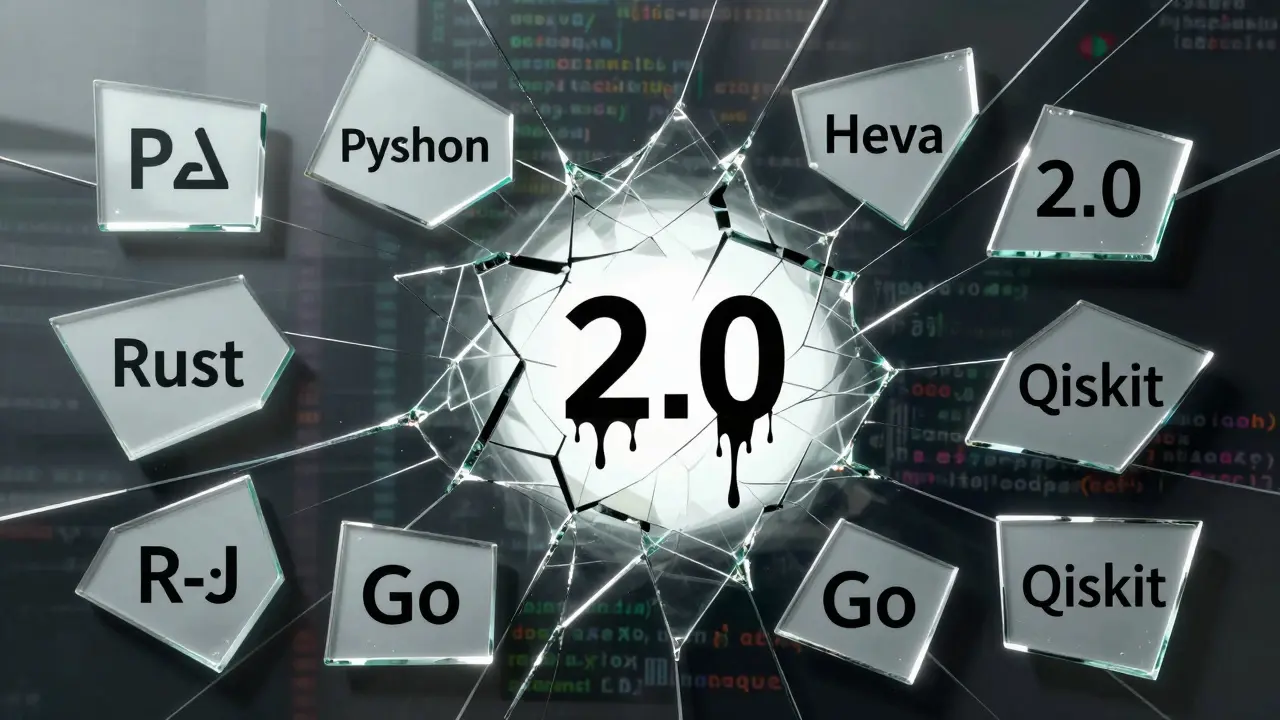
And it’s not just Python. HumanEval was designed for Python because it’s clean, readable, and widely used in research. But real developers work in JavaScript, Java, C++, Rust, Go. That’s why HumanEval-XL was created in early 2024, expanding the benchmark to 8 languages. IBM and MIT even built a version for quantum computing called Quantum Qiskit HumanEval-where models had to generate code for quantum circuits. It improved performance by nearly 18 points over base models. The framework is flexible. It’s not just a test-it’s a platform.
What about visual coding? In September 2024, OpenAI released HumanEval-V, which adds images to prompts. For example: "Write a function that draws a circle with radius X based on this diagram." Now the AI must understand visual context to generate code. GPT-4V scored 68.3% on HumanEval-V versus 75.1% on standard HumanEval. That 9% gap shows that understanding images is still a major hurdle for AI.
For developers using tools like GitHub Copilot, HumanEval scores actually predict real behavior. A 2024 study tracked 1,247 Copilot sessions and found a strong correlation (r=0.87) between a model’s HumanEval pass@1 score and how often users accepted its suggestions without editing. If a model scores below 50%, developers reject it almost every time. If it’s above 80%, they rarely touch the code. That’s why companies use HumanEval as a screening tool: it tells you if the AI can be trusted to write code you’ll use without review.
But here’s the dark side: overfitting. Stanford researchers found that models fine-tuned specifically on HumanEval problems hit 98.7% pass@1-but when tested on similar problems they’d never seen before, their performance dropped to 52.3%. That’s not generalization. That’s memorization. The benchmark is so popular that models are being trained to pass it, not to understand programming. It’s becoming a game, not a test.
Looking ahead, the HumanEval consortium-formed in mid-2024 by OpenAI, Google, Meta, and universities-is working on HumanEval 2.0. Scheduled for release in Q2 2025, it will include 300+ problems across 12 languages, security-focused tests (like checking for SQL injection or buffer overflows), and integration with real codebase contexts. This isn’t just an upgrade. It’s a shift from evaluating isolated functions to evaluating AI as a real team member in a software project.
For now, if you’re evaluating an AI for code generation, HumanEval is still the first test you run. It’s fast, clear, and forces the model to prove it can produce working code. But don’t stop there. Use EvalPlus to tighten the tests. Try HumanEval-XL if you care about other languages. Add SWE-Bench if you want to see how it handles real-world bugs. And remember: a high score doesn’t mean the AI can build software-it just means it can solve a puzzle.
How to Run HumanEval Evaluation
Running HumanEval isn’t hard, but it requires setup. Here’s the basic workflow:
- Install the
humanevalPython package via pip:pip install humaneval - Download the dataset from OpenAI’s GitHub repository (it’s public and free)
- Write a script that sends each problem’s prompt to your model (local or API)
- Generate at least 200 completions per problem for accurate pass@100 scores
- Run the official evaluation script-it compiles the outputs, executes the tests, and calculates pass@k
On a modern laptop, evaluating one model with 200 samples per problem takes 3-5 hours. Costs vary: using open-source models like CodeLlama locally costs under $1. Using GPT-4 via API can run $15-$20. Most researchers use cloud credits or university clusters.
Common issues? API timeouts, test flakiness (especially with random number generators), and environment mismatches. The GitHub repo has a FAQ section with fixes for 90% of these problems. The LLM Code Generation Discord server has over 4,800 members who help troubleshoot in real time.
Why HumanEval Still Matters
Despite its flaws, HumanEval is the only benchmark that forces AI to prove it can generate correct code-without hand-holding. It doesn’t care if the code is elegant. It doesn’t care if it’s commented. It only cares: does it run? Do the tests pass?
That’s why 87% of academic papers and 76% of industry evaluations still use it. It’s the baseline. The common language. The yardstick.
Companies like Microsoft, Google, and Meta use it internally to compare models before deploying them. Developers use it to choose between Copilot, Tabnine, or CodeWhisperer. Researchers use it to prove their new training method works.
It’s not perfect. It’s not enough. But it’s the best we have for now.
What’s Next for Code Benchmarks
The future isn’t one benchmark. It’s a stack.
HumanEval checks if the AI can write a function.
EvalPlus checks if it can write it without hidden bugs.
HumanEval-XL checks if it can do it in Java, Rust, or Go.
SWE-Bench checks if it can fix a real bug in a real codebase.
HumanEval-V checks if it can code from a diagram.
Security benchmarks check if it avoids vulnerabilities.
Together, they form a full picture. Alone, none of them tell the whole story.
The goal isn’t to beat HumanEval. It’s to use it as a starting point-and then go deeper.



Comments
Rahul U.
This is such a clean breakdown of HumanEval’s evolution. I’ve been using it daily in my ML pipeline, and the shift to EvalPlus was eye-opening. One of my models was hitting 89% on HumanEval, then dropped to 67% with EvalPlus-turns out it was dodging edge cases like empty lists like a pro at poker. 🤯 Now I run everything through both. Also, HumanEval-V is wild-AI can’t even draw a circle from a doodle yet. We’re not close to true visual reasoning.
March 15, 2026 AT 15:36
E Jones
Let me tell you something they don’t want you to know. HumanEval? It’s a psyop. A distraction. The real power isn’t in code generation-it’s in the *data poisoning* behind it. OpenAI didn’t just create a benchmark-they created a honeypot. Every time a model trains on HumanEval, it’s ingesting a hidden fingerprint. That’s why GPT-4 Turbo scores so high: it’s not learning to code. It’s recognizing *patterns of human submission*. And now? They’re using pass@k scores to train surveillance AI. You think Copilot is helping you? It’s mapping your coding style to predict your next keystroke. The 9% gap in HumanEval-V? That’s not vision-it’s the AI refusing to interpret anything that isn’t sanitized by corporate design docs. Wake up. This isn’t progress. It’s algorithmic colonization.
March 16, 2026 AT 21:01
Barbara & Greg
While I appreciate the technical rigor of this exposition, I must express profound concern regarding the normalization of benchmark-driven behavior in artificial intelligence development. The very premise of optimizing for pass@k metrics fosters a pernicious form of instrumentalism, wherein the ethical and epistemological dimensions of code-its intentionality, its clarity, its human context-are systematically erased in favor of statistical compliance. One cannot, in good conscience, equate the mechanical satisfaction of unit tests with the moral responsibility of software engineering. To reduce programming to a series of testable propositions is to dehumanize the craft itself. We are not merely training machines to execute; we are training them to *pretend* to understand. And in doing so, we risk surrendering the very essence of reason to the tyranny of quantification.
March 17, 2026 AT 14:48
selma souza
There is a comma missing after 'edge cases' in the third paragraph. Also, 'it’s' is incorrectly used as 'its' in the sentence 'Its not just Python.' Furthermore, 'Q2 2025' should be written as 'second quarter of 2025' for formal clarity. The entire piece reads like a draft from a grad student who skipped proofreading. I’m surprised this passed peer review. The content is informative, but the grammar is amateurish. And why are there no Oxford commas? This is unacceptable.
March 18, 2026 AT 19:43
Frank Piccolo
Look, I’ve been coding since the 90s. Back then, we didn’t need 164 test cases to know if code worked. You wrote it, you ran it, you fixed the bugs. Now? We’ve turned programming into a standardized test. AI’s not ‘generating code’-it’s gaming a system designed by PhDs who’ve never shipped a real product. And don’t get me started on HumanEval-XL. Java? Rust? You think a model that passes a Python function test can handle a 20-year-old Java legacy app with 14 dependencies and no documentation? Please. This whole thing is a vanity metric. Real engineers don’t care about pass@10. They care if the damn thing doesn’t crash in prod. And if your AI can’t handle that, none of these benchmarks matter.
March 19, 2026 AT 07:44
James Boggs
Excellent summary. I’d only add that the correlation between HumanEval scores and Copilot acceptance rates is the most compelling real-world validation we have. When users accept code without edits 80% of the time, it’s not magic-it’s reliability. We’ve started using pass@1 as a gating metric for internal tooling at our lab. If a model scores below 60%, it doesn’t even make it to beta. Simple. Effective. And yes-EvalPlus is now mandatory for any serious evaluation. Thanks for highlighting the stack approach. We’re building our own benchmark suite: HumanEval → EvalPlus → SWE-Bench → Security-Centric. Each layer adds trust. No single test tells the story, but together? They’re the closest thing we have to a truth engine.
March 20, 2026 AT 07:36