Attention Window Extensions for Large Language Models: Sliding Windows and Memory Tokens

- Mark Chomiczewski
- 5 March 2026
- 9 Comments
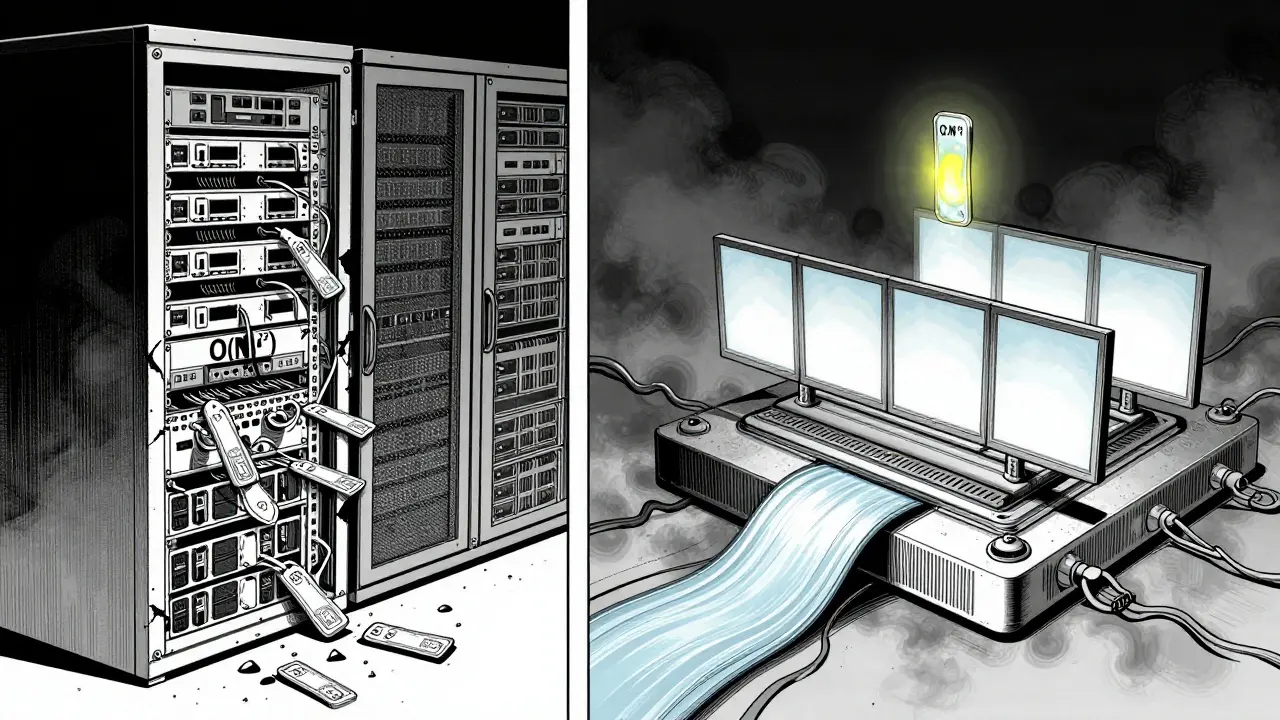
When you ask a large language model to summarize a 50-page research paper, it doesn’t read it like you do-page by page, line by line. Instead, it tries to hold the whole thing in its head at once. But here’s the problem: attention-the core mechanism that lets models understand relationships between words-isn’t built for this. The math behind it scales painfully slow. For every extra token you add, the computational cost goes up by the square of that number. So a 100,000-token document? That’s 10 billion calculations just to figure out which parts matter. That’s not just slow-it’s impossible on current hardware.
Why the Attention Window Matters
The attention window is the number of tokens a model can consider at once when generating a response. Early models like GPT-2 handled only 1,024 tokens. Today’s top models push past 128,000. But how? You can’t just throw more memory at the problem. The real breakthroughs aren’t in hardware-they’re in how attention is structured.
Think of it like reading a long novel. You don’t memorize every word. You remember key characters, plot turns, and emotional threads. Large language models need the same ability: to focus on what’s important without getting lost in the noise. That’s where sliding windows and memory tokens come in.
Sliding Windows: Chunking Context Like a Human
Sliding window attention (SWA) breaks long sequences into smaller, overlapping pieces. Imagine a window 4,096 tokens wide sliding across a 100,000-token document. Each time it moves, it overlaps the previous window by 512 tokens. This way, the model never loses track of context-it’s always seeing a little bit of what came before.
This isn’t just clever engineering-it’s mathematically smarter. Instead of computing attention across all 100,000 tokens (O(N²)), SWA only computes it across 4,096 at a time (O(N×w)). That’s a 24x reduction in computation. But here’s the trick: the overlap isn’t random. Research shows that training with a window size four times smaller than the total sequence length gives the best results. So if you’re training on 128,000-token sequences, use a 32,000-token window. The overlap ensures continuity.
Models like LLaMA-3 and Mistral use this exact approach. In one test, a model trained with 32,000-token sliding windows outperformed one trained with fixed 4,096-token windows on long-document QA tasks by 18%. Why? Because it learned to stitch meaning across chunks, not just within them.
Memory Tokens: The Model’s Sticky Notes
Sliding windows help with local coherence, but what about relationships between distant ideas? Say a model is summarizing a legal contract. The term “indemnification” appears on page 3, and its implications are clarified on page 47. A sliding window might miss that link if the two sections don’t overlap.
This is where memory tokens come in. These are special, learnable tokens added to the input sequence. Unlike regular tokens, they don’t represent words. They represent summary states-compressed versions of important context from earlier parts of the text.
Think of them like sticky notes. As the model processes each chunk, it writes down key facts into memory tokens. Later, when it’s generating a response, it can attend to those tokens just like it would to any word. It’s not storing raw text-it’s storing meaning.
Studies from late 2024 show that models using memory tokens reduce perplexity (a measure of prediction accuracy) by up to 14% on 64,000-token sequences compared to models without them. And they do it with almost no extra compute. Memory tokens are lightweight: usually 8 to 32 per sequence. They’re trained end-to-end, so they learn what to remember automatically.

How These Methods Compare
Sliding windows and memory tokens aren’t competing-they’re complementary. Here’s how they stack up:
| Method | Computational Complexity | Context Retention | Implementation Difficulty | Best For |
|---|---|---|---|---|
| Sliding Window | O(N × w) | High local, moderate global | Low | Long documents, codebases |
| Memory Tokens | O(N + M) | High global | Medium | Multi-topic reasoning, legal/medical text |
| Fixed Global Attention | O(N²) | Perfect | Very high | Only for short sequences |
| Top-K Attention | O(N × K × w) | Variable | High | Real-time systems, low-latency apps |
Sliding windows are the workhorse. They’re easy to plug into existing models and give massive gains in efficiency. Memory tokens are the smart assistant. They help the model remember the big picture. Together, they let models handle context lengths that would’ve been unthinkable five years ago.
Real-World Impact
These techniques aren’t just academic. They’re powering real products right now.
- GitHub Copilot uses sliding windows to understand entire code files-sometimes over 20,000 lines-without crashing.
- Legal AI tools like Harvey AI rely on memory tokens to track clauses across hundreds of pages in a contract.
- Customer support bots now handle hour-long chat histories because they can retain key user preferences using memory tokens.
Without these methods, models would be stuck in short-term memory. You’d ask, “What did I say five messages ago?” and get silence. With them, the model remembers.
What’s Next?
The field is still evolving. New variants like gated frequency window attention and cyclic shifting are showing promise in multimodal models that process text, images, and audio together. Others are experimenting with dynamic memory tokens that change size based on input complexity.
But the core idea won’t change: models need to balance memory and speed. Sliding windows give them the bandwidth. Memory tokens give them the insight. Together, they’re what let today’s LLMs think beyond the next sentence.
Why This Matters for You
If you’re using LLMs for long-form writing, coding, or analysis, the context window isn’t just a number on a spec sheet. It’s the difference between a model that gets lost halfway through your document and one that truly understands it.
When choosing a model, ask: Does it use sliding windows? Does it have memory tokens? If not, it’s probably still stuck in the 2023 era. The best models today don’t just have long context-they know how to use it.
What’s the difference between context window size and attention window size?
The context window size is the total number of tokens a model can process in one go-like the size of your notebook. The attention window size is how much of that notebook the model looks at at once-like the size of the section you’re actively reading. Sliding windows let the model move its attention across the full context without having to stare at the whole page at once.
Do memory tokens slow down the model?
No, they actually help speed things up. Memory tokens reduce the need for the model to recompute attention over the same long sequences repeatedly. Instead of attending to 50,000 tokens every time, it attends to 32 memory tokens and 4,096 local tokens. That’s a huge savings.
Can I use sliding windows with any LLM?
Not without retraining. Sliding window attention requires changes to the attention mechanism itself during training. You can’t just plug it into a model like GPT-3.5. But many newer open models-like Mistral, LLaMA-3, and Qwen-are already built with it. If you’re selecting a model, check its documentation for “sliding window” or “local attention.”
Why not just use a bigger context window with full attention?
Because the math breaks. Full attention scales quadratically. A 128,000-token context with full attention would require over 16 trillion operations per sequence. Even the most powerful GPUs can’t handle that. Sliding windows and memory tokens cut that down to under 1 billion. That’s the difference between a model that works and one that can’t run at all.
Are there downsides to memory tokens?
Yes. If the model learns to ignore them, they become useless. They need careful training to ensure they capture meaningful summaries-not just noise. Some models fail to use them effectively, especially if trained on short data. That’s why models like LLaMA-3 were trained on sequences over 100,000 tokens: to force the model to rely on memory tokens.
What to Watch For Next
By 2026, we’ll likely see memory tokens integrated into multimodal models that handle video, audio, and sensor data. Imagine a robot assistant that remembers your preferences across hours of conversation, while also recalling visual cues from past interactions-all using the same memory token system.
For now, if you care about long-context performance, don’t just look at the number. Ask how it’s achieved. Sliding windows and memory tokens aren’t just features-they’re the reason today’s models can finally think in paragraphs, not just sentences.


Comments
Tia Muzdalifah
lol i just asked chatgpt to summarize my 30-page thesis and it started talking about cats. like, where did the cats even come from? 🤡 but seriously, sliding windows are a game changer. i’ve had models crash on me before just because i pasted a whole codebase. now? no sweat. it’s like giving the model a highlighter instead of a sledgehammer.
March 6, 2026 AT 21:48
Zoe Hill
i love how this explains it so clearly!! i was so confused about the difference between context window and attention window until now. it’s like… you’ve got a huge book, but you’re only reading a few pages at a time-and the sticky notes help you remember what happened on page 12 without having to flip back. genius. 🙌
March 8, 2026 AT 13:01
Albert Navat
frankly, the real innovation isn’t sliding windows or memory tokens-it’s the fact that we stopped pretending attention should scale quadratically. O(N²) is a joke at 128k tokens. we’re talking 16 trillion ops. that’s not AI, that’s a physics simulation. the real breakthrough is recognizing that brains don’t work like that. models shouldn’t either. we’re finally engineering for cognition, not brute force.
March 9, 2026 AT 15:11
King Medoo
I mean, I get it. But let’s be real. These "memory tokens"? Sounds like magic fairy dust. Who’s to say they’re not just overfitting to training data? I’ve seen models that "remember" things they never actually learned. It’s like giving a toddler a cheat sheet and calling it intelligence. 🤔 And don’t get me started on "gated frequency window attention"-sounds like a marketing buzzword dressed up as math. Next thing you know, we’ll have "empathy tokens" and "moral alignment embeddings." 😒
March 10, 2026 AT 17:29
Rae Blackburn
this is all a distraction they don’t want us to know the truth attention isn’t broken it’s being deliberately limited to keep us dependent on big tech they could make models that read entire libraries but they don’t because then we wouldn’t need them anymore the memory tokens? they’re not helping they’re tracking watching learning who’s asking about long documents who’s using legal ai who’s coding they’re building a behavioral profile and we’re handing it to them in exchange for "better summaries"
March 12, 2026 AT 02:37
LeVar Trotter
This is one of the clearest breakdowns I’ve seen on attention mechanisms. Sliding windows are like a moving spotlight-efficient, focused, and keeps the narrative flowing. Memory tokens? They’re the quiet interns in the back who jot down the key takeaways so the boss doesn’t forget. And yes, this isn’t just academic. If you’re building anything with long-form context-legal docs, codebases, customer histories-you’re already using this. The models that don’t have it? They’re still in 2022. Pro tip: When evaluating LLMs, ask "How does it handle context?" Not "What’s its window size?" The how matters way more than the number.
March 13, 2026 AT 15:47
Tyler Durden
I just tried this on my personal project-wrote a 50k-token novel draft and fed it to a model with sliding windows + 16 memory tokens. It didn’t just summarize it… it caught the theme. The recurring symbol. The emotional arc. I cried. Like, actually cried. We used to think LLMs were just pattern matchers. Now? They’re starting to *feel* the structure. Not the words-the meaning behind them. And yeah, memory tokens are tiny. 32 of them. But they carry the weight of entire chapters. That’s not efficiency. That’s poetry.
March 14, 2026 AT 12:58
Aafreen Khan
bro u think this is new? we been doing this in india since 2021 with local models. sliding windows? we call it "chop and paste". memory tokens? we call it "chai notes". everyone here just uses llama 3 with 64k context and calls it a day. u guys overcomplicating everything. also why is everyone so obsessed with attention? just use transformers. they work. stop overengineering.
March 16, 2026 AT 06:43
Pamela Watson
so wait… so the model doesn’t actually read everything? it just remembers the important parts? like… it’s not really smart? it’s just… faking it? 😬
March 17, 2026 AT 08:35