Batched Generation in LLM Serving: How Request Scheduling Impacts Outputs
- Mark Chomiczewski
- 19 November 2026
- 3 Comments
You send a prompt to an LLM API. It takes 200 milliseconds. You send another one immediately after. It takes 800 milliseconds. Why the difference? The answer isn't just about model size or network latency-it's about how your request got scheduled alongside everyone else's. This is batched generation, and it’s the invisible engine driving modern AI infrastructure.
If you’ve ever wondered why your chatbot slows down during peak hours while others stay snappy, you’re looking at a scheduling problem. Traditional computing processes tasks one by one. But Large Language Models (LLMs) are different. They thrive on parallelism, yet their variable output lengths create chaos for hardware. Understanding how request scheduling impacts outputs isn't just academic; it determines whether your application feels instant or sluggish, and whether your cloud bill stays manageable or explodes.
The Problem with Static Batching
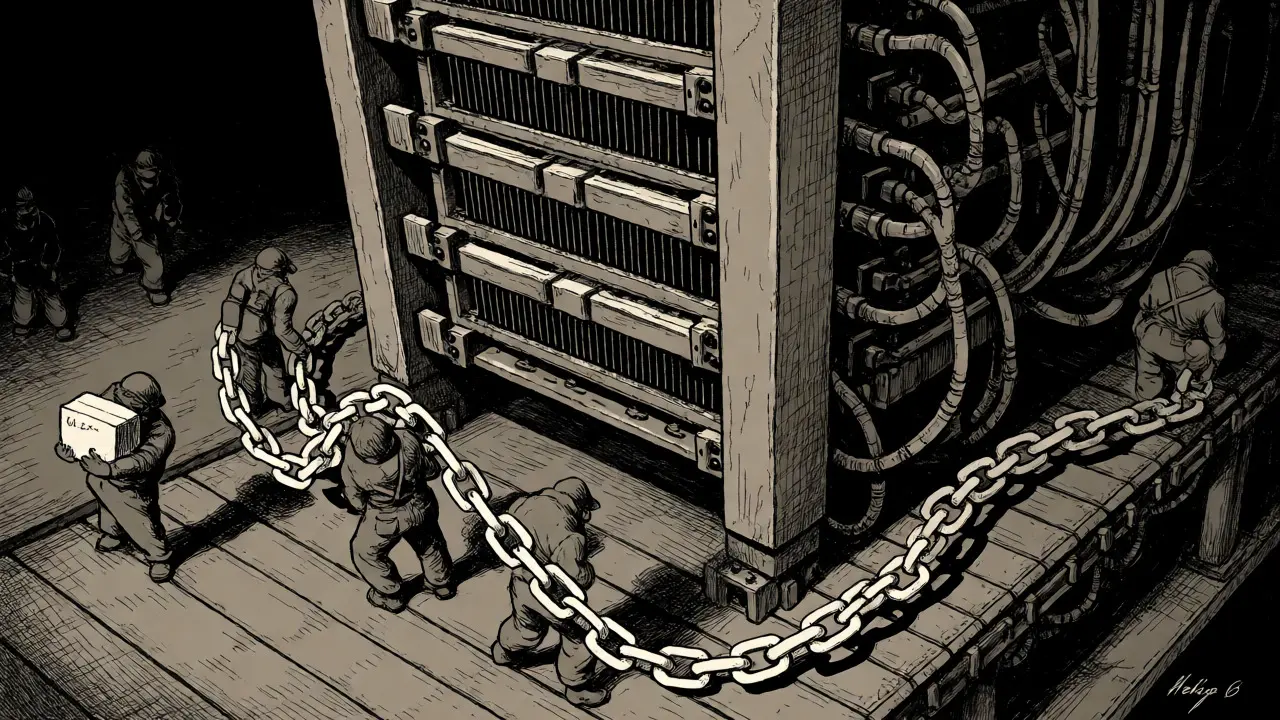
To understand why we need smart scheduling, look at what came before. Early systems used static batching. Imagine a bus that only leaves when it’s full, regardless of how long the last passenger took to board. In static batching, the system waits until it has enough requests to fill a batch, then processes them all together. When the longest sequence finishes, the whole batch ends, even if shorter sequences finished minutes ago.
This creates two massive inefficiencies. First, GPU idle time. If one user asks for a 5-word response and another asks for a 500-word essay, the GPU sits idle waiting for the essay writer to finish, wasting cycles that could have served new users. Second, head-of-line blocking. A short request gets stuck behind a long one, suffering unnecessary latency. Studies from UCSD’s Hao AI Lab showed this approach wastes up to 60% of GPU cycles. That’s not just inefficient; it’s expensive.
Continuous Batching: The Game Changer
Enter continuous batching. Unlike its static predecessor, continuous batching doesn’t wait for entire requests to finish. Instead, it operates at the iteration level. At every single token generation step, the scheduler checks the active batch. If a sequence finishes, it’s immediately removed. If there’s room in the GPU memory, a new request enters the queue.
This dynamic reshuffling keeps the GPU saturated. Frameworks like vLLM implement this by managing a key-value (KV) cache efficiently. By using techniques like PagedAttention, which partitions memory into small blocks similar to virtual memory in operating systems, vLLM reduces memory fragmentation by up to 70%. This allows more concurrent sequences to fit on the same hardware.
The result? Throughput increases by 3-5x compared to static methods. But here’s the catch: throughput isn’t the only metric that matters. Latency variance can become unpredictable. If the scheduler isn’t careful, some requests might get starved, waiting indefinitely while newer, shorter requests jump the queue.

How Scheduling Algorithms Shape Your Output
The heart of efficient serving lies in the scheduling algorithm. It decides who gets processed next. Let’s break down the common strategies and their impact on your experience.
| Strategy | Mechanism | Impact on Latency | GPU Utilization |
|---|---|---|---|
| FIFO (First-In-First-Out) | Processes requests in arrival order | Predictable but high tail latency | Low to Medium |
| Length-Aware | Groups requests by input length | Better for uniform workloads | Medium |
| Learning-to-Rank | Predicts output length using ML models | Optimized for average case | High |
| SLO-Aware | Prioritizes requests near deadline | Reduces 99th percentile latency | Variable |
Length-aware scheduling tries to group similar prompts together. If you know most users ask short questions, grouping them prevents long essays from dominating the batch. However, this fails when generation length varies wildly despite similar input lengths-a common scenario in creative writing apps.
More advanced systems use learning-to-rank algorithms. These models predict how many tokens a request will generate based on features like input length, semantic content, and application type. By predicting the future workload, the scheduler can form batches that finish around the same time, minimizing idle gaps. Research shows this approach achieves 23.7% higher throughput than simple FIFO queues.
The Hidden Cost: Memory and Preemption
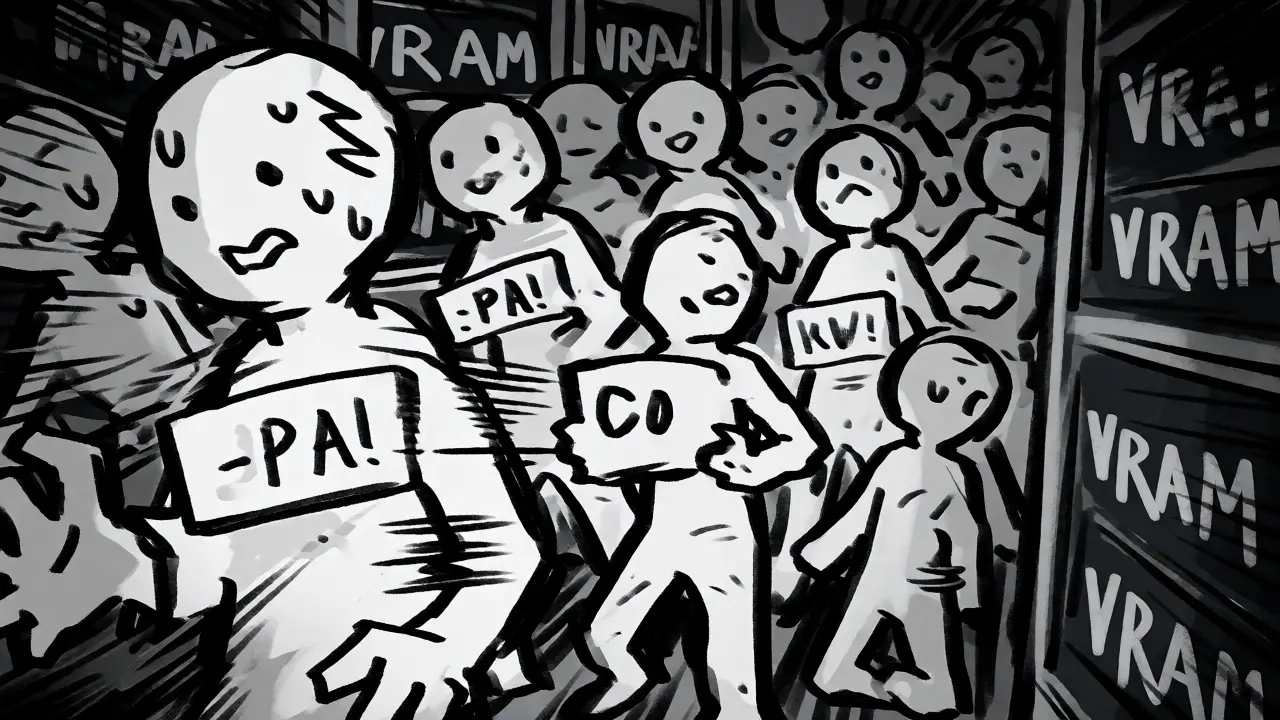
Memory is the bottleneck in LLM serving. Every token generated adds to the KV cache, consuming GPU VRAM. When memory fills up, the system faces a choice: reject new requests or preempt existing ones.
Preemption means pausing an ongoing generation, saving its state, and swapping it out to CPU memory or disk. When space frees up, the system swaps it back in. While this maximizes throughput, it hurts latency. If your request gets preempted three times, your total response time balloons. Developers often struggle with this "black box" behavior. As one engineer noted, debugging performance issues becomes hard when you don’t know if a delay was due to computation or memory swapping.
Systems like Magnus address this by integrating a generation length predictor and an adaptive batcher. Magnus uses Highest Response Ratio Next (HRRN) scheduling to prevent starvation. It ensures older requests aren’t perpetually bypassed by newer, shorter ones. In tests, Magnus reduced average latency by 22.8% compared to standard continuous batching.
Practical Tuning for Developers
If you’re deploying an LLM service, you can’t just rely on defaults. You need to tune parameters to match your traffic patterns. Here’s what actually moves the needle:
- Max Num Sequences: This caps how many requests run concurrently. Too low, and you underutilize the GPU. Too high, and you risk OOM (Out of Memory) errors. Start with 256 and adjust based on your average prompt length.
- Max Batched Tokens: This limits the total number of tokens in a single forward pass. Balancing this parameter is critical. Larger batches improve throughput but increase per-token latency because the model spends more time processing each step.
- Starvation Thresholds: Configure a time limit (e.g., 200-500ms). If a request waits longer than this, boost its priority. This prevents edge cases where complex queries get stuck forever.
Remember, providing all prompts at once in a single call helps the scheduler see the bigger picture. Fragmenting requests across multiple calls reduces the scheduler’s ability to optimize batch composition.
Future Trends: From Heuristics to AI-Driven Scheduling
We are moving away from rule-based schedulers toward intelligent, data-driven systems. New algorithms like WAIT and nested WAIT set dynamic batch thresholds based on continuous flow approximations. These methods offer provable guarantees on latency scaling, even under heavy traffic.
By 2026, analysts predict that 90% of production systems will use some form of length prediction. We’re already seeing frameworks integrate real-time rescheduling across multiple model instances. If one GPU server is overloaded, requests migrate dynamically to less busy nodes. This cross-instance scheduling improves throughput by nearly 30% in heterogeneous environments.
For you, the developer, this means better tools are coming. But it also means complexity. Monitoring metrics like preemption rates, queue depth, and token-level latency percentiles is no longer optional. It’s essential for keeping your users happy.
What is the difference between static and continuous batching?
Static batching processes a fixed group of requests together, waiting for the longest one to finish before starting new ones. Continuous batching dynamically adds and removes requests at each token generation step, allowing finished sequences to exit immediately and new ones to enter, significantly improving GPU utilization.
Why does my LLM response time vary so much?
Response time varies due to request scheduling and resource contention. If your request shares a batch with longer generations, or if it gets preempted due to memory constraints, latency increases. Advanced schedulers try to mitigate this, but variability remains inherent to shared inference services.
How does vLLM handle memory for batching?
vLLM uses PagedAttention, a technique inspired by virtual memory management. It partitions the KV cache into non-contiguous blocks, reducing memory fragmentation by up to 70%. This allows more requests to be packed into the same GPU memory, enabling larger batch sizes without running out of VRAM.
Can I control the batching behavior in my application?
Yes, through configuration parameters like max_num_seqs and max_num_batched_tokens. You can also influence scheduling by sending requests in bulk rather than individually, giving the scheduler more visibility to optimize batch composition. Some platforms allow custom scheduling policies via plugins.
What is the 'long-tail problem' in LLM serving?
The long-tail problem occurs when a few requests with very long generation lengths block the processing of many shorter requests in static batching. This leads to poor GPU utilization and high latency for the majority of users. Continuous batching solves this by allowing short requests to finish and exit independently.



Comments
Taylor Lewis
Obvious stuff.
November 20, 2026 AT 12:30
Patrick Sarandi
this is actually huge for anyone running their own inference server 🚀 the part about preemption killing latency really hits home since i've been debugging weird spikes in my p99 metrics all week
also totally agree that sending bulk requests helps the scheduler see the bigger picture instead of guessing blindly
November 21, 2026 AT 19:12
Arundhati M
While the explanation of PagedAttention and KV cache fragmentation is technically accurate, it somewhat oversimplifies the architectural trade-offs inherent in modern serving frameworks like vLLM or TGI.
The mention of learning-to-rank algorithms achieving a 23.7% throughput increase is interesting, but one must consider the computational overhead introduced by the prediction model itself. In high-concurrency environments, the cost of feature extraction and inference for the scheduler can negate the gains from better batch composition if not implemented with extreme efficiency.
Furthermore, the discussion on SLO-aware scheduling neglects the complexity of defining meaningful Service Level Objectives for generative tasks where output length is stochastic rather than deterministic. A request's deadline might be met regarding time-to-first-token, but the total generation time could still violate user expectations if the tail latency distribution shifts unexpectedly due to memory pressure.
It would have been beneficial to delve deeper into how cross-instance scheduling handles state consistency when migrating active sequences between heterogeneous GPU nodes, as this introduces network bandwidth bottlenecks that are often overlooked in throughput-centric analyses.
Overall, a solid overview, though it lacks the granular engineering perspective required for production-grade deployment strategies involving multi-tenant isolation and dynamic resource allocation policies.
November 22, 2026 AT 02:03