Model Context Protocol (MCP): The Standard for Tool-Using AI Agents
- Mark Chomiczewski
- 20 July 2026
- 0 Comments
Imagine trying to build a smart home where every device-thermostat, lights, security camera-speaks a completely different language. You’d need a custom translator for each pair of devices. Now multiply that by thousands of AI applications and millions of external tools. That was the reality before the Model Context Protocol (MCP) arrived.
Introduced by Anthropic in November 2024, MCP is an open standard that solves this integration nightmare. It acts as a universal remote for Large Language Models (LLMs), allowing them to connect seamlessly with external data sources, tools, and systems. Instead of building bespoke connectors for every combination of AI app and database, developers now use one standardized interface. This shift has fundamentally changed how we build tool-using AI agents, reducing complexity from an unmanageable N×M problem to a scalable N+M solution.
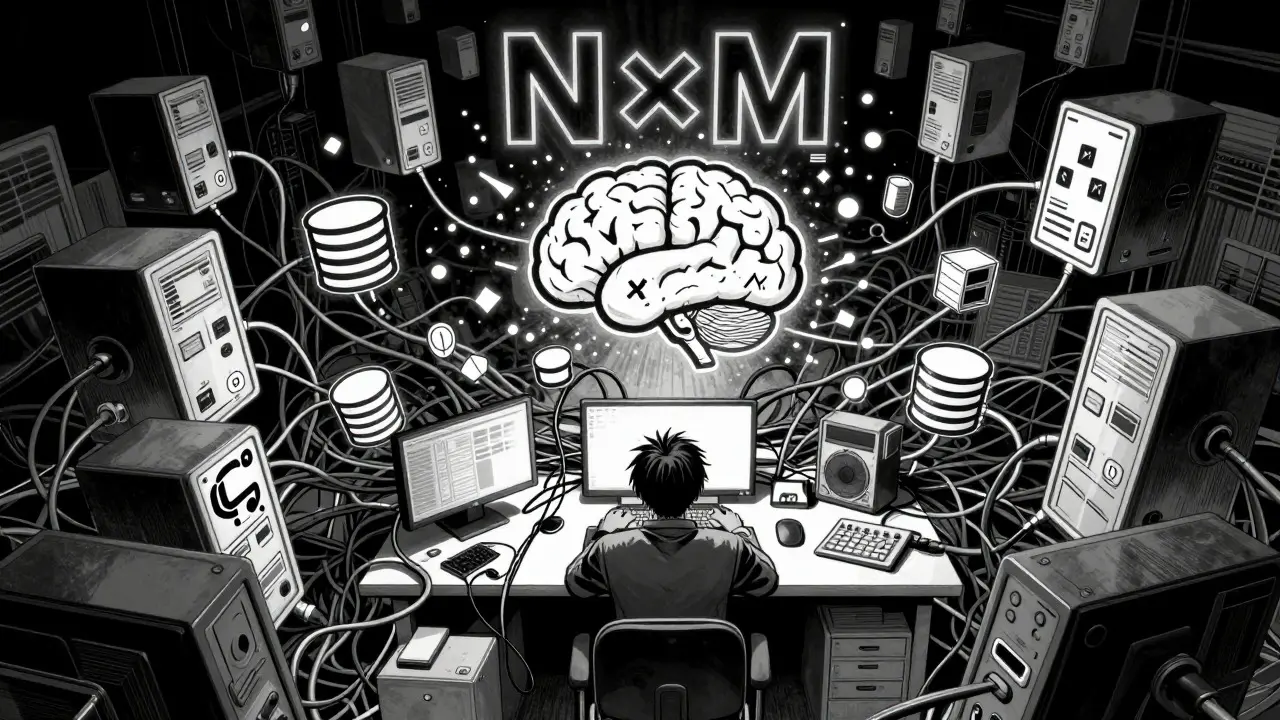
The Core Problem: The N×M Integration Trap
To understand why MCP matters, you have to look at the math behind AI development. Before MCP, if you had five different AI applications (N) and wanted them to access ten different external services like databases, CRMs, or APIs (M), you needed fifty separate integrations. As your ecosystem grew, the number of required connections exploded exponentially. This is known as the N×M integration problem.
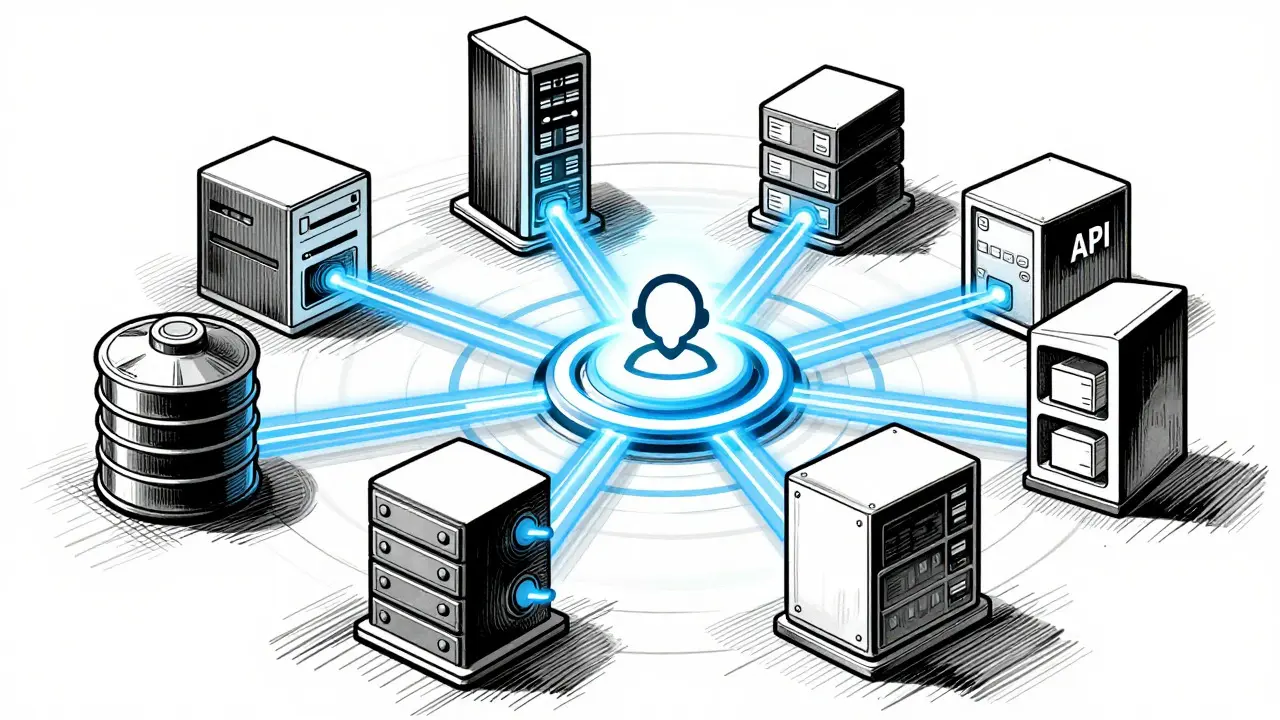
MCP breaks this cycle. By implementing the protocol, each AI client only needs to speak MCP once, and each server only needs to expose its tools via MCP once. The total integrations drop from N×M to N+M. For a large enterprise with dozens of internal tools and multiple AI agents, this isn't just a convenience; it's a survival mechanism for engineering teams drowning in maintenance code.
How MCP Works: Architecture and Components
MCP doesn't reinvent the wheel; it adapts proven patterns. Its architecture is partially inspired by the Language Server Protocol (LSP), which solved similar interoperability issues in developer tooling. The system relies on four core components working together:
- Host Applications: These are the environments where users interact with AI, such as Claude Desktop, AI-enhanced IDEs like Cursor, or web-based chat interfaces.
- MCP Clients: Integrated within the host, these handle the actual connection to servers, managing the communication channel.
- MCP Servers: These expose the capabilities. A server might wrap a SQL database, a file system, or a third-party API, presenting them as usable tools for the LLM.
- MCP Hosts: In more complex setups, hosts manage multiple client connections, acting as intermediaries.
Technically, MCP uses bidirectional, message-driven communication over JSON-RPC 2.0. Unlike traditional REST APIs that often rely on one-way requests, MCP allows servers to initiate requests and stream partial results. This bidirectional flow is crucial for real-time interactions, enabling the AI to receive updates without constantly polling the server.
Four Pillars of MCP Resources
MCP standardizes how AI agents perceive and interact with the outside world through four distinct resource types. Understanding these is key to effective implementation:
- Tools: Functions the LLM can invoke. Think of these as actions-looking up a stock price, sending an email, or querying a database. Tools are the "hands" of the agent.
- Resources: File-like data structures. These provide context, such as API responses, database contents, or document text. They are the "eyes" of the agent.
- Prompts: Pre-written templates that guide LLM interactions. These ensure consistency when the agent performs specific tasks repeatedly.
- Sampling: A capability allowing client-hosted LLMs to be used by remote MCP servers. While less common, it enables distributed reasoning scenarios.
This structure creates a machine-readable capability surface. At runtime, an AI system can query available tools and resources dynamically. It doesn't need hardcoded endpoints; it discovers what’s available and uses it. This reduces serialization complexity and allows for just-in-time data access with full provenance metadata.
MCP vs. Traditional APIs and RAG
You might wonder, "Why not just use REST APIs or Retrieval-Augmented Generation (RAG)?" The answer lies in context management and dynamism.
| Feature | Traditional REST/RPC | RAG Systems | Model Context Protocol (MCP) |
|---|---|---|---|
| Integration Complexity | High (Custom per endpoint) | Medium (Vector DB setup) | Low (Standardized interface) |
| Data Freshness | Real-time | Static/Snapshot | Real-time with provenance |
| Discovery | Hardcoded endpoints | Embedding search | Dynamic runtime discovery |
| Communication | Unidirectional | Read-only typically | Bidirectional streaming |
RAG systems primarily provide static document retrieval. They are great for answering questions based on past data but struggle with live, authoritative lookups. MCP offers live data access with traceability, telling the AI exactly where information came from. Meanwhile, traditional APIs require hardcoded endpoints for each service. MCP servers expose a discoverable surface, allowing agents to identify and use tools without predefined connections. This eliminates the "screen-scraping" approach of headless browsing, replacing it with structured, secure data exchange.
Security and Governance: The Double-Edged Sword
With great power comes great responsibility. MCP’s ability to connect AI to live systems introduces significant security risks if not managed properly. Red Hat’s security analysis in April 2025 warned that improper configuration could make MCP implementations the largest attack surface in enterprise AI deployments.
The primary concern is privilege escalation. If an MCP server has excessive permissions to internal systems, a compromised AI agent could inadvertently execute destructive commands. To mitigate this, MCP 1.1, released in April 2025, introduced enhanced security features including fine-grained permission controls and mandatory audit trails. Developers must carefully scope permissions for each exposed tool, ensuring the principle of least privilege is strictly enforced.
Implementation requires a team composition that includes at least one security specialist during the initial phases. Teams unfamiliar with JSON-RPC patterns often face a steep learning curve, requiring 2-3 weeks of dedicated training. However, those experienced with LSP report faster adoption due to architectural similarities.

Adoption Landscape and Market Trends
Since its launch, MCP has seen rapid adoption across industries. Anthropic reported that 78% of enterprise Claude customers implemented MCP integrations within six months of release. The competitive landscape includes alternatives like LangChain’s tool integration framework, but MCP’s open-standard approach has positioned it as the preferred solution for enterprises seeking vendor-agnostic integration.
Current adoption varies by sector:
- Financial Services: 62% of surveyed banking enterprises use MCP, often for real-time trading systems requiring sub-second latency.
- E-commerce: 71% of retail tech companies leverage MCP for inventory and customer data access.
- Healthcare: 48% of health tech firms adopt MCP, focusing on secure patient data retrieval.
Gartner predicts MCP will become the de facto standard for AI agent tool integration by 2027, with 85% enterprise adoption in AI agent deployments. The protocol is particularly valuable in hybrid cloud environments, where 68% of implementations occur, balancing performance with data sovereignty requirements.
Getting Started with MCP Implementation
If you’re ready to integrate MCP into your stack, start by deciding whether you’re building a client or a server. Anthropic provides reference implementations in Python, JavaScript, and Java on their GitHub repository. For most teams, the first step is wrapping existing internal APIs into MCP servers.
Key steps include:
- Audit Your Tools: Identify which internal services should be exposed to AI agents.
- Define Permissions: Establish strict access controls for each tool before deployment.
- Implement Streaming: Ensure your servers can handle bidirectional JSON-RPC streams for long-running operations.
- Test Discovery: Verify that clients can dynamically discover and list available capabilities.
Early adopters report a 40-60% reduction in integration code compared to custom API implementations. One engineer on Reddit noted saving approximately 200 engineering hours on a single project by eliminating the need to write separate connectors for each LLM. However, be prepared for edge cases in troubleshooting, as documentation for niche scenarios is still evolving.
Future Roadmap: What’s Next for MCP?
The MCP working group, comprising representatives from Anthropic, OpenAI, Google DeepMind, and Microsoft, is actively developing the protocol. Recent milestones include the release of MCP 1.1 in April 2025, which focused on security enhancements.
Looking ahead, the roadmap includes:
- MCP 1.2 (Q3 2025): Native support for multi-modal context handling, allowing agents to process images and audio alongside text.
- MCP 1.3 (Q1 2026): Standardized observability metrics, making it easier to monitor agent performance and detect anomalies.
Anthropic has committed to maintaining the specification through at least 2030, signaling long-term viability. However, analysts caution that competing proprietary approaches from major cloud providers could fragment the ecosystem if not carefully managed. For now, MCP stands as the most robust, open solution for connecting AI agents to the real world.
What is the Model Context Protocol (MCP)?
MCP is an open standard introduced by Anthropic in November 2024 that enables AI applications to connect seamlessly with external data sources and tools through a standardized interface. It solves the N×M integration problem by reducing the number of required connections from exponential to linear.
How does MCP differ from traditional REST APIs?
Unlike REST APIs, which often require hardcoded endpoints and unidirectional requests, MCP uses bidirectional JSON-RPC 2.0 communication. It allows for dynamic discovery of tools and resources at runtime, enabling AI agents to adapt to available capabilities without predefined connections.
Is MCP secure for enterprise use?
MCP can be secure if implemented correctly. Version 1.1 introduced fine-grained permission controls and audit trails. However, organizations must carefully scope permissions for each tool to prevent privilege escalation, and security specialists should be involved in the deployment process.
Which programming languages support MCP?
Anthropic provides official reference implementations for Python, JavaScript, and Java. Because MCP is based on standard JSON-RPC, it can technically be implemented in any language that supports this protocol.
What are the main components of the MCP architecture?
The four core components are Host Applications (where users interact with AI), MCP Clients (which manage connections), MCP Servers (which expose tools and resources), and MCP Hosts (which manage multiple client connections). This structure is inspired by the Language Server Protocol.
How much time does it take to learn MCP?
Teams unfamiliar with JSON-RPC patterns typically require 2-3 weeks of dedicated training. Developers with experience in the Language Server Protocol (LSP) often report faster adoption due to architectural similarities.
What is the future roadmap for MCP?
The MCP working group plans to release version 1.2 in Q3 2025 with multi-modal context support, and version 1.3 in Q1 2026 with standardized observability metrics. Anthropic has committed to maintaining the spec through at least 2030.