Choosing Model Families for Scalable LLM Programs: Practical Guidance
- Mark Chomiczewski
- 8 August 2026
- 0 Comments
Picking the right Large Language Model is a software system trained on vast amounts of text data to understand and generate human-like language (LLM) family isn't just about picking the smartest brain in the room. It's a strategic bet on your infrastructure, your budget, and your ability to scale without breaking the bank. By early 2026, the landscape has shifted from a wild west of dozens of options to a consolidated market dominated by a few key players. You aren't just choosing a tool; you're choosing an ecosystem.
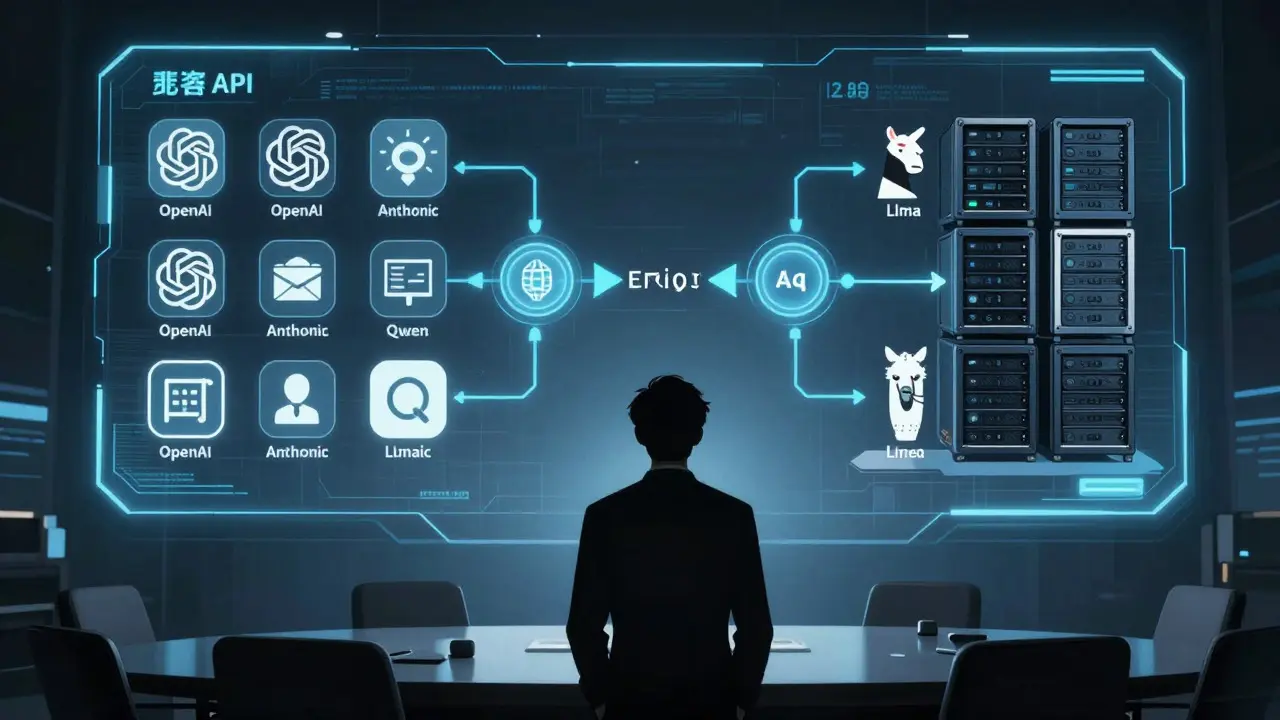
If you are building a scalable program today, you face a clear fork in the road: proprietary APIs that offer ease of use but lock you into vendor pricing, or open-weight models that demand engineering heavy-lifting but offer total control and lower long-term costs. The gap between these two worlds has narrowed significantly. In fact, the performance difference on standard benchmarks like the Epoch AI Capabilities Index (ECI) is now only about 8% to 12%. That small margin changes everything for enterprise decision-makers.
The Proprietary Powerhouses: Speed vs. Cost
For teams that need to move fast and have the budget to support it, proprietary models remain the default choice. They handle the complexity of scaling so you don't have to. But "scalable" can be a dangerous word when your costs are tied directly to token usage.
OpenAI's GPT family, specifically GPT-4o, positions itself as the go-to for deep reasoning and complex planning tasks. It’s powerful, yes, but expensive. If you are processing millions of documents or running high-frequency customer service bots, those per-token costs add up quickly. The advice from industry analysts is clear: use GPT-4o selectively. Save it for the hard problems-legal analysis, complex code refactoring-and use smaller models for the rest.
Anthropic's Claude family offers a different value proposition. With tiered models like Haiku and Sonnet, Anthropic focuses on strong writing capabilities and a robust safety posture. Their documentation is widely praised as clean and comprehensive, which saves engineering time during integration. However, their pricing structure includes multiple rate dimensions that require careful monitoring. If you don't track your input/output ratios closely, scaling Claude can become unpredictable.
Then there is Google's Gemini ecosystem. Gemini shines if you are already deep in the Google Cloud environment. Its Flash and Pro tiers are designed for multimodal tasks-processing text, images, and audio simultaneously. A key feature here is caching. Google explicitly documents how caching works, allowing you to store frequent context windows and reuse them at a fraction of the cost. For scalable programs with repetitive queries, this can slash your bill significantly.
The Open Source Revolution: Control and Customization
The narrative that open-source models are "worse" is dead. In Q4 2025, 78% of enterprise implementations used one of the top five families, and open models like Meta's Llama and Alibaba's Qwen are leading the charge in self-hosted deployments. Why? Because they eliminate vendor lock-in and allow for fine-tuning on private data without sending it to a third-party server.
Meta's Llama 4 is currently the heavyweight champion of the open world. It uses a mixture-of-experts architecture, meaning it activates only the necessary neural pathways for a given task, improving efficiency. The family includes variants like Scout (with a staggering 10 million token context window), Maverick (1 million tokens), and Behemoth (up to 2 trillion parameters). Llama 4 powers most AI features within Meta's own apps, proving its reliability at scale. However, deploying Llama 4 isn't plug-and-play. Expect a 2-3 week deployment timeline involving Kubernetes expertise and specialized GPU provisioning. As one ML engineer noted on Reddit in January 2026, "mid-sized enterprises often lack the ongoing model monitoring skills required to keep Llama 4 running smoothly."
Alibaba's Qwen family has emerged as a serious contender, especially for multilingual and mathematical tasks. Qwen3-Omni processes text, images, audio, and video, rivaling proprietary multimodal models. With parameter sizes ranging from 0.5 billion to 235 billion, you can pick a size that fits your hardware. Qwen supports context windows up to 1 million tokens. Be aware, though: community reports highlight issues with "context overflow errors" if not managed carefully. You need robust error handling in your pipeline.
Google also plays in the open space with Gemma 3. Available in five sizes (from 270 million to 27 billion parameters), Gemma 3 is optimized for safety and efficiency. It features a 128,000 token context window and includes a specific variant, Gemma 3n, designed for mobile architectures. If you are building edge-based AI applications, Gemma is a top choice.

Comparing the Contenders: Key Metrics
To make an informed decision, you need to look beyond marketing claims. Here is how the major families stack up against each other based on current benchmarks and technical specifications.
| Model Family | Max Context Window | Key Strength | Best For | Cost Profile |
|---|---|---|---|---|
| GPT-4o | Standard Enterprise Size | Deep Reasoning & Planning | Complex logic, selective high-value tasks | High (Per-token API) |
| Claude 3 | Tiered Variants | Safety & Writing Quality | Customer-facing content, regulated industries | Medium-High (Complex pricing) |
| Gemini 2.5 Pro | 1 Million Tokens | Multimodal & Caching | Google Cloud users, image/text/audio mix | Medium (Lower with caching) |
| Llama 4 | Up to 10 Million (Scout) | Open Weight & Ecosystem | Self-hosted, privacy-critical, custom fine-tuning | Low (Infrastructure dependent) |
| Qwen3 | 1 Million Tokens | Multilingual & Math | Global applications, STEM tasks | Low (Open weight) |
Infrastructure and Implementation Reality
Choosing a model is easy. Running it at scale is hard. Your choice dictates your tech stack.
If you choose proprietary models like GPT or Claude, your implementation time is short-typically 3 to 5 business days. You integrate via API, and you're live. The trade-off is dependency. You are at the mercy of their uptime, rate limits, and price hikes. There is no escape hatch if they change their terms.
If you choose open models like Llama 4 or Qwen, you are hiring a team of DevOps engineers. You need GPUs. You need orchestration tools like Kubernetes. You need monitoring dashboards to watch for latency spikes and hallucination rates. Pinggy's analysis highlights that privacy, control, and cost-effectiveness are the main drivers for on-premises deployment, but the learning curve is steep. Don't underestimate the operational overhead. A single misconfigured GPU cluster can burn through more cash than an API bill ever could.
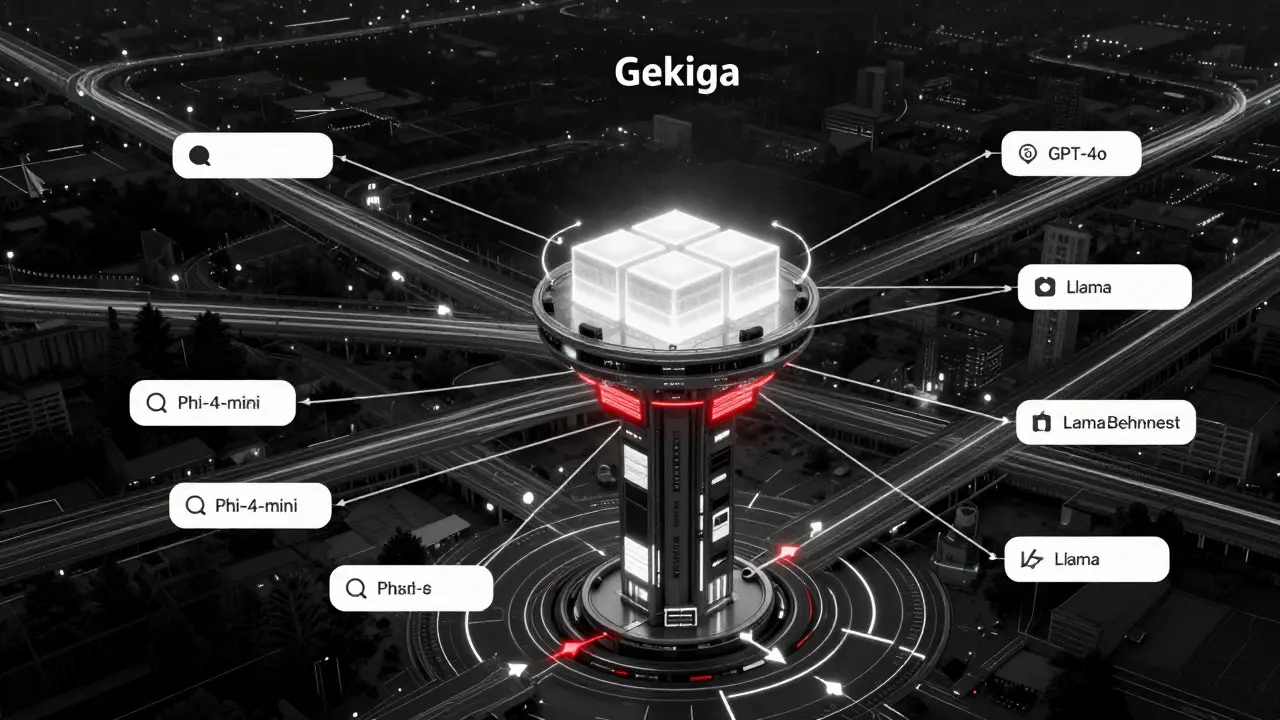
Consider hybrid approaches. Many successful programs use a "router" pattern. Simple queries go to a cheap, fast model like Microsoft's Phi-4-mini-flash or Mistral's Magistral Small. Complex reasoning tasks get routed to GPT-4o or Llama 4 Behemoth. This balances cost and performance dynamically.
Future-Proofing Your Choice
The market is consolidating. Gartner predicts that niche, single-purpose models will face significant pressure in the next 18 months. Stick to families with strong ecosystem support. Llama 4 has a massive community building derivative models. Gemini is deeply integrated into Google Cloud. These ecosystems provide stability.
Also, watch the convergence. By Q4 2026, analysts predict the top three open models will match proprietary performance on 80% of enterprise tasks. If you start with open models now, you position yourself to capture that value as soon as it arrives. If you lock into a proprietary API, you may find yourself paying premium prices for performance that open alternatives soon match for free.
Which LLM family is best for coding tasks?
For coding, specialized models perform better than general ones. In 2026, DeepSeek's reasoning models and Microsoft's Phi-4-mini-flash show exceptional results in code analysis and generation. If you prefer open source, Llama 4 variants fine-tuned for code are highly effective. Always benchmark using the Coding Performance Index (CPI) rather than general benchmarks.
Is it cheaper to host Llama 4 myself or use an API?
It depends on volume. For low to medium usage, APIs are cheaper because you avoid hardware costs. For high-volume, scalable programs, self-hosting Llama 4 becomes significantly cheaper over time. However, you must factor in the salary of the engineers needed to maintain the infrastructure. Calculate your break-even point based on your expected token throughput.
What does "context window" mean for scalability?
The context window is the amount of text the model can process at once. Larger windows (like Llama 4 Scout's 10 million tokens) allow you to feed entire books or large codebases into the model without splitting them up. This reduces latency and improves coherence in long-form tasks, making it easier to scale document-heavy applications.
How do I mitigate vendor lock-in with proprietary models?
Use abstraction layers in your code. Build your application to interface with a generic LLM provider interface rather than hardcoding calls to OpenAI or Anthropic. This allows you to swap out the underlying model family (e.g., switching from GPT-4o to Llama 4) with minimal code changes if pricing or availability shifts.
Are open-source models safe for enterprise data?
Yes, often safer than proprietary ones. When you self-host an open model like Llama 4 or Qwen, your data never leaves your servers. Proprietary models require sending data to the vendor's cloud, which introduces privacy risks despite their security certifications. Self-hosting gives you full control over data governance and compliance.