Task Decontamination for LLM Benchmarks: Avoiding Leakage from Training Data

- Mark Chomiczewski
- 21 May 2026
- 0 Comments
Imagine spending months training a massive language model, only to have your team celebrate record-breaking scores on standard benchmarks. Then, a closer look reveals the truth: the model didn't actually learn the reasoning skills you thought it had. It simply memorized the test questions because they were hidden in its training data. This isn't a hypothetical scenario; it is the reality of task decontamination, a critical process in modern AI development that ensures the removal of overlapping data between training sets and evaluation benchmarks to prevent inflated performance metrics. As of 2026, this issue has moved from an academic footnote to a central pillar of responsible AI engineering.
The problem of data contamination emerged as large language models (LLMs) grew in size and their training corpora expanded to include nearly all publicly available text. By 2021, researchers began noticing suspiciously high scores on benchmarks like MMLU and HumanEval. The core issue is simple but devastating: if a model sees the exact question during pre-training, it doesn't need to generalize or reason. It just needs to recall. This creates an illusion of capability that collapses when the model faces novel problems in the real world. For developers and researchers, understanding how to detect and remove this leakage is no longer optional-it is essential for scientific integrity.
Why Benchmark Contamination Matters More Than Ever
You might wonder why we can't just trust the numbers. After all, higher scores usually mean better performance, right? Not when those scores are built on a foundation of leaked data. According to research by Maxim AI in 2024, contamination can artificially inflate benchmark scores by 15-20% for large models. That is a huge margin. It means a model labeled "state-of-the-art" might actually be performing significantly worse than its smaller, cleaner competitor.
This distortion affects every stage of the AI lifecycle. Investors rely on these benchmarks to decide where to put their money. Developers use them to choose which base model to fine-tune. If the baseline is corrupted, the entire decision-making chain breaks down. Dr. Sarah Chen, lead author of the pivotal ConTAM study, noted that current detection methods often miss 38-42% of contaminated examples. This false sense of security leads teams to deploy models that lack genuine generalization abilities, resulting in failures in production environments where data is never identical to training sets.
The stakes are particularly high for enterprise applications. In 2025, the EU AI Act introduced amendments requiring demonstrable decontamination procedures for high-risk AI systems. This regulatory shift means that ignoring data leakage is not just bad science; it is a compliance risk. Companies must now prove that their models' capabilities are earned through learning, not cheating via data overlap.
Understanding the Mechanics of Data Leakage
To fix the problem, you first need to understand how the leakage happens. Large language models are trained on massive datasets scraped from the internet. These datasets often include GitHub repositories, educational websites, forums, and published papers. Many popular benchmarks, such as GSM8K for math or HumanEval for coding, have been online for years. Over time, snippets of these tests inevitably end up in the training corpus.
When a model encounters a benchmark question at evaluation time, it may recognize parts of the prompt. Even if it hasn't seen the exact question, seeing similar phrasing or context can trigger memorized responses. This is known as n-gram overlap. An n-gram is a contiguous sequence of n items (like words or tokens). If a significant portion of a benchmark question matches sequences in the training data, the model is likely relying on recall rather than inference.
The severity of this issue scales with model size. Larger models have more parameters to store information, making them better at memorizing specific instances. Studies show that Llama 1 65B showed a 17.2% Estimated Performance Gain (EPG) on MMLU due to contamination, while the smaller Pythia 12B showed only 4.3%. This disparity highlights a dangerous trend: the most powerful models appear the most capable partly because they are the best at exploiting leaked data.
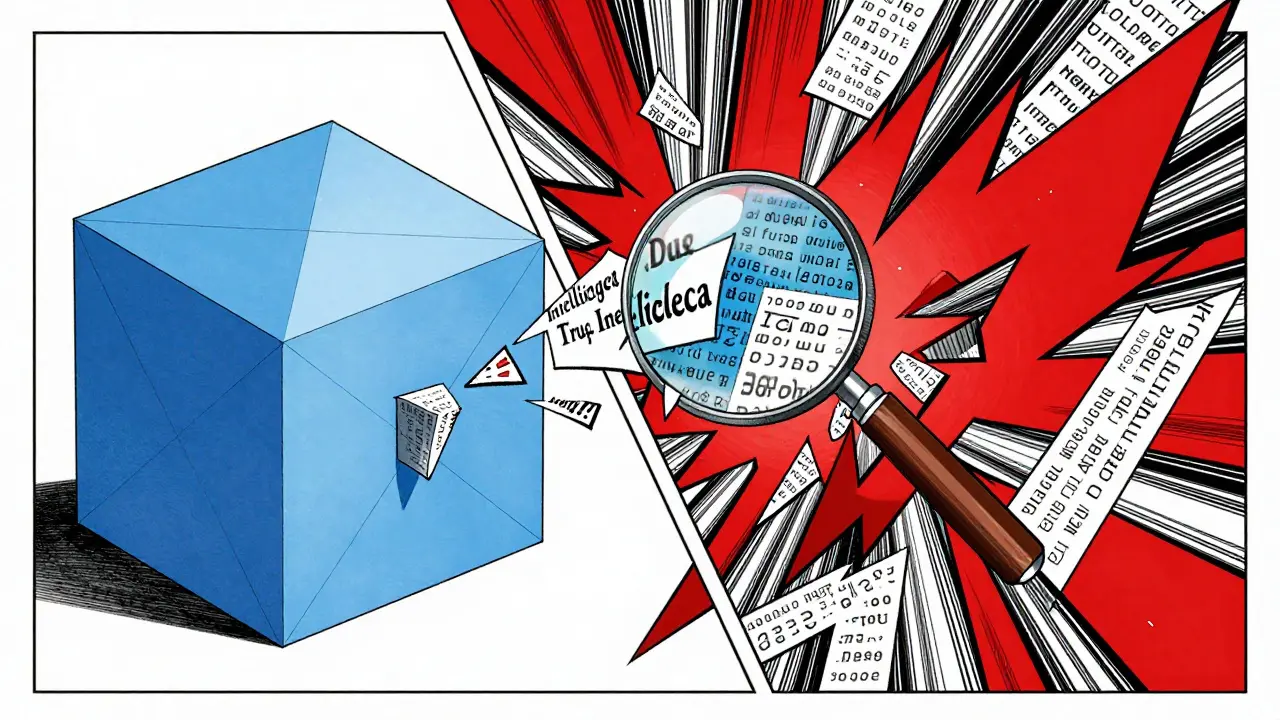
Core Detection Metrics and the ConTAM Framework
Detecting contamination requires precise measurement. You cannot simply search for exact string matches because paraphrasing and minor variations can hide the overlap. This is where the ConTAM (Contamination Threshold Analysis Method) framework comes in. Introduced by Maxim AI researchers in March 2024, ConTAM provides a systematic way to evaluate different contamination metrics.
There are four primary metrics used in this analysis:
- TOKEN-MATCH: Identifies individual tokens in evaluation samples that exactly match tokens in the pre-training corpus. It counts raw overlaps but ignores context.
- NGRAM-MATCH: Focuses on continuous sequences of n tokens. It calculates the fraction of n-grams in the evaluation sample that appear in the training data. This is more robust than token matching because it considers local structure.
- TOKEN-EXTEND: Allows for small deviations. It uses a configurable 'skip budget' to account for mismatches, making it useful for detecting paraphrased content where a few words have been changed.
- LONGEST-MATCH: Currently considered the most effective metric. It looks only at the longest contiguous contaminated span. This prevents inflated scores caused by many tiny, insignificant matches that don't represent true memorization.
The key output of these metrics is the Estimated Performance Gain (EPG). EPG quantifies the impact of contamination by measuring the difference in model performance on the full benchmark versus the clean, uncontaminated subset. A high EPG indicates that the model's score is heavily reliant on leaked data. ConTAM plots visualize how EPG changes as you adjust the contamination threshold, helping you determine which samples to remove.
| Metric | Focus | Sensitivity to Paraphrasing | Best Use Case |
|---|---|---|---|
| TOKEN-MATCH | Individual tokens | Low | Quick initial screening |
| NGRAM-MATCH | Continuous sequences | Medium | Standard baseline detection |
| TOKEN-EXTEND | Sequences with skips | High | Paraphrased or edited content |
| LONGEST-MATCH | Longest contiguous span | Very High | Accurate EPG calculation |
Implementing Decontamination in Your Pipeline
Knowing the theory is one thing; applying it is another. Most teams use the lm-evaluation-harness, an open-source library maintained by EleutherAI since 2020. It provides built-in functionality for decontamination through methods like should_decontaminate and doc_to_decontamination_query. When enabled, it produces clean benchmark versions with a 'decontaminate' suffix in the results, clearly separating verified performance from potentially inflated scores.
Setting up this pipeline requires access to the original training corpus. You need to compare every benchmark example against the vast sea of training data. This is computationally expensive. According to EleutherAI's documentation updated in January 2025, initial setup takes about 80-120 hours, and processing a full benchmark can take 37-62 hours depending on hardware. You will need Python 3.8+, PyTorch 1.12+, and at least 32GB of RAM for medium-sized tasks.
Here is a simplified workflow for implementing decontamination:
- Gather Training Corpus: Ensure you have a searchable index of all data used in pre-training. If you are using a third-party model without access to its raw training data, you will need to rely on alternative methods like embedding similarity.
- Select Metric: Start with LONGEST-MATCH for the most accurate assessment. Configure your n-gram length based on the benchmark type (e.g., larger n for code, smaller for natural language).
- Run Detection: Use the lm-evaluation-harness to scan benchmark samples against the training corpus. Identify matches that exceed your chosen threshold.
- Calculate EPG: Evaluate the model on both the full set and the cleaned set. Compare the scores to determine the Estimated Performance Gain.
- Refine Thresholds: Adjust your contamination threshold if the EPG seems too high or too low. Remember, optimal thresholds vary by model size. Larger models may require stricter filters.
A common pitfall is using default settings without calibration. Surveys show that 63% of users stick to defaults despite evidence that optimal thresholds depend on specific model architectures. Taking the time to tune these parameters is crucial for accurate results.

Advanced Approaches: LLM-Based Verification
Traditional n-gram matching has limitations. It struggles with semantic equivalence-cases where the meaning is the same but the words are different. This is the "paraphrasing problem," which affects nearly 40% of contaminated samples according to ConTAM tests. To address this, newer approaches use other LLMs to verify contamination.
The LLM Decontaminator, proposed in 2023, uses a two-stage approach. First, it retrieves top-k similar samples from the training data using embedding similarity search. This catches semantic matches that n-gram tools miss. Second, it employs a powerful model like GPT-4 to verify whether the retrieved sample truly represents contamination. This method achieved 92.3% accuracy compared to 67.8% for conventional methods.
This approach reduces the dependency on having the exact raw training corpus, which is often proprietary. Instead, you can use embeddings of public data sources that are likely included in the model's training. While more resource-intensive due to API costs or compute requirements for the verifier model, it offers superior precision in detecting subtle leaks.
In June 2025, Meta AI released ContamScan, an open-source tool that implements all four ConTAM metrics with automated threshold selection. This lowers the barrier to entry for teams that lack the expertise to manually tune detection parameters. Similarly, Google Research introduced ProactiveBench in late 2024, which generates synthetic evaluation data designed to be less prone to contamination from the start.
The Future of Clean Evaluation
The field is moving toward proactive solutions rather than reactive cleaning. Dynamic benchmarks like LiveCodeBench update continuously, ensuring that new questions haven't had time to leak into training data. However, this introduces inconsistency, as performance variance can increase by 8-12% across evaluations. Static decontaminated benchmarks remain the standard, used by 82% of evaluation frameworks in 2025, but they require periodic manual updates.
By early 2026, the ML Reproducibility Consortium released the Unified Decontamination Framework (UDF), combining n-gram matching, LLM verification, and dynamic updating into a single pipeline. This represents the state-of-the-art in maintaining evaluation integrity. Looking ahead, Hugging Face plans to integrate decontamination metrics directly into model cards by Q3 2026, making transparency a default feature rather than an afterthought.
As Dr. Alan Ng of DeepMind stated, decontamination is becoming as fundamental to LLM evaluation as statistical significance testing is to clinical trials. Ignoring it risks building an industry on shaky foundations. For any serious AI project, investing in robust decontamination protocols is not just a technical requirement; it is a commitment to truth in technology.
What is task decontamination in LLM benchmarks?
Task decontamination is the process of identifying and removing examples from evaluation benchmarks that also appear in the model's training data. This prevents the model from leveraging memorized answers, ensuring that performance scores reflect genuine reasoning and generalization abilities rather than simple recall.
How much can data contamination inflate benchmark scores?
Research indicates that contamination can inflate scores by 15-20% for large models. For example, studies on Llama 1 showed significant Estimated Performance Gains (EPG) on benchmarks like MMLU when contaminated data was present, leading to overestimated capabilities.
Which contamination detection metric is most effective?
The LONGEST-MATCH metric is currently considered the most effective. Unlike TOKEN-MATCH or NGRAM-MATCH, it focuses on the longest contiguous span of overlapping text, avoiding inflated scores from numerous small, insignificant matches. It provides a more accurate measure of true memorization.
Do I need access to the full training corpus to decontaminate?
Ideally, yes. Traditional methods like those in lm-evaluation-harness require comparing benchmark samples against the original training data. However, newer LLM-based methods like the LLM Decontaminator use embedding similarity and verifier models to detect contamination without needing the full raw corpus, though they may have higher computational or API costs.
What is the Estimated Performance Gain (EPG)?
EPG is a metric that quantifies the impact of contamination. It is calculated as the difference between a model's performance on the entire benchmark (including contaminated samples) and its performance on the clean, decontaminated subset. A high EPG suggests the model is relying heavily on leaked data.
Are there tools available for automatic decontamination?
Yes. Tools like the lm-evaluation-harness offer built-in decontamination features. Additionally, Meta AI released ContamScan in 2025, which automates threshold selection and implements multiple detection metrics. The Unified Decontamination Framework (UDF) released in 2026 combines various methods for comprehensive coverage.