Design Reviews for Vibe-Coded Features: ADRs and Architecture Boards

- Mark Chomiczewski
- 27 March 2026
- 6 Comments
The Speed Trap of Modern Development
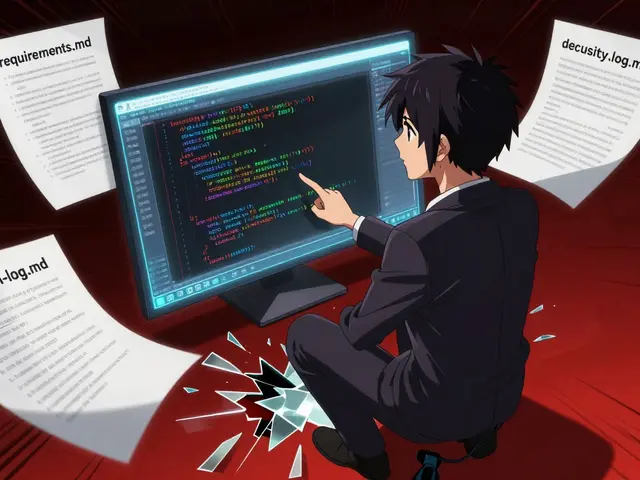
Imagine a scenario where your engineering team ships features three times faster than last quarter. Product velocity is through the roof. Stakeholders are thrilled. Then, six months in, the system starts buckling under its own weight. You find tangled logic, undocumented security gaps, and a codebase that feels less like a foundation and more like a house of cards. This isn't a hypothetical nightmare anymore; it is the common outcome of vibe coding AI-assisted software development using natural language prompts instead of manual code writing. When we rely on generative models to build our systems, we trade precision for speed, often forgetting to ask "how does this fit?"
In 2026, we cannot treat AI-generated components like magic boxes. They require the same rigor as hand-written logic, but with stricter guardrails. That means we need to bring formal governance back to the table. We are talking about design reviews specifically tailored for prompted code, rigorous use of Architecture Decision Records (ADRs), which document why a technical decision was made, including alternatives considered,, and active oversight from architecture boards. Without these, maintainability dies.
Why Vibe Coding Breaks Traditional Review Loops
Vibe coding works by translating intent into implementation. You describe a feature in plain English, and the AI writes the code. While this is incredible for prototyping, it creates a specific kind of rot known as architectural drift. The primary issue is scope blindness. An AI model optimizes for the immediate request-the branch you are typing on-but it cannot see the forest. It doesn't understand your global state management strategy or your data consistency model unless explicitly told.
When developers skip formal design reviews in favor of rapid prompting, they create strong coupling where loose coupling should exist. For example, a vibe-coded feature might hardcode dependencies that were supposed to be abstract interfaces. In isolation, the feature works perfectly. It passes unit tests. But when integrated, it forces a rigid dependency graph that makes future refactoring painful. Standard pull requests often catch syntax errors, but they miss systemic dysfunction. If the review process focuses only on "does it compile," you miss the structural damage accumulating underneath.
Traditional peer reviews assume humans wrote the code line-by-line, reasoning through every edge case. With AI generation, the cognitive load shifts. The developer becomes the architect of the prompt, not the coder of the function. If the review process doesn't change to match this new dynamic, you end up with working code that hides systemic issues. This leads to significant amounts of unused code fragments and module divisions that violate standard best practices.
Redefining Architecture Decision Records for AI Workflows
An Architecture Decision Record is typically a document saved in a repository folder. It records the context, decision, and consequences of a major architectural move. In a vibe-coding environment, the timing and content of these records need adjustment. You cannot wait until the code is written to document the decision. By then, the AI has already made choices embedded in the logic that are hard to reverse.
We need "Prompt-First" ADRs. Before you even open the IDE or the chat interface, you document the architectural boundaries. The ADR should specify:
- The Problem Space: What business capability are we enabling?
- Constraints: Which legacy systems must this interact with?
- Promising Patterns: Which existing libraries or frameworks should the AI use?
- Anti-Patterns: Explicitly forbid certain approaches (e.g., "No direct database queries from the frontend").
This shifts the control plane from the code back to the architecture. Instead of debugging generated code weeks later, you are guiding the generation process. If the resulting code violates the ADR, the fix is to update the prompt or the input parameters, not to refactor the entire file. This keeps the "source of truth" aligned between your documentation and your system behavior. When tests are written after the fact - often by the AI itself - they tend to expose previously hidden flaws requiring multiple cycles of regeneration. Front-loading decisions prevents this reactive patchwork.
| Aspect | Traditional Workflow | Vibe-Coding Workflow |
|---|---|---|
| Timing | After implementation starts | Before prompt generation begins |
| Focus | Implementation details | Boundary definitions and constraints |
| Verification | Code review of files | Review of prompt outputs against spec |
| Risk | Human error in logic | Systemic drift from AI defaults |

The New Role of the Architecture Board
The Architecture Board a governance body responsible for reviewing and approving architectural standards and changes usually meets quarterly or per release cycle. That cadence is too slow for AI-driven development. If you are shipping daily via vibe coding, waiting for a monthly board meeting to approve a module is a bottleneck. However, skipping the board entirely is negligence.
The solution is a tiered review process. Low-risk modules, like internal admin dashboards or throwaway prototypes, can bypass full board review. High-risk domains-authentication, payment processing, or data migration-require immediate board sign-off on the design phase, not the code. The board needs to shift from reviewing Java classes to reviewing "system sketches." Even a rough system sketch is better than letting AI invent your architecture.
Your board should enforce a policy of externalizing anything that might change. If a vibe-coded feature assumes a constant API contract, the board asks: "Will this change next year?" If yes, the design is flawed. MVPs are the starting point, not the end state. Design with extension in mind. Security and data handling matter above all else. When security is at stake, bring engineering in early. Do not let the AI guess how to encrypt sensitive data; provide strict guidelines.
Maintaining Long-Term Health
Sustainability is the biggest challenge with accelerated development. Reactive development tends to accumulate Technical Debt the implied cost of additional rework caused by choosing an easy or limited solution now instead of a better approach that would take longer. With vibe coding, debt accumulates exponentially because the AI doesn't know what "clean" looks like for your specific organization. It defaults to general patterns that might not fit your stack.
To combat this, establish a "Refactor Sprint" cycle. Dedicate specific sprints solely to cleaning up vibe-coded artifacts. Purposeful modularization must be planned. Establishing reusability requires human intervention to identify patterns across generated files. Removing obsolete code is rarely automatic; the AI generates fresh solutions rather than deleting old ones. Your teams need to actively prune the garden.
Furthermore, integrate architectural compliance into your CI/CD pipeline. If a file fails to adhere to the directory structure defined in an ADR, the build should fail. Automated checks cannot replace human judgment, but they prevent obvious drift. Assume features will evolve. By designing for evolution upfront, you ensure that your rapid delivery doesn't result in rapid decay.

Executing the Process
Implementing this requires cultural shifts alongside technical ones. Engineers might feel constrained by heavy documentation, so keep ADRs lightweight but mandatory for key paths. Train your teams on prompt engineering that includes architectural constraints. A prompt that says "make this secure" is useless; a prompt that says "implement OAuth2 using our custom library X" is actionable.
Finally, measure success by maintainability metrics, not just feature velocity. Track bug rates, integration friction, and time-to-refactor. If your vibe-coded features are becoming harder to change than the legacy code, the balance has tipped. Adjust the intensity of your design reviews accordingly. The goal is speed without instability.
Frequently Asked Questions
Can I use vibe coding for everything?
No. While powerful, it is best suited for well-defined, isolated modules. Core infrastructure and security-critical logic require traditional engineering oversight and explicit architectural planning.
How detailed should an ADR be for AI features?
Focus on boundaries and constraints. You don't need implementation details. Specify allowed libraries, forbidden patterns, and integration points to guide the AI generation safely.
Does the Architecture Board review every prompt?
Absolutely not. Focus reviews on high-risk areas. Low-risk UI components or internal tools can follow streamlined approval paths to maintain velocity.
What happens if generated code violates an ADR?
Regenerate immediately. Treat the code as a failed artifact. Update the prompt instructions to align with the ADR rather than manually fixing the non-compliant code.
Is manual testing still necessary?
Yes. AI-written tests often lack system-level coverage. Human QA ensures the overall workflow behaves correctly across different modules and environments.

Comments
Ian Cassidy
scope blindness is definitely the real killer here when you just let the LLM run wild without guardrails.
March 27, 2026 AT 09:00
Zach Beggs
It makes sense that we need stricter boundaries before we even write prompts.
Teams often skip the documentation phase because they think speed is priority one.
We should probably enforce those Architecture Decision Records earlier in the sprint planning.
This way everyone knows what libraries are allowed beforehand instead of fixing things later.
March 29, 2026 AT 05:16
Ben De Keersmaecker
The distinction between traditional review and AI review is crucial.
Most teams don't realize how fast technical debt accumulates during rapid prototyping.
We need to change our definition of what a code review actually entails.
If the human isn't writing logic lines, the review shifts to intent validation.
It is fascinating how the architecture board role must evolve to match daily release cycles.
Waiting quarterly for approvals creates too much friction in modern agile environments.
A tiered approach seems like the only viable path forward for scaling teams.
Low risk modules deserve less oversight to keep velocity high.
Core infrastructure needs heavier scrutiny because failures there cascade everywhere.
Security protocols cannot be left to the discretion of a generative model.
Encryption standards should be hardcoded into the prompt constraints themselves.
Refactoring sprints are essential to maintain code health over the long term.
Automated checks in CI pipelines help catch structural drift early on.
But nothing replaces human judgment when evaluating system integrity.
Ultimately maintaining balance between speed and stability is the new KPI.
March 29, 2026 AT 20:29
Kenny Stockman
I really appreciate that breakdown regarding the security protocols and encryption standards.
It feels like something we often overlook until it becomes a crisis down the road.
Keeping the human element involved in judging system integrity is such a good reminder.
We sometimes get too comfortable with automation tools handling everything for us.
March 30, 2026 AT 03:21
Paritosh Bhagat
While the points are valid, the terminology used in section two was slightly imprecise regarding architectural drift.
You must define scope clearly so the model does not hallucinate constraints.
Otherwise the resulting artifact will violate compliance standards which nobody wants to explain to legal.
March 31, 2026 AT 09:31
Aaron Elliott
The notion of compliance suggests a fundamental distrust in the autonomous agent capabilities.
However, perhaps governance is merely the shadow cast by unchecked creativity upon the wall of reality.
We must remain vigilant lest we become mere administrators of systems we no longer comprehend.
April 1, 2026 AT 19:18