How Generative AI Is Reshaping Automotive Design, Diagnostics, and In-Car Experiences

- Mark Chomiczewski
- 18 June 2026
- 0 Comments
Imagine walking into a dealership where the salesperson doesn't just show you specs, but generates a custom interior layout based on your lifestyle preferences. Or picture a mechanic who diagnoses a complex engine fault in minutes by asking an AI assistant that has read every service manual ever written for that model. This isn't science fiction anymore. It is happening right now.
The automotive industry is undergoing its biggest transformation since the assembly line. We are moving from rule-based systems to Generative AI, which is a class of artificial intelligence capable of creating new content, designs, code, and solutions rather than just analyzing existing data. From the first sketch of a new concept car to the final diagnostic check ten years later, these models are rewriting how vehicles are built, fixed, and experienced.
Redefining Vehicle Design: From Sketches to Digital Twins
Traditionally, designing a car component was slow. Engineers would create a few physical prototypes, test them, fail, and start over. This cycle could take months. Today, generative AI changes the game by exploring thousands of possibilities instantly.
Companies like IBM and L&T Technology Services (LTTS) are using text-conditioned diffusion models to turn simple prompts into detailed 3D designs. For example, an engineer might type: "Create a bumper design that meets Euro NCAP safety standards while reducing weight by 15%." The AI generates dozens of viable options, complete with geometric constraints compatible with CAD software.
This process integrates seamlessly with legacy Product Lifecycle Management (PLM) systems. Each generated design is automatically checked against crash performance metrics, aerodynamic coefficients, and manufacturability rules. What used to require a team of engineers working for weeks can now be evaluated in days. NVIDIA takes this further by treating the factory itself as a compute platform, optimizing robot programming and logistics layouts using agentic AI.
- Faster Iteration: Move from fewer than 10 physical prototypes to hundreds of virtual simulations.
- Cost Optimization: Automatically balance material costs with performance targets.
- Validation Speed: Run batch simulations on cloud HPC clusters to verify safety and efficiency.
Smarter Diagnostics: Beyond Fault Codes
For decades, vehicle diagnostics relied on reading error codes from the CAN bus. If the code wasn't clear, mechanics guessed or swapped parts until the issue disappeared. Generative AI adds a layer of reasoning that mimics-and often exceeds-senior technician expertise.
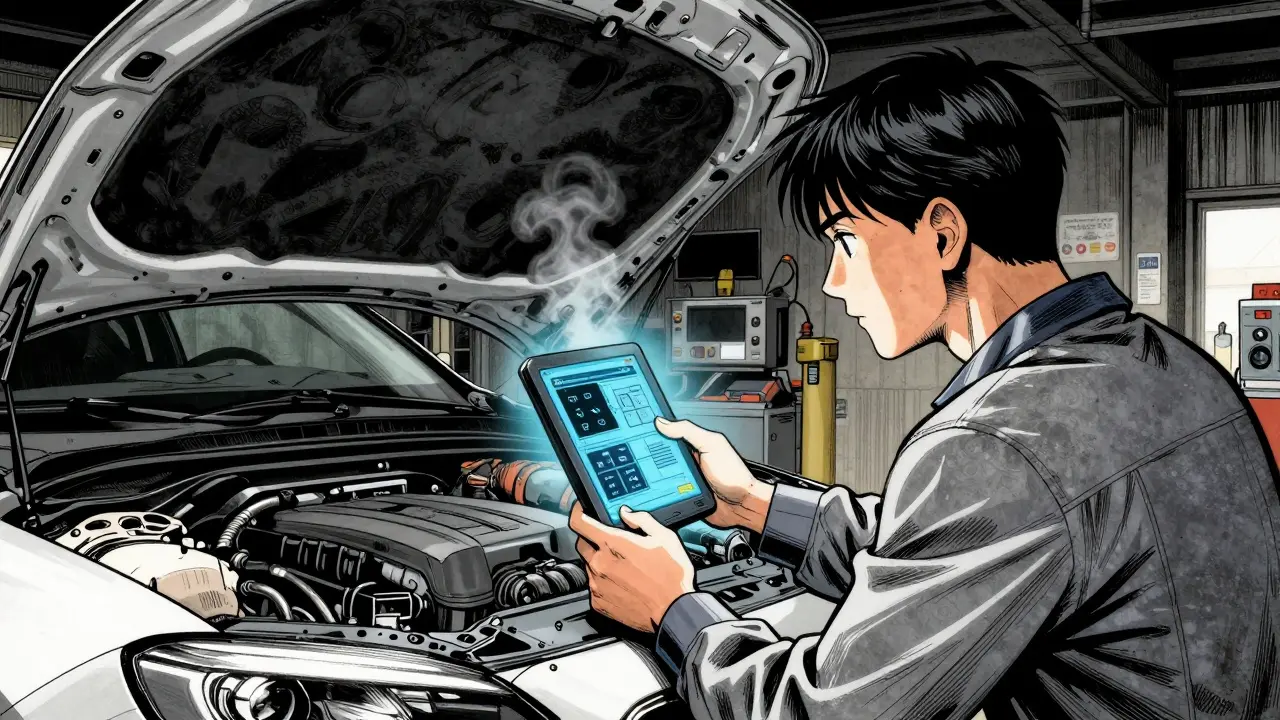
Consider a scenario described by NVIDIA in 2024. A computer vision system detects smoke under the hood. Instead of just alerting the driver, it triggers a diagnostic AI agent. This agent uses Retrieval-Augmented Generation (RAG) to search through tens of thousands of pages of technical documentation, past service records, and warranty data. It then provides a step-by-step repair guide tailored to that specific vehicle's history.
IBM’s watsonx platform supports similar copilots for engineers and service staff. They can ask natural language questions like, "Why is this battery module overheating in cold climates?" and get grounded answers instead of generic keyword matches. However, caution is key. As noted in arXiv surveys, generative models can hallucinate. Therefore, these recommendations are treated as suggestions, requiring human verification before any critical action is taken.
| Feature | Traditional Method | Generative AI Approach |
|---|---|---|
| Data Source | Error codes, basic sensors | Vision, audio, telemetry, manuals, history |
| Output | Generic fault code description | Contextualized repair steps & explanations |
| Speed | Hours to days for complex issues | Minutes for initial diagnosis |
| Human Role | Primary investigator | Validator & executor |
Connected Experiences: The Car as a Companion
The most visible change for consumers is inside the cabin. Early voice assistants were rigid. You had to use exact phrases like "Navigate home." Now, thanks to large language models (LLMs), conversations feel natural.
Cerence launched CaLLM, a generative AI assistant integrated with NVIDIA’s automotive platforms. It understands context. If you say, "I'm tired," it might dim the lights, suggest a rest stop, and play calming music. It connects to cloud services for real-time traffic and local events, while running core functions on embedded System-on-Chips (SoCs) for low latency.
AWS highlights how these assistants extend beyond the car. They link mobile apps, dealer portals, and backend services. Imagine your car reminding you to book a tire rotation because it detected wear patterns via sensors, then generating a personalized message to your preferred dealer. This creates a hyper-personalized ecosystem spanning millions of vehicles.
However, safety remains paramount. Drivers interact with these systems while operating heavy machinery. Guardrails are essential to ensure responses are concise, accurate, and non-distracting. Continuous monitoring prevents the AI from drifting into irrelevant or unsafe topics.
Accelerating Software Development
Modern vehicles contain tens of millions of lines of code. Managing this complexity is a nightmare for engineering teams. Generative AI acts as a powerful copilot for developers.
KPIT explains how LLMs can generate C or AUTOSAR-compliant code snippets from natural language requirements. Need a function to handle a specific diagnostic trouble code? Describe it, and the AI writes the draft. It also creates unit tests and scenario-based test cases, increasing coverage without proportional increases in manual effort.
This integration fits into the traditional V-model development process. While AI speeds up coding and testing, rigorous validation against standards like ISO 26262 is still mandatory. Human engineers review the output, ensuring safety-critical modules meet formal evidence requirements. This hybrid approach reduces task-level effort significantly, saving hours per feature across long platform cycles.

Implementation Challenges and Realities
Despite the hype, adopting generative AI in automotive is not plug-and-play. Several hurdles remain.
Data Quality and Governance: Training effective models requires clean, labeled data. Automotive data spans terabytes of telemetry, CAD files, and documents. IBM emphasizes the need for governed data foundations to prevent bias and ensure security. Sensitive information like driver behavior must be protected.
Computational Cost: Running large foundation models demands significant GPU power. Most OEMs rely on cloud providers like AWS or NVIDIA for training, while deploying smaller, optimized versions on edge devices. This hybrid architecture balances cost and performance.
Skill Gaps: Engineering teams need new skills. Prompt engineering, data management, and ML workflow understanding are becoming as important as mechanical knowledge. Companies are building blended teams where AI specialists support domain experts.
Regulatory Compliance: Safety regulations have evolved over 50 years. Integrating AI into safety-critical systems requires proving reliability. Hallucinations in diagnostics or design flaws in generated components can lead to severe liability. Verification processes must adapt to account for probabilistic AI outputs.
The Road Ahead
We are only at the beginning. By 2030, generative AI will likely be embedded in every stage of the vehicle lifecycle. Expect more multimodal models that combine text, image, and sensor data for unified decision-making. Agentic architectures, where multiple specialized AI agents collaborate under strict guardrails, will become standard.
For automakers, the race is no longer just about hardware. It is about software, data, and AI capabilities. Those who integrate these tools effectively will deliver faster innovation, better customer experiences, and more efficient operations. The question is no longer if you should adopt generative AI, but how quickly you can do it safely.
What is generative AI in the automotive industry?
Generative AI in automotive refers to AI systems, particularly large language models and diffusion networks, that create new designs, code, simulations, and diagnostic recommendations. Unlike traditional AI that analyzes data, generative AI produces original content to accelerate development and enhance user experiences.
How does generative AI improve vehicle design?
It allows engineers to explore hundreds of design variants rapidly using text prompts and constraints. These designs are automatically validated against safety, aerodynamics, and manufacturing rules, reducing the time from concept to prototype from months to days.
Can generative AI replace mechanics?
No, it augments them. Generative AI assists technicians by providing contextualized diagnostic insights and repair steps based on vast technical databases. However, human verification is required to ensure accuracy and safety, especially for complex or rare faults.
What are the risks of using generative AI in cars?
Key risks include hallucinations (incorrect information), data privacy concerns, and computational costs. In safety-critical applications, there is a risk of unreliable recommendations if models are not properly constrained and verified against regulatory standards like ISO 26262.
Which companies are leading in automotive generative AI?
Major players include NVIDIA (compute and software platforms), IBM (watsonx for enterprise governance), AWS (cloud infrastructure and models), and Cerence (in-car voice assistants). Service firms like KPIT and LTTS help integrate these technologies into OEM workflows.
How does generative AI affect in-car experiences?
It enables natural, context-aware conversations with voice assistants. These assistants can plan trips, control vehicle functions, and provide personalized entertainment, connecting seamlessly with cloud services and mobile apps for a unified user experience.