Localization Prompts for Generative AI: Adapting Content Across Regions and Languages

- Mark Chomiczewski
- 8 May 2026
- 0 Comments
You spend hours crafting the perfect marketing message in English. It’s witty, sharp, and converts like crazy. Then you throw it into a standard translation tool, and suddenly your brand sounds robotic, culturally tone-deaf, or worse-offensive-in Spanish, Japanese, or German. The problem isn’t just the language; it’s the lack of context. This is where localization prompts come in. These aren't just simple "translate this" commands. They are sophisticated instructions that teach Large Language Models (LLMs) to think like a local expert, adapting nuance, culture, and terminology for specific regions.
Since ChatGPT burst onto the scene in late 2022, teams have been racing to automate localization. But early attempts failed because they treated AI like a dumb dictionary. By 2024, the industry shifted. Workshops like Custom.MT’s April 2024 event showed that when professionals design structured prompts, error rates drop by up to 47%. Today, we’re past the hype phase. We’re in the precision phase. If you want your global content to resonate, not just translate, you need to master the art of the localization prompt.
The Core Problem: Why Standard Translation Fails Globally
Standard Neural Machine Translation (NMT) engines are great at grammar but terrible at intent. They give you a literal translation, which often misses the point entirely. Imagine telling a joke about baseball in the US. A standard translator might keep the reference intact for an audience in India, where cricket is king. That’s a failure of localization, not translation.
Generative AI changes the game because it can reason, not just swap words. However, without specific guidance, it hallucinates or defaults to generic American English norms. Lionbridge’s 2024 analysis highlights a critical gap: while GPT-4 Turbo scores high on creative transcreation (87/100), it lags behind specialized NMT in technical accuracy (72/100). This tells us one thing: the model needs direction. You must tell it who it is, where it is speaking, and why it matters.
| Metric | Standard NMT | Prompted GPT-4/Claude |
|---|---|---|
| Technical Accuracy | High (85/100) | Medium (72/100) |
| Cultural Nuance | Low | High (with proper prompting) |
| Transcreation Score | 79/100 | 87/100 |
| Terminology Consistency | Variable | Improved by 63% with RAG |
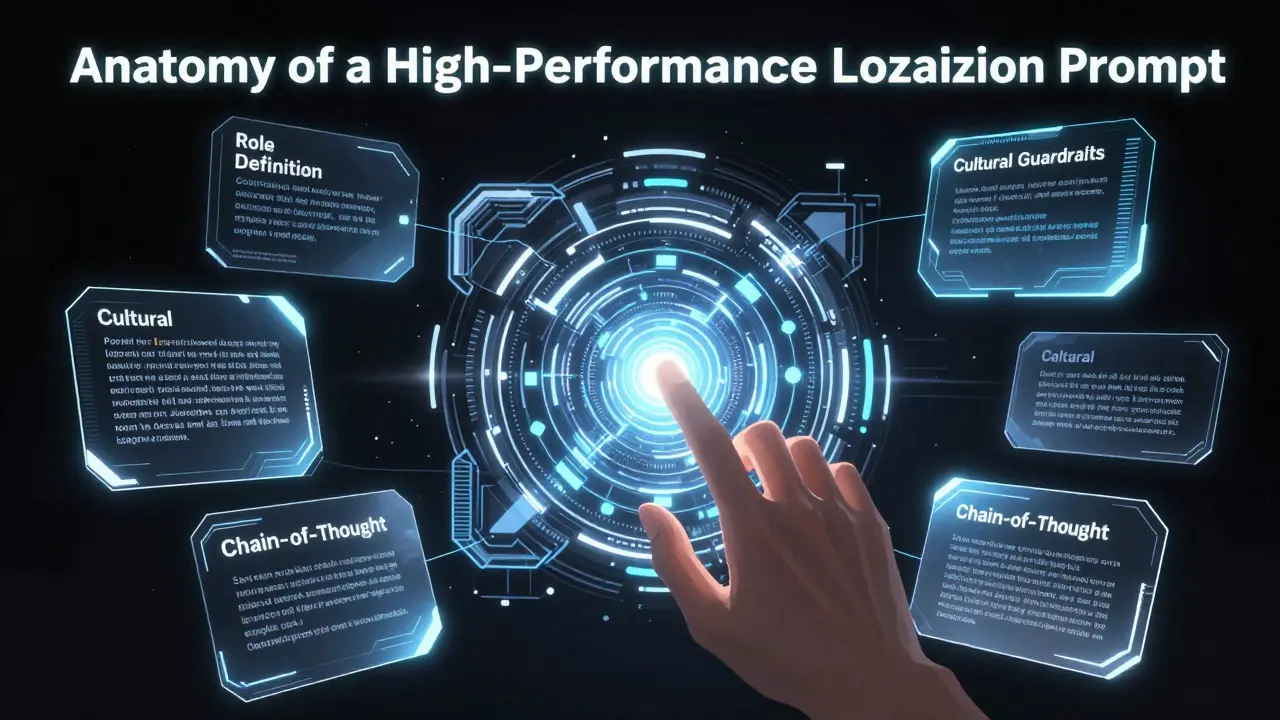
Anatomy of a High-Performance Localization Prompt
A bad prompt says: "Translate this email to French." A good localization prompt builds a persona and a constraint set. Based on data from Custom.MT’s 2024 workshop involving nearly 200 professionals, effective prompts share six structural elements.
- Role Definition: Assign a specific identity. Instead of "translator," use "Senior Medical Device Translator specializing in EU regulations." This primes the model’s internal weights toward formal, compliant language.
- Target Audience Context: Define who is reading. "For patients in Quebec, using informal 'tu' forms" differs vastly from "For corporate executives in Paris, using formal 'vous'."
- Cultural Guardrails: Explicitly forbid idioms or slang that don’t cross borders. Microsoft’s guidelines stress keeping prompts culturally neutral unless a specific regional adaptation is requested.
- Chain-of-Thought Instructions: Ask the model to explain its reasoning before translating. For example: "First, identify any cultural references. Second, suggest a localized equivalent. Third, provide the final translation." This reduces hallucinations by 78%.
- Terminology Constraints: Integrate glossaries. Use Retrieval-Augmented Generation (RAG) to feed the model your approved term base so it doesn’t invent synonyms for your product features.
- Output Format: Specify the structure. Do you need JSON? HTML tags preserved? Plain text? Ambiguity here leads to broken code in web apps.
When you combine these, you stop getting a machine translation and start getting a localized asset ready for human review.
Choosing the Right Model for the Job
Not all models are created equal for localization. Your choice depends on budget, complexity, and privacy needs. As of mid-2026, three players dominate the landscape for prompt-driven localization.
GPT-4 Turbo remains the workhorse for general marketing and transcreation. OpenAI’s pricing (around $0.01 per 1,000 input tokens) makes it cost-effective for high-volume campaigns. It excels at creative rewriting but struggles with strict technical compliance unless heavily constrained.
Claude 3, developed by Anthropic, shines in long-context tasks. With a 200K token window, it can ingest entire style guides and previous project history, ensuring consistency across massive documentation sets. It’s slightly more expensive ($15 per million tokens) but often requires less post-editing for coherent document flow.
Mistral 7B is the open-source champion. For companies worried about data sovereignty or those operating in regions with strict AI export restrictions, Mistral offers a self-hosted option. It costs roughly 40% less than commercial APIs and performs surprisingly well for resource-constrained environments, though it lacks some of the nuanced cultural awareness of its larger counterparts without fine-tuning.
Implementing RAG for Terminology Consistency
The biggest complaint from localization managers is inconsistency. One day the button says "Save," the next it says "Store." In legal or medical contexts, this is unacceptable. The solution is Retrieval-Augmented Generation (RAG).
RAG works by fetching relevant data from your external knowledge base (glossaries, style guides, past translations) and injecting it into the prompt context. When you ask the AI to translate "battery life," the system first checks your glossary. If "battery life" maps to "autonomie de la batterie" in French, the prompt forces the model to use that exact phrase.
Custom.MT’s data shows that integrating RAG boosts terminology consistency by 47%. To implement this:
- Export your term base into a searchable vector database.
- Create a pre-processing step that queries this database for key terms in the source text.
- Inject these terms into the prompt as mandatory constraints: "Use these exact translations for the following terms..."
This hybrid approach combines the speed of AI with the precision of human-curated assets.
The Human-in-the-Loop Workflow
Let’s be clear: AI does not replace localization experts. It amplifies them. Dr. John Tinsley of Iconic Transmission warned that unvalidated prompts can cause hundreds of thousands in rework costs due to scaled errors. The goal is not full automation; it’s efficient augmentation.
The most successful enterprise workflows follow a tiered model:
- AI First Draft: The LLM generates the initial localization using structured prompts.
- Automated QA: Tools like AutoLQA check for length constraints, tag integrity, and basic terminology mismatches.
- Human Review: Editors focus only on flagged segments or high-stakes content (legal, medical, sensitive marketing). Seatongue’s case studies show this reduces review time by 52% while maintaining 98.7% quality scores.
By handling 65-80% of the volume with AI, humans shift from translators to cultural validators. They ensure the tone hits right, the humor lands, and the brand voice remains consistent. This is where the real value lies.

Common Pitfalls and How to Avoid Them
Even with great prompts, things go wrong. Here are the top issues reported by professionals in 2024-2026:
- Honorifics in Asian Languages: 63% of Japanese and Korean translators report AI struggling with keigo (polite speech levels). Fix this by explicitly defining the relationship between speaker and listener in the prompt role.
- Regional Dialect Confusion: Spanish is not monolithic. Mexican Spanish differs from Iberian Spanish in vocabulary and formality. Always specify the locale code (e.g., es-MX vs es-ES) in your prompt.
- Right-to-Left (RTL) Formatting: Arabic and Hebrew require special attention to punctuation and layout. Ensure your output format preserves RTL markers, or the UI will break.
- Over-Literalism: AI sometimes translates metaphors literally. Use chain-of-thought prompting to force the model to identify and adapt cultural metaphors rather than preserving them word-for-word.
Future Trends: Multimodal and Agent-Based Localization
We are moving beyond text-only prompts. The next frontier is multimodal localization, where prompts handle both text and image adjustments simultaneously. Preliminary tests show a 59% improvement in visual-textual consistency when AI suggests image swaps alongside text translations-for instance, replacing a US-specific holiday icon with a locally relevant one.
Additionally, agent-based workflows are emerging. Instead of one prompt doing everything, multiple AI agents collaborate. One agent extracts terms, another drafts the translation, and a third reviews for cultural sensitivity. This mimics a human team’s workflow and is projected to handle 60% of localization projects by 2026.
The market is growing fast. Goldman Sachs estimates generative AI could add $7 trillion to global GDP by 2033, with localization tech capturing a significant slice. Companies that master prompt engineering now will have a massive competitive advantage in reaching global audiences faster and cheaper.
What is the difference between translation and localization prompts?
Translation prompts focus on converting words from one language to another accurately. Localization prompts include cultural context, regional dialect specifications, tone adjustments, and terminology constraints to ensure the content feels native to the target audience.
Which AI model is best for localization in 2026?
It depends on your needs. GPT-4 Turbo is best for creative marketing and transcreation. Claude 3 excels at long-document consistency and complex context. Mistral 7B is ideal for cost-sensitive or private, self-hosted deployments.
How do I prevent AI from making cultural errors?
Use chain-of-thought prompting to make the AI explain its cultural adaptations. Define specific regional targets (e.g., es-MX) and avoid idiomatic expressions in your source material unless explicitly asked to localize them. Always use a human-in-the-loop review for high-stakes content.
Can I use AI for legal or medical translations?
Not without heavy human oversight. Error rates in specialized domains can exceed 15% with AI alone. Use AI for drafting and terminology extraction, but require certified human translators to validate every segment for compliance and accuracy.
What is RAG in the context of localization?
Retrieval-Augmented Generation (RAG) connects the AI to your existing glossaries and style guides. It ensures the model uses your approved terminology consistently, boosting accuracy and reducing post-editing time significantly.