Prompt Chaining vs Single-Shot: Designing Multi-Step LLM Workflows
- Mark Chomiczewski
- 17 August 2026
- 7 Comments
Imagine you ask an AI to "write a marketing email based on this customer data." You get back a generic, slightly off-target draft. Now imagine breaking that request into three steps: extract key insights, draft the body, then refine the tone. The second approach usually wins. That’s the core tension between prompt chaining and single-shot prompting. While single-shot prompts are faster and cheaper for simple tasks, they often struggle with complex, multi-faceted requests where context gets lost or instructions conflict.
Prompt chaining solves this by decomposing a large task into sequential, specialized subtasks. Each step has a clear input and output, allowing you to validate results before moving forward. It’s not just about doing more; it’s about doing things in a structured way that mimics how humans actually plan work. If you’re building enterprise-grade applications or handling nuanced content generation, understanding when and how to chain your prompts is no longer optional-it’s essential for reliability.
The Core Difference: Monolithic vs. Modular
Single-shot prompting tries to do everything in one go. You feed the model all your instructions, context, and examples at once. This works well for straightforward queries like "Translate this sentence to French" or "Summarize this paragraph." However, as soon as the task involves multiple distinct operations-like extracting data, analyzing trends, and then generating a report-the model starts to juggle too many balls. Instructions can bleed into each other, leading to hallucinations or missed constraints.
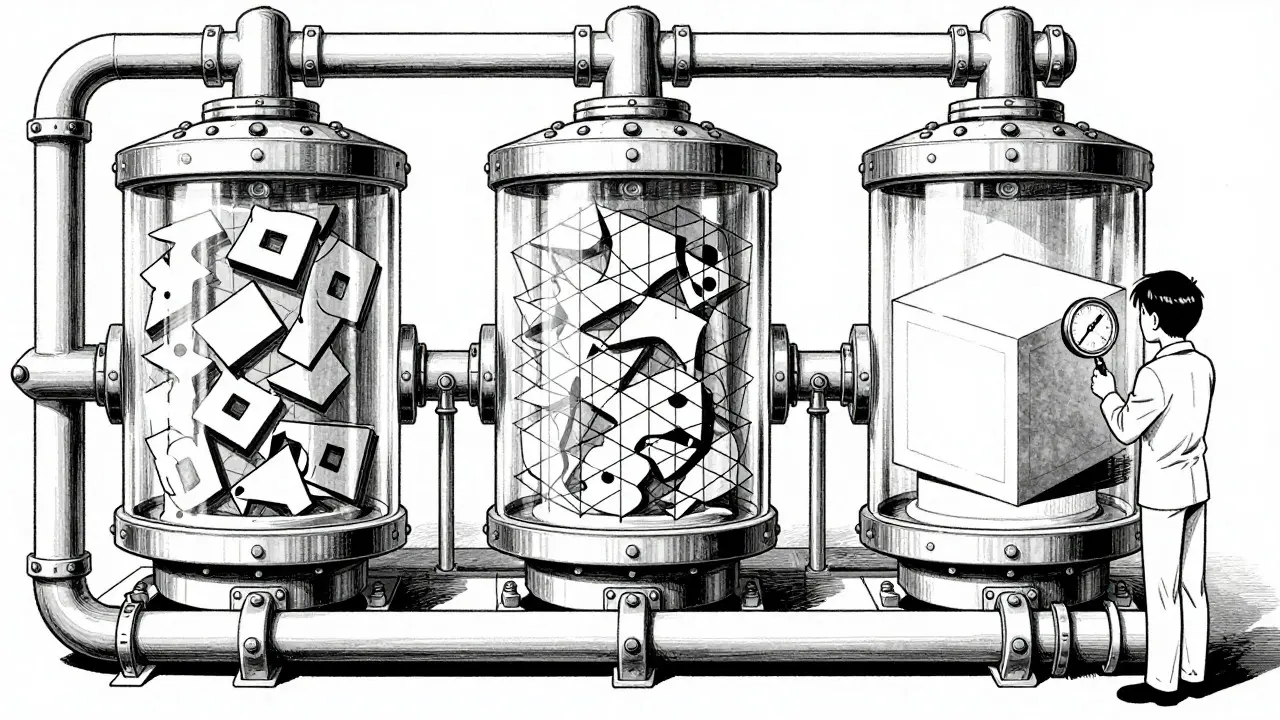
Prompt Chaining is a technique that breaks complex AI tasks into sequential steps, where the output of one prompt serves as the input to the next. Instead of one giant instruction set, you create a pipeline. Step 1 might focus solely on extraction. Step 2 takes that extracted data and performs analysis. Step 3 formats the final output. This modularity means if Step 2 goes wrong, you only need to fix that specific prompt, rather than unraveling a tangled mess of conflicting instructions in a single block.
This distinction is crucial because it changes how you debug and maintain your AI systems. In a single-shot workflow, a small error in the middle of the reasoning process can cascade through the entire response. In a chained workflow, you have checkpoints. You can inspect the intermediate outputs, ensuring that the logic holds up at every stage before proceeding.
Why Accuracy Matters More Than Speed
You might wonder why we’d accept higher costs and latency for chaining. The answer lies in accuracy metrics from recent industry benchmarks. Controlled experiments documented by Maxim.ai in early 2024 showed that prompt chaining increased accuracy by 37% on complex tasks compared to single-shot approaches. For high-stakes applications like financial reporting or legal document drafting, that margin isn’t just nice to have; it’s the difference between a usable tool and a liability.
Consider a real-world scenario from a Fortune 500 company implementing customer service automation. Their initial single-prompt version took two days to build but misrouted 24% of support tickets. After switching to a four-step prompt chain, development time increased to four weeks, but misrouting dropped to 8.7%. The upfront complexity paid off in operational stability. This trade-off-time and tokens for precision-is the fundamental calculus of prompt design.
Furthermore, error propagation is significantly reduced. When you validate each step, you catch errors early. Maxim.ai’s systematic experiments measured a 42% reduction in error propagation compared to single-prompt approaches. This means fewer downstream failures and less manual intervention required after the AI generates its response.
Chaining vs. Chain-of-Thought: Don’t Confuse Them
A common point of confusion is mixing up prompt chaining with Chain-of-Thought (CoT) prompting. They sound similar, but they operate differently. CoT encourages the model to think step-by-step *within* a single prompt. You ask it to show its work, and it does so in one continuous stream of consciousness. Prompt chaining, on the other hand, uses *multiple* distinct prompts. The model doesn’t know it’s part of a larger sequence; each prompt is treated as an independent task with specific inputs and outputs.
This distinction matters for flexibility. With CoT, if the model makes a mistake in step three of its internal reasoning, you often have to re-run the entire prompt or tweak the initial instructions globally. With prompt chaining, you can adjust the third prompt independently without affecting the first two. YourGPT’s comparative analysis noted that prompt chaining achieves 92% error correction efficiency at individual stages, whereas CoT sits at 68% when errors occur in the reasoning process. That’s a significant advantage for iterative development and debugging.
Another related technique is ReAct prompting, which interleaves reasoning with external actions, like API calls. While powerful, ReAct adds another layer of complexity. Prompt chaining remains more predictable because it relies on standard text-in/text-out interactions, making it easier to integrate with existing data pipelines and validation tools.
The Cost-Benefit Analysis: Tokens and Latency
Let’s talk numbers, because nobody wants to burn cash on unnecessary API calls. Prompt chaining typically increases token consumption by 25-35% compared to single-shot approaches. Why? Because you’re sending context multiple times, and each step generates its own overhead. Additionally, end-to-end latency increases by approximately 150-200ms per additional chain step. For real-time applications requiring responses under 500ms, this can be a dealbreaker.
However, for batch processing or asynchronous workflows, these costs are often negligible. A developer on Reddit’s r/MachineLearning forum reported that implementing a three-step prompt chain for financial report analysis reduced their error rate from 19% to 6.2%, despite increasing processing costs by 28%. For them, the accuracy gain was worth the extra spend. The key is to assess whether your use case prioritizes speed or precision. If you’re building a chatbot that needs instant replies, stick to single-shot. If you’re generating detailed reports or code reviews, chain your prompts.
| Feature | Single-Shot Prompting | Prompt Chaining |
|---|---|---|
| Complexity Handling | Struggles with multi-step tasks | Excels with sequential transformations |
| Token Cost | Lower (baseline) | Higher (25-35% increase) |
| Latency | Faster (single call) | Slower (+150-200ms per step) |
| Error Debugging | Difficult (monolithic) | Easier (modular checkpoints) |
| Best For | Simple queries, real-time apps | Complex workflows, high-accuracy needs |
When to Use Which Approach
So, how do you decide? Start by evaluating the nature of your task. If it involves multiple distinct operations-extraction, transformation, analysis-chaining is likely the better fit. Ask yourself: Does the task require sequential ordering? Can I define clear schemas for the input and output of each step? If yes, proceed with chaining.
On the other hand, if the task is simple, linear, or requires immediate feedback, single-shot prompting is sufficient. Over-engineering a chain for a basic translation task creates unnecessary complexity and cost without proportional gains. Dr. Elena Rodriguez from IEEE Spectrum cautioned that diminishing returns set in beyond five to seven chain steps for most business applications. Keep your chains lean and focused.
A practical heuristic: If you find yourself writing more than three sentences of instructions in a single prompt, consider splitting it. If you notice the model ignoring later instructions because they conflict with earlier ones, break it apart. These are signs that your task has outgrown the single-shot paradigm.

Implementation Best Practices
Building effective prompt chains requires more than just splitting text. You need robust schema definitions between stages. Define exactly what format the output of Step 1 should be in so that Step 2 can parse it reliably. JSON schemas are particularly useful here, as they enforce structure and reduce ambiguity. Many practitioners report that defining these schemas is the hardest part, taking up to 63% of their setup time.
Use validation prompts. Between major steps, insert a lightweight check to ensure the previous output meets the required criteria. If it fails, trigger a fallback mechanism or retry the step. This adds resilience to your workflow. Tools like PromptFlow, an open-source framework with over 1,200 GitHub stars, provide visual chain design and schema validation, which can accelerate this process significantly.
Finally, document your chains. As adoption grows, undocumented enterprise implementations become a maintenance nightmare. Treat your prompt chains like code: version control them, test them, and keep clear records of what each step does. This will save you hours of debugging down the line.
Frequently Asked Questions
Is prompt chaining always better than single-shot prompting?
No. For simple, low-complexity tasks, single-shot prompting is faster, cheaper, and equally accurate. Chaining becomes advantageous when tasks involve multiple distinct operations, require high accuracy, or need modular debugging. Use chaining for complex workflows and single-shot for quick, straightforward queries.
How does prompt chaining differ from Chain-of-Thought prompting?
Chain-of-Thought happens within a single prompt, where the model reasons step-by-step internally. Prompt chaining uses multiple separate prompts, where the output of one feeds into the next. Chaining offers better modularity and easier debugging because you can adjust individual steps without affecting the whole process.
What is the typical cost increase when using prompt chaining?
Token consumption typically increases by 25-35% compared to single-shot approaches. Latency also increases by approximately 150-200ms per additional step. Whether this cost is acceptable depends on your application's tolerance for delay versus its need for accuracy.
How many steps should a prompt chain have?
Most effective chains range from 3 to 7 steps. Beyond this, diminishing returns set in, and complexity management becomes difficult. Aim for the minimum number of steps necessary to achieve the desired accuracy and structure.
Do I need special tools to implement prompt chaining?
Not necessarily. You can implement chaining with any LLM API by manually passing outputs between calls. However, orchestration tools like PromptFlow or Maxim's Playground++ can simplify schema validation, testing, and monitoring, especially for production environments.

Comments
tiffany King
Love the breakdown here! It really highlights how breaking things down makes them so much more manageable. I've been struggling with my own workflows getting too messy, and this feels like a breath of fresh air.
August 18, 2026 AT 04:25
Brenna Gonedrman
Oh wow, look at you all using your big brain words.
It is actually super simple. You just do it in pieces instead of one big lump. Why did we need a whole article for that?
I mean, obviously everyone knows this, right? It's not rocket science. Just don't let the AI get confused by doing too many things at once. That's it. Next question.
Wait, no next question because there are none. We are done here. Great post, very educational for the babies.
August 19, 2026 AT 05:45
Courtney Wagstaff
Hey hey, cool stuff. I see a lot of people overcomplicating this, but honestly, it’s just about keeping the vibes clean between steps. Like, if your first step is a chaotic soup of instructions, your second step is going to taste like regret.
I’ve found that giving each little prompt its own specific flavor-like, maybe one is strict and structured, the next is loose and creative-really helps the model stay in character without getting lost in the sauce. It’s less about rigid engineering and more about guiding the flow.
Also, nobody talks enough about how satisfying it is when the JSON schemas actually line up on the first try. Pure magic.
Anyway, nice read. Gonna go try splitting my next translation task into three tiny bites. Wish me luck!
August 19, 2026 AT 19:54
Elisabeth Ballet
YES! Finally someone saying what we all know deep down! Stop trying to cram everything into one giant box and start building pipelines!
If you are still doing single-shot prompts for complex tasks, you are literally fighting against the machine. Get out there and chain those prompts! You will feel the power!
Let's build something amazing together! Don't be afraid of the extra tokens, they are fuel for success!
Go forth and optimize!
August 20, 2026 AT 12:32
Joanna Mucha
One must consider the ontological implications of such fragmentation.
Is the output truly 'real' if it is merely a concatenation of disparate hallucinations? The soul of the generation is lost in the seams.
We are merely stitching together scraps of digital fabric, pretending it is a coherent garment. How exhausting it is to watch others celebrate such mechanical precision while ignoring the profound emptiness beneath.
But then again, who am I to judge the masses? They want their tickets routed correctly; I just want to understand why the universe allows us to think in chains at all.
Ah, the burden of clarity.
Anyway, nice post. Very... structured.
I suppose structure is a form of comfort for those who fear the void.
Do enjoy your checkpoints.
They are safer than the abyss.
Probably.
Might be wrong.
Who knows?
Time is a flat circle, or a linear chain, depending on your mood.
Goodnight.
Or good morning.
Does it matter?
No.
It does not.
End thought.
Maybe.
Perhaps.
Whatever.
Bye.
August 21, 2026 AT 18:58
Kim Edwards
DID YOU SEE THAT STAT?! 37% MORE ACCURACY?!
THAT IS INSANE!
I MEAN, WHO KNEW THAT SPLITTING UP THE PROMPT WOULD MAKE SUCH A HUGE DIFFERENCE?
I WAS JUST SITTING THERE THINKING IT WAS ALL IN MY HEAD!
BUT NO!
IT'S SCIENCE!
OR SOMETHING CLOSE TO IT!
I AM SO EXCITED ABOUT THIS!
CAN WE TALK ABOUT CHAIN OF THOUGHT VS CHAINING SOME MORE?
BECAUSE I FEEL LIKE THEY ARE TWINS WHO HATE EACH OTHER!
ANYWAY, GREAT POST!
VERY DRAMATIC!
JUST LIKE ME!
LOVE IT!
August 23, 2026 AT 05:35
Bonnie Watt
Actually, this whole thing is overblown. Single-shot is fine if you write good prompts. Chaining is just a crutch for bad prompt engineers who can't get the context window right the first time.
You're adding latency and cost for zero real gain if you know what you're doing. Most people just complain because they don't understand token limits.
Don't buy into the hype. It's just a fancy way of saying 'do it in two parts.'
Save your money. Use one prompt. Be efficient.
That's the only logical take here. Everyone else is just following the crowd because they saw a chart somewhere.
Waste of space, honestly.
But sure, keep chaining if you like the feeling of clicking 'next' multiple times.
Very therapeutic, I'm sure.
Just don't expect miracles.
It's still an LLM.
It's still guessing.
Chaining doesn't change that fundamental flaw.
It just spreads the guesswork around.
Smart.
So smart.
Anyway.
Moving on.
Next topic.
Please.
Let's talk about something interesting.
Like why coffee tastes bad in offices.
That's a real issue.
This isn't.
But whatever.
Have a nice day.
Or night.
Who cares.
It's all the same.
Just pixels.
And now you've wasted five minutes reading my rant.
Sorry.
Not sorry.
Okay, bye.
August 24, 2026 AT 23:27