Prompt-Tuning vs Prefix-Tuning: Lightweight LLM Control Guide
- Mark Chomiczewski
- 23 November 2026
- 0 Comments
You have a massive language model sitting on your server. It’s smart, it’s capable, but it doesn’t know your specific business jargon or handle your niche tasks perfectly. You want to adapt it without spending thousands of dollars on GPUs or waiting days for training to finish. This is where Prompt-Tuning and Prefix-Tuning come into play. These are not just buzzwords; they are practical, lightweight techniques that let you steer Large Language Models (LLMs) with minimal computational cost.
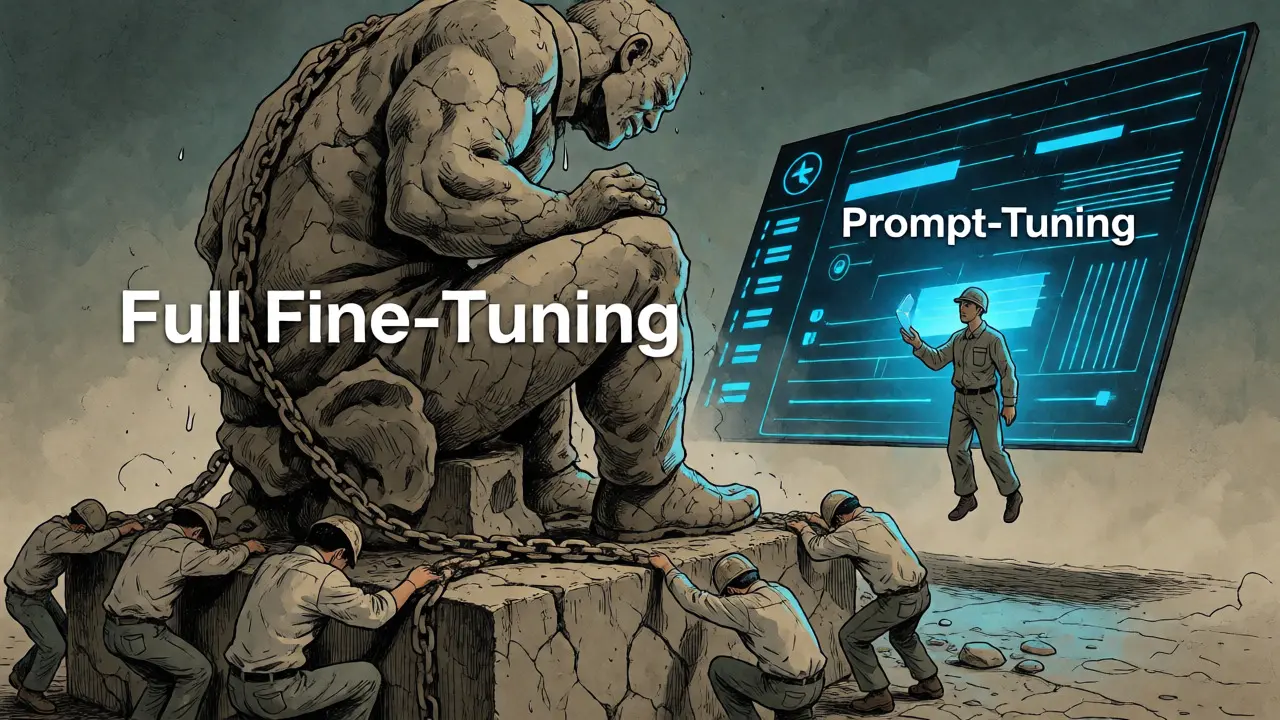
If you’ve ever tried full fine-tuning, you know the pain. Updating billions of parameters requires serious hardware. But what if you could get 90% of the performance benefit by changing less than 1% of the model? That’s the promise of Parameter-Efficient Fine-Tuning (PEFT). Today, we’ll break down the two most popular entry-level methods: Prompt-Tuning and Prefix-Tuning. We’ll look at how they work, when to use which, and the real-world trade-offs involved so you can stop guessing and start building.
The Core Problem: Why Full Fine-Tuning Is Overkill
Let’s be honest about the state of AI in late 2026. Models like LLaMA-3 or Mistral are powerful, but they are also heavy. Full fine-tuning modifies every single weight in the neural network. For a 7-billion parameter model, that means updating seven billion numbers. If you’re running this on a single consumer GPU, you’re likely out of memory before you even start. Even on enterprise-grade A100s, it takes time and energy.
Enter Parameter-Efficient Fine-Tuning (PEFT). The idea is simple: keep the pre-trained model frozen. Don’t touch its core knowledge. Instead, add small, trainable components that guide the model’s behavior. Think of it like teaching a professor new tricks without rewiring their brain. You just give them better instructions. Both prompt-tuning and prefix-tuning fall under this umbrella, developed around 2021 by researchers Lester et al. and Li & Liang respectively. They allow organizations with limited resources to customize state-of-the-art models for specific applications without needing a supercomputer cluster.
How Prompt-Tuning Works: Soft Prompts at the Input
Prompt-Tuning operates by adding 'soft prompts' to the beginning of the input sequence. Unlike hard prompts, which are actual words from the vocabulary (like "Translate this:"), soft prompts are trainable embedding vectors. They don’t correspond to any human-readable word. They are mathematical patterns that the model learns to interpret as task-specific instructions.
Here’s the mechanics: You freeze the entire transformer architecture. You only train these new embedding vectors. Typically, implementations use between 10 to 100 soft tokens. In a 7B parameter model, this represents roughly 0.1% of the total parameters. Because you are only modifying the input layer, the computational overhead is incredibly low. You can often run this on a single mid-range GPU.
| Attribute | Value/Description |
|---|---|
| Parameters Updated | ~0.1% of total model size |
| Location | Input Embedding Layer |
| Hardware Requirement | Low (Single Consumer GPU) |
| Best For | Tasks close to pre-training distribution |
The catch? Prompt-tuning works best when the task is similar to what the model already knows. If you ask it to do something completely alien, it might struggle because it’s only getting a hint at the very start of the processing pipeline. It’s like giving someone a nudge before they walk into a room; if the room layout is totally different from what they expect, the nudge isn’t enough.
How Prefix-Tuning Works: Deep Guidance Inside Layers
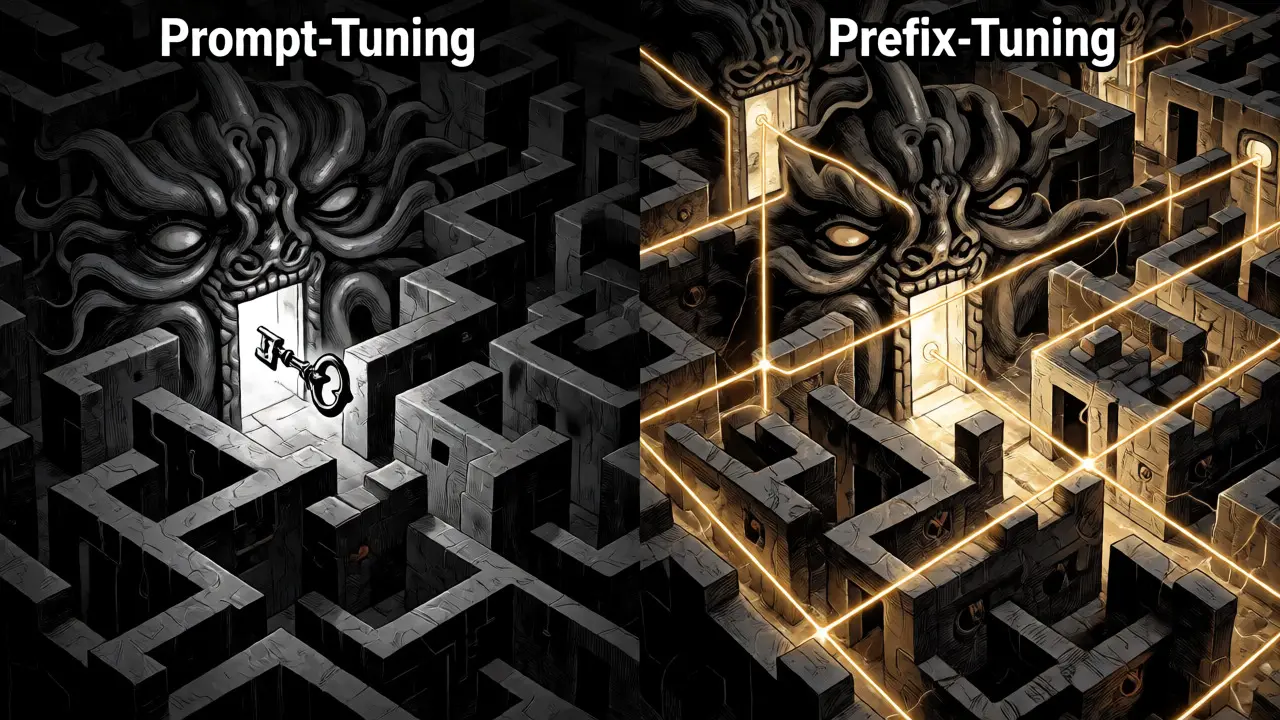
If prompt-tuning is a nudge at the door, Prefix-Tuning is like having a tour guide inside every room of the house. Developed by Li and Liang, this technique inserts trainable key and value vectors into the attention mechanism at every transformer layer. It’s more invasive than prompt-tuning but still far lighter than full fine-tuning.
Instead of just affecting the input, prefix-tuning influences how the model attends to information throughout the entire network. Typical implementations require tuning 0.5% to 1% of the total parameters. That’s 5 to 10 times larger than prompt-tuning, but still negligible compared to 100%. By guiding the attention heads directly, prefix-tuning can correct deeper misunderstandings and adapt to more complex tasks.
A critical limitation identified in recent research (arXiv, Oct 2023) is that prefix-tuning cannot change the relative attention pattern over content. It can only bias the outputs in a fixed direction. This means it excels at refining existing behaviors but fails if the task requires fundamentally new ways of looking at data. For example, if a task requires reversing the logical flow of attention that was established during pre-training, prefix-tuning might hit a wall where full fine-tuning would succeed.
Prompt-Tuning vs Prefix-Tuning: The Head-to-Head Comparison
So, which one should you pick? It depends on your constraints and your goals. Let’s look at the practical differences based on community benchmarks and industry usage.
| Feature | Prompt-Tuning | Prefix-Tuning |
|---|---|---|
| Complexity | Low (Easy to implement) | Medium (Requires layer config) |
| Performance Ceiling | Good for simple/near-distribution tasks | Better for complex/diverse tasks |
| Training Time | Fast (e.g., 1.2 hours on A100) | Moderate (e.g., 3.5 hours on A100) |
| Interpretability | Low (Black box embeddings) | Low (Deep internal biases) |
| Resource Usage | Minimal | Low-Medium |
Real-world data supports this. One practitioner reported achieving 82% accuracy on sentiment analysis with prompt-tuning using only 20 soft tokens. The same task with prefix-tuning reached 87% accuracy but took nearly three times longer to train. Another case study in medical QA showed prefix-tuning achieving 78.3% accuracy with 0.7% parameters updated, compared to 79.1% with full fine-tuning. The gap is narrow, but the resource savings are massive.
When to Use Which Technique
Don’t overcomplicate your decision tree. Here is a straightforward heuristic:
- Choose Prompt-Tuning if:
- You have extremely limited GPU memory (e.g., edge devices, mobile apps).
- Your task is very similar to the model’s pre-training data (e.g., summarization, basic classification).
- You need rapid experimentation and quick iteration cycles.
- You want the smallest possible adapter file size for deployment.
- Choose Prefix-Tuning if:
- You need higher accuracy and can afford slightly more compute.
- The task involves generation or complex reasoning where deep attention guidance helps.
- Prompt-tuning has plateaued in performance despite tuning hyperparameters.
- You are working in enterprise environments (finance, healthcare) where marginal accuracy gains justify extra training time.
It’s worth noting that neither method replaces full fine-tuning for novel tasks. If you are asking the model to learn a completely new language structure or a highly specialized domain logic that contradicts its pre-training, both methods may fail. In those cases, you might need to look at LoRA (Low-Rank Adaptation) or consider partial fine-tuning.
Implementation Tips and Common Pitfalls
Getting started with either method is easier than it looks, thanks to libraries like Hugging Face’s PEFT library. As of version 0.4.0+, support for both is robust. However, there are traps you can fall into.
First, initialization matters. A common mistake is initializing soft prompts randomly. Research suggests that initializing them with embeddings of relevant vocabulary tokens (e.g., "task", "summarize") provides a much better starting point. This reduces training instability and speeds up convergence.
Second, watch your prefix length. For prefix-tuning, increasing the length beyond 50 tokens yields diminishing returns. Stanford researchers found that going from 50 to 100 tokens improved accuracy by only 2.3% on average across benchmarks, while significantly increasing memory usage. Start small, measure, then scale up only if necessary.
Third, remember the "black box" nature. Neither method produces human-readable explanations of why they work. You can’t inspect the soft prompt and say, "Ah, it learned to focus on nouns." You have to rely on empirical validation. Keep rigorous test sets separate from your training data to ensure you aren’t just overfitting to the few thousand examples you have.
The Future of Lightweight LLM Control
The landscape is shifting. While prompt and prefix tuning remain relevant, hybrid approaches are gaining traction. Combining prefix-tuning with LoRA, for instance, leverages the strengths of both: LoRA adapts weights efficiently, while prefix-tuning guides attention. Gartner predicts that by 2025, 60% of enterprise LLM deployments will incorporate some form of PEFT. This suggests that mastering these lightweight techniques is not just a nice-to-have skill-it’s becoming essential for efficient AI engineering.
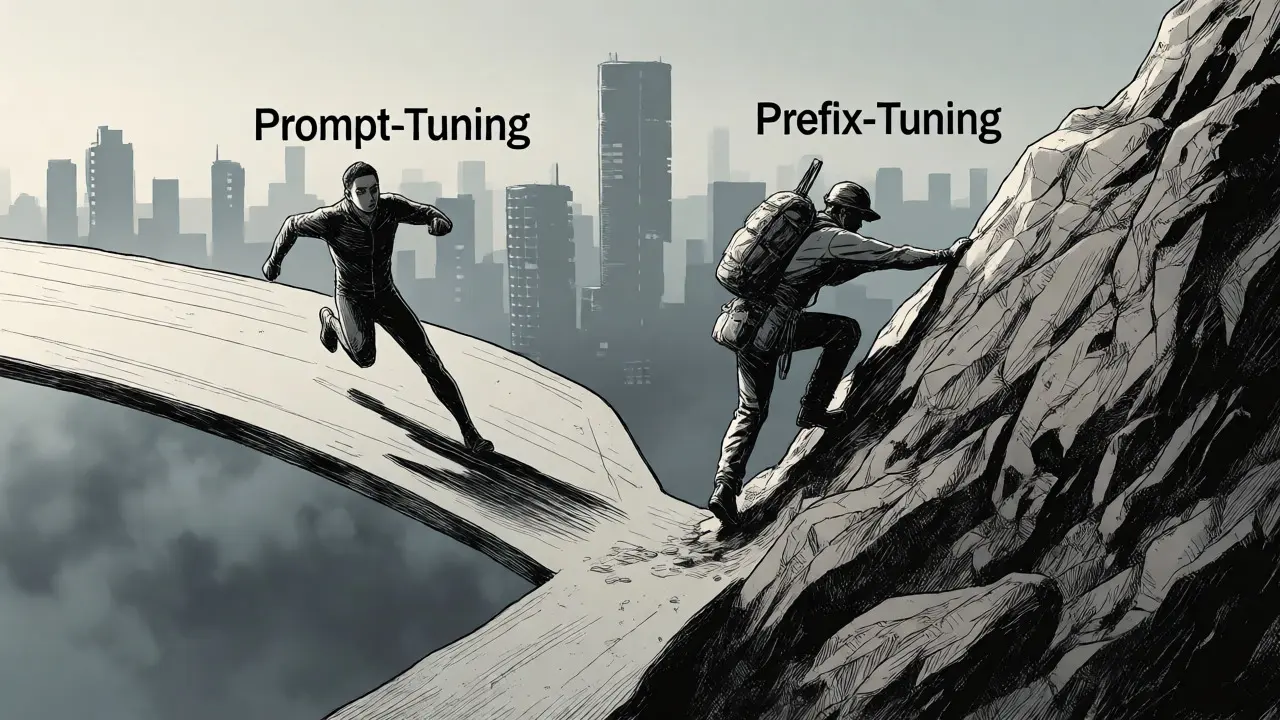
For now, stick to the basics. If you’re new to PEFT, start with prompt-tuning. It’s forgiving, fast, and teaches you the fundamentals of manipulating model inputs. Once you hit a performance ceiling, graduate to prefix-tuning. Only move to heavier methods when you truly need them.
Is prompt-tuning faster than prefix-tuning?
Yes, generally speaking. Prompt-tuning updates fewer parameters (only input embeddings) and typically trains 2-3x faster than prefix-tuning, which modifies internal layers. On an A100 GPU, prompt-tuning might take 1 hour while prefix-tuning takes 3 hours for the same dataset.
Can I switch from prompt-tuning to prefix-tuning easily?
You can switch configurations in libraries like Hugging Face PEFT, but you usually need to retrain from scratch. The learned soft prompts from prompt-tuning are not directly transferable to the internal layer prefixes used in prefix-tuning.
Do these methods work with all LLM architectures?
Mostly yes. They work well with standard Transformer-based models like BERT, GPT, T5, and LLaMA variants. However, implementation details can vary, especially with newer architectures like Mamba or RWKV, which may require custom adaptations.
Why is my prefix-tuning accuracy lower than expected?
This often happens if the task requires new attention patterns that contradict pre-training. Prefix-tuning biases existing attention but cannot fundamentally restructure it. Also, check your prefix length; too short limits capacity, too long causes overfitting or noise.
Which method uses less memory during inference?
Prompt-tuning uses less memory because the added parameters are tiny and located only at the input. Prefix-tuning adds vectors to every layer, increasing the active memory footprint slightly during forward passes, though it is still much smaller than full fine-tuning.