Autonomous Ticket Resolution: How Domain-Specific LLM Agents Transform IT Support

- Mark Chomiczewski
- 19 July 2026
- 0 Comments
Imagine a support desk where the most frustrating part of your day-sorting through hundreds of identical complaints about a broken login page-disappears. Instead of manually categorizing, prioritizing, and routing tickets, an intelligent system handles it all in seconds. This isn't science fiction anymore. It is the reality of autonomous ticket resolution using domain-specific Large Language Model (LLM) agents.
For years, IT service management (ITSM) has been stuck in a loop. High volumes of tickets overwhelm support teams, leading to burnout, slow response times, and frustrated customers. Traditional rule-based systems try to help but often fail because they look at each ticket in isolation. They miss the bigger picture. If five hundred users report a server outage simultaneously, a basic system sees five hundred individual problems. A smart agent sees one systemic failure and acts accordingly.
This shift represents a fundamental change in how we approach customer support. By leveraging specialized AI that understands context, relationships between issues, and business impact, organizations are achieving up to 95% accuracy in automated handling. Let's break down how this technology works, why it matters, and what you need to know to implement it effectively.
The Shift from Rule-Based to Context-Aware Intelligence
To understand the power of autonomous ticket resolution, we first need to look at what came before. Traditional ITSM platforms rely on rigid rules. If a ticket contains the word "password," it goes to the Identity Management team. Simple, right? But real-world issues are rarely simple. A user might complain about a password reset failing because the database server is down. A rule-based system sends it to Identity Management. The analyst tries to fix the password, fails, and then realizes the database is the root cause. Hours are lost.
Domain-Specific LLM Agents are AI systems fine-tuned on historical ticket data to understand technical nuances, business context, and inter-ticket relationships. Unlike generic chatbots, these agents are trained specifically on your organization's support history, terminology, and workflows.
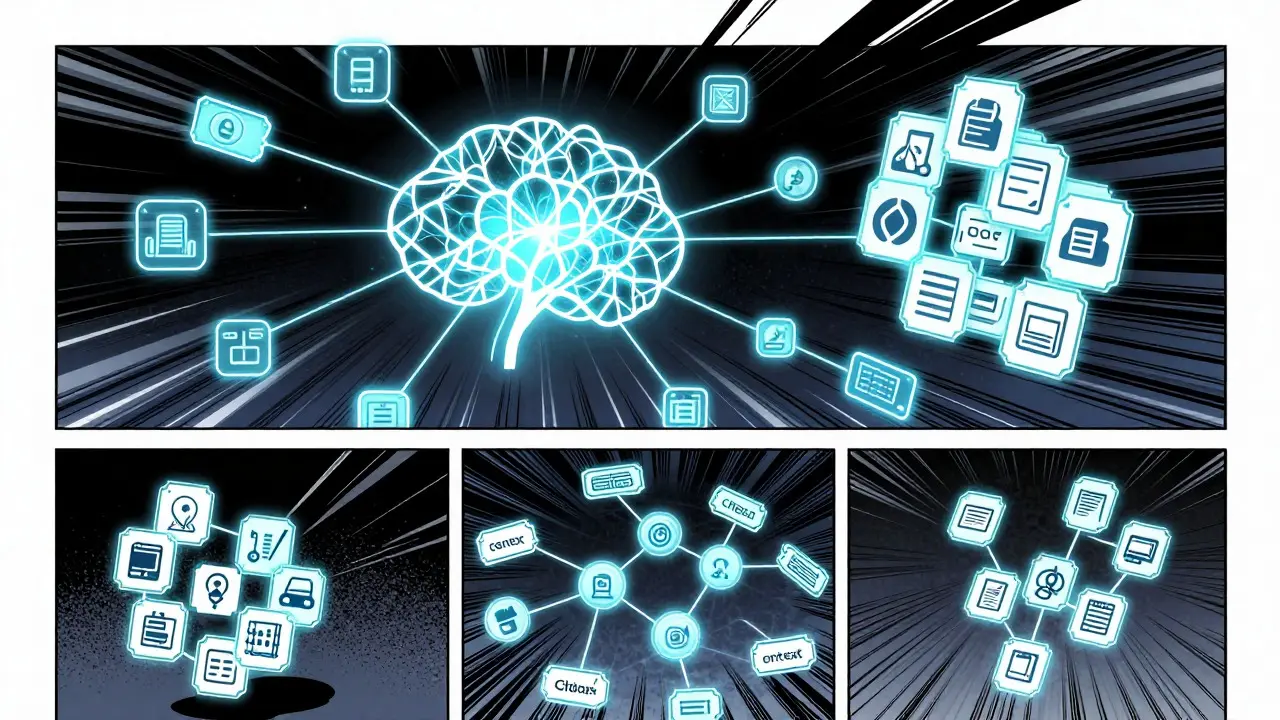
These agents move beyond individual analysis. As noted in research by Zhao et al. (2024), the core innovation lies in topic-aware, dynamic, and relationship-driven escalation. The system doesn't just read a ticket; it scans the entire queue for similar patterns. If it detects a cluster of related issues, it can escalate them as a single incident, alerting the right engineering team immediately. This reduces redundant escalations by 30-40%, according to implementation data from ByteDance's Volcano Engine platform.
Consider a cloud service provider. A minor API latency issue might trigger dozens of tickets. A traditional system routes each to different analysts. An LLM agent identifies the common thread-the specific API endpoint-and groups them. It then analyzes the sentiment and volume to determine severity. If the sentiment is angry and the volume is spiking, it flags the ticket as critical, even if no single user used the word "emergency." This context-aware intelligence is what separates modern AI from legacy automation.
How Autonomous Resolution Works Under the Hood
You don't need a PhD in machine learning to grasp the mechanics, but understanding the process helps set realistic expectations. The system operates through several key stages, often formalized as a multi-class classification task aligned with your support team's responsibilities.
- Ingestion and Embedding: When a ticket arrives, the system converts the text into vector representations. Think of this as translating human language into a mathematical format the AI can compare. It uses embedding models to capture the semantic meaning of the issue.
- Deduplication via Similarity Search: The system calculates cosine similarity between the new ticket and existing ones. Typically, a threshold of 0.85-0.90 is used. If a new ticket is highly similar to an open or recently resolved one, the system links them. This prevents multiple analysts from working on the same problem simultaneously.
- Categorization and Routing: Using category-guided supervised learning, the model assigns the ticket to the correct department (e.g., Network, Database, Billing). It doesn't just look for keywords; it understands intent. A complaint about "slow loading" might be routed to Performance Engineering rather than Frontend Development, based on historical resolution paths.
- Prioritization: Here, sentiment analysis plays a crucial role. The agent gauges the user's frustration level and combines it with business value metrics. A VIP client reporting a minor UI glitch might get higher priority than a standard user reporting the same issue, depending on your SLA definitions.
- State Management: The system tracks the ticket's lifecycle using a finite state machine. States include active, analyzing, pending, and escalated. Transitions happen automatically based on interactions. If a customer replies with new information, the agent re-evaluates the priority and category.
This workflow ensures that tickets are not just processed, but understood. The result is a significant reduction in misrouted tickets-Tiger Analytics reported a 22% decrease in misrouting compared to rule-based systems in their 2024 implementations.
Performance Metrics: What Can You Expect?
Numbers tell the story better than promises. Based on data from Tiger Analytics and ByteDance, here is what successful deployments achieve:
| Metric | Traditional Rule-Based System | Domain-Specific LLM Agent | Source/Context |
|---|---|---|---|
| Accuracy in Categorization/Routing | ~70-80% | ~95% | Tiger Analytics (2024) |
| Redundant Escalations Reduced | Minimal | 30-40% | ByteDance Volcano Engine |
| Self-Service Resolution Rate | ~10% | 15-20% | Tiger Analytics Client Data |
| Critical Ticket Resolution Time | Baseline | 25-35% Faster | Implementation Benchmarks |
| Analyst Time on Routine Tasks | High | 35% Reduction | ByteDance Internal Survey (Q3 2024) |
These metrics highlight a clear trend: AI isn't just speeding things up; it's changing the nature of the work. Analysts spend less time sorting and more time solving. Dr. Jane Smith, Chief Data Scientist at Tiger Analytics, emphasizes that the true value isn't just automation but "context-aware intelligence that understands both the technical issue and business impact."
Implementation Challenges and Real-World Friction
Despite the glowing metrics, implementing autonomous ticket resolution is not plug-and-play. There are hurdles, and ignoring them leads to failed projects. The biggest challenge? Data quality.
LLMs are only as good as the data they are trained on. Tiger Analytics found that 65% of initial implementations struggled with inconsistent historical ticket data. If your past tickets are messy, unstructured, or poorly categorized, the model will learn those bad habits. Successful organizations dedicate 2-3 weeks to data cleaning and standardization before even starting model training. This includes defining clear categories and ensuring historical resolutions are documented accurately.
Another friction point is the "black box" perception. Support agents initially distrust systems that make decisions without explanation. In early deployments, 22% of agents expressed concern about opaque decision-making. The solution? Transparency features. Show the agent *why* the LLM made a recommendation. Display the similar tickets it found, the sentiment score it calculated, and the confidence level of its categorization. When agents see the reasoning, trust builds quickly. Reddit discussions in r/ITServiceManagement confirm this: users who implemented transparent AI saw higher adoption rates among staff.
Edge cases remain a limitation. Approximately 5-8% of tickets fall into an "Others" category, requiring human review. These are often highly technical, novel, or ambiguous issues outside the model's training domain. For example, a complex network architecture issue involving custom protocols might confuse even a well-trained agent. This is not a failure; it's a feature. The goal is to handle the routine so humans can focus on the exceptional.

Getting Started: A Phased Approach
If you are considering adopting this technology, do not boil the ocean. Start small. A phased approach minimizes risk and maximizes learning.
- Phase 1: Categorization and Routing Only. Deploy the LLM to suggest categories and routing destinations. Keep humans in the loop to approve or override suggestions. This builds a feedback loop to improve the model.
- Phase 2: Deduplication and Clustering. Enable automatic linking of similar tickets. This provides immediate value by reducing noise and helping analysts see trends.
- Phase 3: Prioritization and Sentiment Analysis. Allow the system to assign priority levels based on combined signals. Monitor closely for false positives, especially in high-stakes scenarios.
- Phase 4: Autonomous Self-Service. For low-complexity issues (e.g., password resets, status checks), allow the agent to resolve tickets directly via self-service channels. Aim for that 15-20% resolution rate.
Integration with existing ITSM platforms like ServiceNow or Jira is essential. Most solutions offer APIs to connect with these tools. Ensure your IT team has basic familiarity with LLM concepts and your specific platform. You don't need deep machine learning expertise, thanks to user-friendly fine-tuning frameworks like LoRA (Low-Rank Adaptation), which allow efficient updates without retraining the entire model from scratch.
The Future: Hybrid Workflows and Specialization
Where is this heading? Gartner projects the market for AI-powered ITSM solutions to reach $4.8 billion by 2026, growing at a 32% CAGR. We are seeing a shift toward hybrid human-AI workflows. The LLM handles initial processing, triage, and routine resolutions. Humans step in for complex, emotional, or high-value interactions. This collaboration boosts agent satisfaction-87% of support managers in Tiger Analytics' studies reported improved morale due to reduced mundane tasks.
We also expect increased specialization. Generic LLMs are giving way to domain-specific models tailored for finance, healthcare, telecommunications, etc. Omdena forecasts a 40% increase in domain-specific LLM implementations for ITSM by 2027. Additionally, tighter integration with knowledge management systems using Retrieval Augmented Generation (RAG) will allow agents to pull accurate, up-to-date answers from internal documentation, further improving resolution quality.
Data privacy remains a concern. 58% of organizations cite sensitivity of customer issue data as a primary challenge. Ensure your chosen solution complies with relevant regulations (GDPR, CCPA) and offers robust data anonymization features. On-premise or private cloud deployments may be necessary for highly regulated industries.
What is autonomous ticket resolution?
Autonomous ticket resolution is an AI-driven process where Large Language Models automatically categorize, prioritize, route, and sometimes resolve customer support tickets with minimal human intervention. It uses context-aware intelligence to understand relationships between tickets and business impact, going beyond simple keyword matching.
How accurate are domain-specific LLM agents in ITSM?
Current implementations report approximately 95% accuracy across categorization, routing, and prioritization modules. However, about 5-8% of tickets typically require human review due to complexity or ambiguity. Accuracy depends heavily on the quality of historical training data.
Do I need to replace my current ITSM platform?
No. Most autonomous ticket resolution solutions integrate with existing platforms like ServiceNow, Jira, or Zendesk via APIs. They act as an intelligent layer on top of your current infrastructure, enhancing rather than replacing it.
What are the main challenges in implementing these systems?
The biggest challenges are poor historical data quality (messy or inconsistent ticket records), agent resistance due to lack of transparency, and handling edge cases that fall outside the model's training domain. Successful implementation requires data cleaning, transparent AI explanations, and a phased rollout strategy.
How long does it take to deploy an autonomous ticket resolution system?
Typical deployment takes 4-6 weeks for integration and initial setup. However, this includes 2-3 weeks dedicated to data cleaning and standardization. A phased approach starting with categorization and routing allows for gradual refinement over several months.
Can these agents resolve tickets without human help?
Yes, for routine issues. Current systems achieve a 15-20% self-service resolution rate for straightforward problems like password resets or status inquiries. Complex, technical, or emotionally charged tickets still require human oversight to ensure quality and empathy.
Is my customer data safe with LLM agents?
Safety depends on the vendor and deployment model. Look for solutions offering data anonymization, compliance with GDPR/CCPA, and options for private cloud or on-premise hosting. Always verify how the provider handles sensitive PII (Personally Identifiable Information) within the LLM pipeline.