Self-Hosted LLMs vs APIs: When Does Self-Hosting Actually Save Money?

- Mark Chomiczewski
- 3 September 2026
- 7 Comments
You look at the monthly bill from your LLM provider and feel a familiar sting. Thousands of dollars gone, just for processing text. It’s tempting to think, "I could just run this on my own server." But is that actually cheaper? The short answer: it depends entirely on volume. If you’re sending fewer than two million tokens a day, stick with the API. If you’re pushing billions, self-hosting can slash your costs by 80%. But there’s a catch most people miss: the hidden tax of engineering time.
Let’s cut through the noise. This isn’t about whether GPUs are powerful-they are. It’s about total cost of ownership (TCO). We’ll break down exactly when self-hosted large language models beat cloud APIs, where the trapdoors are, and how to model the math so you don’t end up paying more in salaries than you saved in compute.
The Raw Math: GPU Costs vs. Token Pricing
Start with the obvious numbers. Cloud providers like OpenAI or Anthropic charge per token. For example, GPT-4o mini might cost around $0.15 per million input tokens. That sounds cheap until you scale. Let’s say you process 1 billion tokens a month. At $0.15/million, that’s $150. Wait, that’s not right-let’s use realistic high-end pricing. If you’re using a frontier model at $10 per million tokens, 1 billion tokens costs $10,000 a month.
Now, look at self-hosting. Renting an NVIDIA H100 GPU on a spot instance costs roughly $1.65 per hour. Running it 24/7 for a month is about $1,200. If you get 70% utilization, you’re getting massive throughput. For a 7B parameter model, this setup can handle enough requests to drop your effective cost to $0.013 per 1,000 tokens. Compare that to API rates often sitting between $0.15 and $0.60 per million tokens for smaller models, or much higher for larger ones. The per-token advantage for self-hosting becomes undeniable once you cross the 5-10 billion token monthly threshold.
| Monthly Volume | API Cost Estimate | Self-Hosted Cost (GPU Only) | Winner |
|---|---|---|---|
| < 2 Million Tokens | $1 - $10 | $900+ (Idle GPU waste) | API |
| 1 Billion Tokens | $150 - $10,000* | $1,200 - $3,000 | Tie / Platform Approach |
| 10 Billion Tokens | $1,500 - $100,000* | $2,000 - $5,000 | Self-Hosted |
The Hidden Tax: Why GPU Price Isn’t Total Cost
Here is where most cost models fail. They count the GPU rental fee and stop there. Wrong. Running production-grade inference infrastructure requires six other major expense categories that inflate your TCO by 3x to 5x.
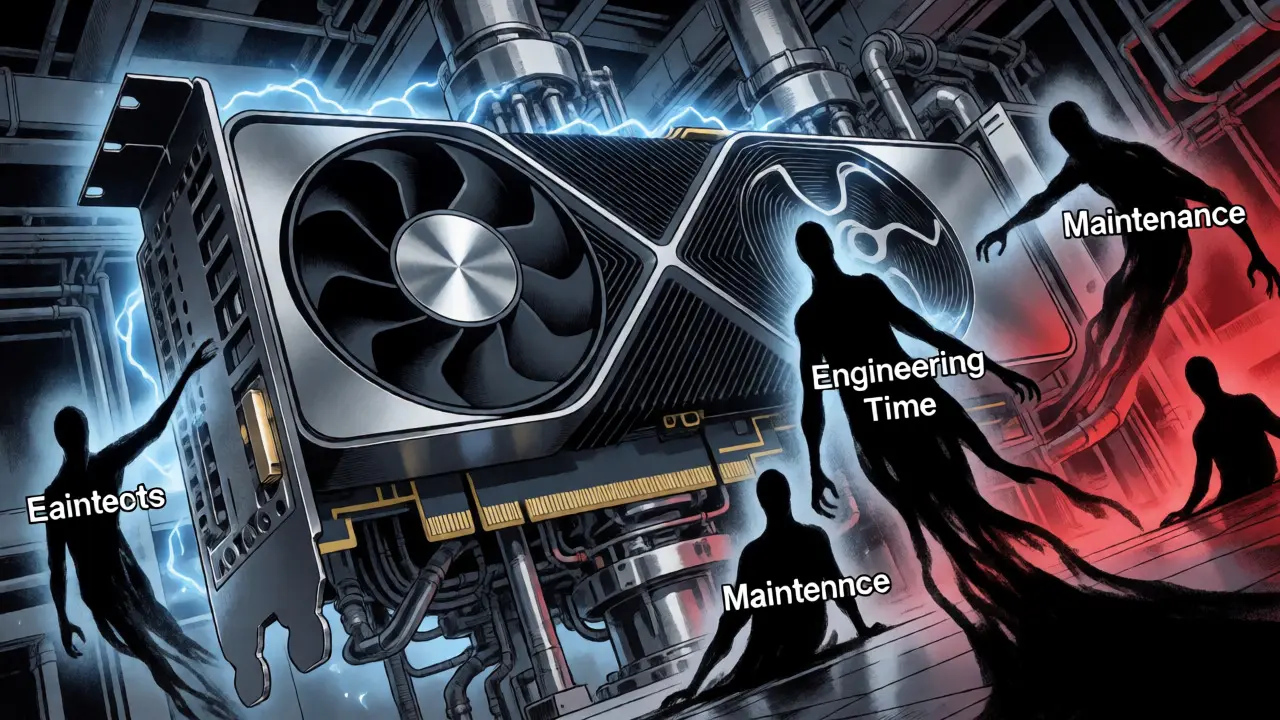
- Engineering Time: This is the biggest killer. Deploying vLLM or Ollama, optimizing quantization, handling batching, and fixing memory leaks takes senior engineer hours. If your team spends 20 hours a month maintaining this, that’s real salary money.
- MLOps Overhead: You need monitoring, logging, and alerting systems. Tools like Prometheus or Grafana aren’t free, and neither is the time spent configuring them.
- Hardware Replacement: GPUs depreciate. You need a budget for upgrading hardware every 2-3 years to stay competitive.
- Incident Response: When the server crashes at 2 AM, who fixes it? On-call rotations cost money.
- Opportunity Cost: Your engineers could be building product features instead of babysitting Docker containers.
- Underutilization: Traffic isn’t flat. If your app gets quiet on weekends, you’re still paying for idle GPUs unless you have sophisticated auto-scaling, which adds complexity.
A fintech company I read about recently cut their AI spend from $47,000 to $8,000 a month by going hybrid. But they had a dedicated MLOps team. If you’re a startup with one full-stack developer, that same move might bankrupt you in lost productivity.
The Break-Even Point: Finding Your Sweet Spot
So, when does the switch make sense? Think of it in three zones.
Zone 1: The API Zone (< 2 Million Tokens Daily)
Stay with the API. The overhead of managing servers outweighs any savings. You pay a premium for convenience, but you’re buying speed-to-market and zero operational risk. This is perfect for prototyping or low-volume internal tools.
Zone 2: The Platform Zone (500 Million - 5 Billion Tokens Monthly)
This is the gray area. Pure self-hosting is risky here because utilization fluctuates. Instead, consider managed open-source platforms like Firework AI, DeepSeek AI, or Novita AI. These services let you run open-source models (like Llama 3 or Mistral) on shared infrastructure. You get better pricing than proprietary APIs without the headache of owning the metal. You capture 40-50% savings compared to hyperscaler clouds, without the 3x engineering markup.
Zone 3: The Self-Hosted Zone (> 10 Billion Tokens Monthly)
If you’re here, and you have the engineering chops, self-hosting wins. You can achieve costs as low as $0.001-$0.002 per token. This is typical for large-scale consumer apps, search engines, or enterprise data pipelines.
Quality Matters: Cost Per Successful Outcome
Don’t fall into the trap of comparing raw token prices. A cheap model that fails half the time is expensive. Imagine you use a tiny 7B model hosted locally for $0.002/token. It hallucinates 50% of the time. You have to retry twice. Now your effective cost is $0.006/token. Plus, you’ve added latency and user frustration.
Compare that to a larger 70B model costing $0.02/token that gets it right the first time. In many complex reasoning tasks, the "expensive" model is actually cheaper because it reduces retries and downstream cleanup costs. Always measure cost per successful outcome, not just cost per token. Use eval frameworks to test accuracy before you commit to infrastructure.
When Compliance Forces Your Hand
Sometimes, cost doesn’t matter. If you’re in healthcare, finance, or legal, you might be legally required to keep data on-premises. HIPAA, GDPR, or SOC2 compliance might forbid sending sensitive PII to third-party APIs. In these cases, self-hosting isn’t an economic choice-it’s a regulatory necessity. Even if it costs more, it’s the only viable option. Here, the value proposition shifts from "saving money" to "risk mitigation."

The Hybrid Strategy: Best of Both Worlds
The smartest organizations don’t pick one lane. They route traffic based on task complexity. This is the hybrid approach, and it’s becoming the standard for mature AI teams.
- Simple Tasks: Classification, extraction, FAQ responses. Route these to small, self-hosted models (7B-13B parameters). They’re fast, cheap, and good enough.
- Complex Tasks: Creative writing, multi-step reasoning, code generation. Route these to premium APIs (GPT-4o, Claude Opus). Pay for quality where it counts.
This strategy can reduce overall spend by 40-70% compared to an all-API approach, while keeping output quality high. It also gives you a safety net: if your self-hosted cluster goes down, you can failover to the API.
Decision Checklist: Are You Ready?
Before you buy those GPUs, ask yourself these five questions honestly:
- Volume: Are we consistently processing over 5 billion tokens a month? If no, wait.
- Compliance: Do we have strict data residency requirements? If yes, self-host or use a private cloud platform.
- Fine-Tuning: Do we need to fine-tune models on our own data? APIs restrict this; self-hosting gives you full control.
- Engineering Capacity: Do we have at least one senior engineer dedicated to MLOps? If no, don’t do it.
- Model Availability: Can open-source models (Llama 3, Qwen, Gemma) match the quality of the API model we currently use? Test this rigorously.
If you answered "yes" to most of these, start small. Spin up a single node, benchmark it against your current API usage, and see if the math holds up in practice, not just on paper.
Is self-hosting always cheaper than using an API?
No. For low-volume applications (under 2 million tokens daily), API costs are typically lower because you avoid the fixed costs of server maintenance, engineering time, and idle infrastructure. Self-hosting only becomes cheaper at high volumes, usually above 5-10 billion tokens per month, due to economies of scale.
What are the hidden costs of self-hosting LLMs?
Beyond GPU rental fees, hidden costs include engineering time for deployment and maintenance (often the largest cost), MLOps infrastructure, hardware depreciation, incident response labor, opportunity costs of diverted engineering resources, and expenses related to underutilized capacity during low-traffic periods. These can increase total cost of ownership by 3-5 times the raw GPU price.
Can open-source models match the quality of paid APIs?
For many tasks, yes. Models like Llama 3, Qwen, and Gemma perform competitively with mid-tier API models for classification, extraction, and general chat. However, for complex reasoning, creative writing, or niche tasks, frontier models like GPT-4o or Claude Opus may still offer superior quality. Always evaluate specific use cases rather than assuming parity.
What is the hybrid approach to LLM deployment?
A hybrid strategy routes simple, high-volume tasks (like classification or FAQs) to cost-effective self-hosted small models, while reserving expensive API calls for complex reasoning or high-quality generation tasks. This balances cost efficiency with performance, often reducing overall spend by 40-70% compared to using APIs for everything.
Do I need specialized hardware to self-host LLMs?
Yes, generally. High-performance inference requires GPUs with significant VRAM, such as NVIDIA A100s or H100s. While smaller models can run on consumer GPUs like RTX 4090s, production-scale deployments usually require data-center grade hardware to ensure low latency and high throughput. CPU-only inference is possible but significantly slower for large models.


Comments
Elizabeth Brooks
exactly this. the engineering time is the real killer nobody talks about.
i spent three months just getting vllm to play nice with our batching logic and it cost way more in salary than we saved on tokens for the first year. if you dont have a dedicated mlops person, just stick to the api until you hit like 5b tokens a month. its not worth the headache otherwise.
September 4, 2026 AT 04:58
Anthony Miller
You are missing the point entirely
The article assumes a static workload which is naive at best. Real world traffic spikes destroy your utilization metrics. You pay for idle capacity during troughs and get throttled during peaks unless you over-provision massively which negates the savings. This isn't an analysis it's marketing fluff for people who have never managed production infrastructure. The hidden costs listed are trivial compared to the operational risk of running your own cluster. One bad update to CUDA drivers or a kernel panic and you're down for hours while the API stays up. Stop pretending hobbyist math applies to enterprise scale. It doesn't. The TCO model here is fundamentally flawed because it ignores the premium on reliability and SLA guarantees that cloud providers offer. If you value uptime self hosting is strictly inferior financially when you factor in incident response labor and lost revenue during downtime. Your break even point is wrong. It should be higher by an order of magnitude once you account for true total cost including opportunity cost of senior engineers babysitting containers instead of shipping features. This is why most startups fail their infra bets. They underestimate complexity. They overestimate their ability to handle edge cases. They ignore the human element. Do not fall for the sunk cost fallacy of buying GPUs. Rent compute. Buy peace of mind. That is the only rational choice for any business without a dedicated platform team. Anything else is gambling with company survival. The data supports this view overwhelmingly if you look past the vendor hype cycles. Open source models require constant tuning to match API quality which adds yet another layer of maintenance burden not accounted for here. It is a trap. A shiny expensive trap designed to drain your runway. Wake up.
September 4, 2026 AT 05:58
john randall
agreed on the hybrid approach being the sweet spot for most teams i've seen
September 5, 2026 AT 13:48
Jacob Baby Official
Oh please. Another tech bro trying to optimize his $500 hobby project into a "cost saving strategy"? The author clearly has never dealt with the nightmare of GPU driver hell or the sheer incompetence of open-source quantization libraries breaking inference every other week. This article is pure fantasy written by someone who thinks "deploying vLLM" is as easy as clicking a button. It’s not. It’s a black hole that eats weekends and sanity. And don’t get me started on the "hybrid strategy." Routing traffic based on task complexity sounds great in PowerPoint slides but in reality, your latency jitter will make users rage quit before they even see the answer. You’re trading predictable API performance for unpredictable self-hosted garbage just to save pennies on the dollar. It’s pathetic. Most companies don’t need billions of tokens; they need reliable answers. This post ignores the fact that model drift and hallucination rates in smaller self-hosted models can cost you more in customer support tickets than you ever save in compute. It’s a toxic mindset that prioritizes cheap compute over actual product quality. Grow up and realize that convenience has a price tag, and paying it is often the smartest business decision. This entire premise is flawed from the ground up.
September 6, 2026 AT 14:11
michelle veluz
Wait... wait... WAIT!!!
Are we really ignoring the fact that Big Tech wants us to self-host so they can dump their older hardware on us??
Think about it!!
They push these "open source" models that are actually distilled versions trained on OUR data, right??
And then they charge us for the GPUs??
It’s a conspiracy!!
A complete and utter conspiracy to keep us locked into their ecosystem while making us do the heavy lifting!!
Why do you think H100s are so hard to get??
Because they want you to use their API!!!
They want your data!!!
They want to train on it!!!
Self-hosting is the only way to escape the matrix!!!
But they make it so hard!!!
On purpose!!!
To make you give up!!!
Don’t let them win!!!
Buy the GPUs!!!
Run the models!!!
Keep your data safe!!!
Before they change the terms again!!!
Again!!!
And again!!!
Wake up sheeple!!!
September 7, 2026 AT 10:22
Savara Gunn
this was really helpful for my small agency context
we were looking at moving off api but the tco breakdown stopped us cold
the point about engineering time being the biggest cost resonated deeply
we don't have an mlops team and one dev wearing too many hats would burn out fast
sticking with api for now feels like the right call
thanks for sharing this
September 8, 2026 AT 12:41
Jeff Falcon
I completely agree with the sentiment expressed in the original post, especially regarding the critical importance of considering the total cost of ownership rather than just the raw compute prices, because if you simply look at the hourly rate of a GPU versus the per-token cost of an API, you might think you are saving money immediately, but when you factor in the salaries of the engineers required to maintain the infrastructure, the monitoring tools needed to ensure reliability, and the inevitable downtime that occurs during updates or hardware failures, the financial picture changes dramatically, and it becomes clear that for most organizations that are not operating at a massive scale, the convenience and reliability offered by established API providers are well worth the premium, particularly when you consider the opportunity cost of having your talented developers spend their valuable time debugging CUDA errors or managing container orchestration instead of building core product features that drive revenue and user engagement, so ultimately, the advice to stay in the API zone until you reach significant volume thresholds is sound practical guidance that prevents premature optimization and ensures that resources are allocated efficiently where they matter most.
September 9, 2026 AT 02:42