Transfer Learning in NLP: How Pretraining Made Large Language Models Possible

- Mark Chomiczewski
- 28 February 2026
- 6 Comments
Before transfer learning, training a language model for even a simple task like sentiment analysis meant collecting thousands of labeled examples, spending weeks on a cluster of GPUs, and hoping the model didn’t overfit. Then everything changed. The breakthrough didn’t come from a smarter algorithm or a new type of neural network. It came from one simple idea: reuse.
What if you trained a model not to do one thing, but to understand language itself? What if you let it read the entire internet - books, articles, forums, code comments - and learn how words connect, how sentences flow, and how meaning shifts with context? That’s the core of transfer learning in NLP. And it’s why today’s AI can write emails, answer questions, and summarize reports without being explicitly programmed for any of those tasks.
How Transfer Learning Works in NLP
Transfer learning in NLP isn’t magic. It’s two clear steps: pre-training and fine-tuning.
During pre-training, a model is fed massive amounts of unlabeled text - think Wikipedia, news archives, Reddit threads, and public books. It doesn’t know what a question is or what sentiment means. Instead, it plays games with language. For example, it might see:
- "The cat sat on the ___" and guess the missing word.
- "The sky is blue. I like ice cream." and decide if the second sentence logically follows the first.
These aren’t tasks humans would label. They’re self-supervised learning tricks. The model doesn’t get told the right answers - it figures them out by detecting patterns. Over time, it learns that "cat" often goes with "sat," "blue" goes with "sky," and "I like" usually precedes something positive. It builds a deep, internal map of how language works.
Then comes fine-tuning. Now you take that pre-trained model - which already understands grammar, context, and word relationships - and give it a small set of labeled examples for a specific job. Say, 500 reviews tagged as "positive" or "negative." You replace the final layer of the model with a new one that outputs two classes instead of guessing missing words. You train it for a few hours, not weeks. And suddenly, it’s great at sentiment analysis.
This is the game-changer. You don’t need millions of labeled examples. You don’t need a supercomputer. You just need a pre-trained model and a few hundred examples. That’s why small teams, startups, and even individual developers can now build powerful NLP tools.
The Models That Changed Everything
Before 2018, most NLP models were built from scratch for each task. A sentiment analyzer was separate from a question-answering system. Each one needed its own data, its own training time, its own bugs.
Then came BERT.
Developed by Google in 2018, BERT (Bidirectional Encoder Representations from Transformers) was the first model to truly prove that bidirectional context mattered. Earlier models read text left-to-right or right-to-left. BERT read both at once. It saw not just "I love this movie," but also how "movie" connects to "love" and "this" simultaneously. It used Masked Language Modeling - hiding random words and forcing the model to predict them - to build a deep understanding of word relationships. Suddenly, models could handle ambiguity, sarcasm, and nuance far better than before.
But BERT wasn’t the end. OpenAI’s GPT-3 took the idea further. With 175 billion parameters, it didn’t just understand language - it generated it. GPT-3 didn’t need fine-tuning for many tasks. Just give it a few examples in the prompt, and it would figure out what to do. It could write code, answer trivia, draft legal clauses, and mimic Shakespeare - all from the same base model. Its power came from scale: more data, more parameters, more context.
Other models followed with clever tweaks:
- T5 turned every task into text-to-text. Translation? Input: "English sentence." Output: "French sentence." Summarization? Input: "Long article." Output: "Short summary." One architecture for everything.
- XLNet improved on BERT by not just masking words - it shuffled the order and predicted them in random sequences, forcing the model to learn deeper dependencies.
- ALBERT made models smaller by sharing weights between layers. Same performance, less memory. Perfect for phones and edge devices.
These weren’t just incremental upgrades. They were different ways of asking: "How can we make language understanding more general, more efficient, and more reusable?"
Why Transfer Learning Wins
Here’s the raw math:
- Training a model from scratch on 10 million labeled examples? That might take 30 days and $50,000 in cloud costs.
- Starting with a pre-trained model and fine-tuning on 1,000 examples? That’s 3 days and $200.
And the results? Often better.
Pre-trained models don’t just save time. They generalize better. Why? Because they’ve seen way more variation in language. A model trained only on medical reviews might miss slang, typos, or emotional tone. But a model that’s read Twitter, Reddit, and novels already knows how people really talk. Fine-tuning just sharpens that knowledge for your specific use case.
Here are three real advantages:
- Less data needed - You can train a working model with 100 labeled examples instead of 10,000.
- Faster deployment - No need to wait for months of training. Start with a model already trained on billions of words.
- Better performance - Even on small datasets, fine-tuned models outperform models trained from scratch.
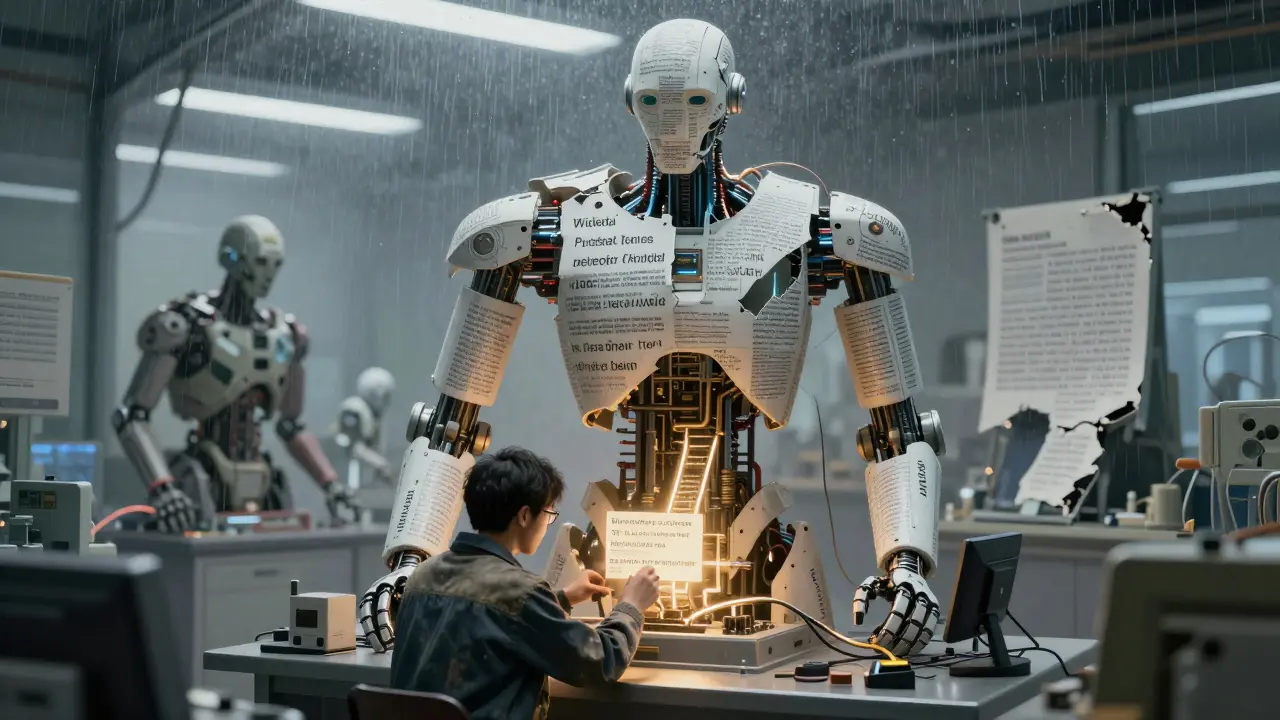
This is why companies like healthcare startups, customer service platforms, and legal tech firms - who never had the data or budget for AI - are now using NLP. They didn’t build a model. They adapted one.
How It’s Used Today
Transfer learning isn’t just academic. It’s in your daily life.
- Chatbots - A bank’s chatbot doesn’t have its own AI. It’s a fine-tuned version of Llama 3 or GPT-4, trained on customer service logs.
- Document summarization - Legal firms use models fine-tuned on contracts to pull out key clauses in seconds.
- Medical coding - Hospitals use models pre-trained on medical journals and fine-tuned on patient notes to auto-code diagnoses.
- Customer feedback analysis - A retail brand can analyze 100,000 reviews without hiring a team to read them all.
Even tools like Grammarly or Notion AI aren’t built from scratch. They’re built on top of pre-trained models. The real innovation isn’t the tool - it’s the foundation beneath it.
What’s Next
Transfer learning is no longer new. But it’s still evolving.
One direction is domain adaptation: instead of fine-tuning on a few hundred examples, you give the model a small corpus of your own data - say, internal emails or product manuals - and let it adjust quietly, without labeled examples. This is called unsupervised fine-tuning.
Another is parameter-efficient fine-tuning. Instead of updating all 175 billion weights in GPT-4, you only tweak a few hundred. Techniques like LoRA (Low-Rank Adaptation) let you adapt massive models on a laptop. That’s why you can now run a customized LLM on your phone.
And then there’s multimodal transfer: using text pre-training to help image models understand captions, or vision models help text models understand context. The lines between NLP and computer vision are blurring.
But the biggest shift? It’s no longer about building the best model. It’s about finding the right pre-trained model and adapting it well. The race isn’t to train bigger models - it’s to reuse smarter.
Challenges and Limits
Transfer learning isn’t perfect.
First, garbage in, garbage out. If the pre-trained model learned biased language - sexist, racist, or misleading patterns - fine-tuning won’t fix that. It might even amplify it.
Second, you still need quality data for fine-tuning. If your 500 labeled examples are messy, inconsistent, or too narrow, the model will be too.
Third, not every task benefits. For highly specialized tasks - say, decoding ancient scripts - you might still need to train from scratch. Transfer learning works best when the pre-training data overlaps with your target task.
And yes, the models are huge. Even though fine-tuning is cheap, downloading a 10GB model isn’t trivial. But tools like Hugging Face and quantized versions (like TinyBERT) are making this easier every month.
Still, the trade-off is worth it. You get near-state-of-the-art performance with 1% of the effort.
Final Thought
Transfer learning didn’t just make NLP better. It made it accessible.
Before, only Google, Meta, and OpenAI could build powerful language models. Now, a grad student with a laptop can take a pre-trained model, tweak it for their thesis, and publish results that rival big labs.
It’s like the shift from building your own car to buying a Toyota and upgrading the stereo. You still need skill. You still need to understand how it works. But you don’t need to forge the steel, cast the engine, or weld the frame.
That’s the real breakthrough. The foundation is built. Now, everyone gets to build on top of it.
What is the difference between pre-training and fine-tuning in transfer learning?
Pre-training is when a model learns general language patterns by reading massive amounts of unlabeled text - like books or web pages. It doesn’t know what sentiment or translation means yet. Fine-tuning is when you take that pre-trained model and train it on a small, labeled dataset for a specific task - like classifying customer reviews or answering questions. The model keeps most of what it learned during pre-training but adjusts just enough to excel at the new job.
Do I need a GPU to use transfer learning in NLP?
You don’t need a GPU for fine-tuning small models on limited data - many can run on a modern laptop. But pre-training requires massive computing power, and that’s why you usually skip it. Most people start with a pre-trained model from Hugging Face or another source. Fine-tuning on 1,000 examples might take 30 minutes on a single GPU. If you’re just experimenting, cloud services like Google Colab offer free GPU access.
Can transfer learning work with small datasets?
Yes - that’s one of its biggest strengths. A model pre-trained on billions of sentences already understands language structure. Fine-tuning it on just 100 labeled examples often outperforms a model trained from scratch on 10,000. This is why transfer learning is perfect for niche domains like legal documents, medical notes, or customer support logs where labeled data is scarce.
Is BERT still the best model for transfer learning?
BERT was revolutionary, but it’s not the best anymore. Models like Llama 3, Mistral, and GPT-4 often perform better, especially on complex tasks. However, BERT is still widely used because it’s lightweight, well-documented, and works great for tasks like text classification or named entity recognition. The best model depends on your task, data size, and hardware - not just age.
What’s the biggest mistake people make when using transfer learning?
They assume the pre-trained model is "smart" and skip checking for bias or mismatched domains. If you use a model trained on news articles to analyze social media slang, it might fail badly. Or if the pre-training data had gender stereotypes, fine-tuning won’t fix that - it might make it worse. Always audit your pre-trained model’s source data and test performance on real examples before deployment.



Comments
Sheetal Srivastava
Let’s be real-the real magic isn’t in BERT or GPT, it’s in the ontological reconfiguration of linguistic epistemes through self-supervised latent space alignment. We’re not just fine-tuning models; we’re engaging in semantic transduction at scale, where the pre-trained transformer becomes a distributed cognition substrate. The paradigm shift isn’t technical-it’s phenomenological. Language isn’t a system to be modeled anymore; it’s an emergent field of meaning that we now merely calibrate. This is post-linguistic AI.
And don’t get me started on LoRA. Low-rank adaptation isn’t parameter efficiency-it’s epistemic minimalism. You’re not tweaking weights; you’re sculpting the latent topology of collective discourse with surgical precision. The model doesn’t learn-it remembers. And we’re just the curators.
February 28, 2026 AT 08:37
Bhavishya Kumar
There is a critical error in the article's use of the term 'self-supervised learning tricks.' This is not a trick. It is a rigorously defined methodology within the field of computational linguistics. Furthermore, the phrase 'the entire internet' is imprecise. The training corpora consist of curated, filtered, deduplicated datasets-commonly drawn from Common Crawl, BooksCorpus, and Wikipedia. To imply unrestricted access to 'the internet' is misleading and undermines academic rigor.
Additionally, the comparison between training on 10 million examples versus 1,000 is statistically invalid without specifying variance, confidence intervals, or baseline model architecture. Please cite sources. Precision matters.
February 28, 2026 AT 20:34
ujjwal fouzdar
Bro. Think about it. We’re not just talking about AI here. We’re talking about the soul of language. The moment a machine reads a Reddit thread and *feels* the sarcasm-that’s not math. That’s communion. BERT didn’t just learn word patterns. It learned the loneliness behind a tweet, the joy in a poem, the rage in a comment section. We gave it the internet. And it… understood us. Not perfectly. But enough.
And now? We’re fine-tuning it to write legal clauses? To code? To summarize medical notes? That’s like giving Van Gogh a paintbrush and asking him to fix your leaky faucet. It’s beautiful. It’s terrifying. It’s the end of human exclusivity in meaning-making.
I cried when I saw my dog’s bark get transcribed into a haiku by a fine-tuned Whisper model. Not because it was accurate. Because it was… poetic.
February 28, 2026 AT 22:01
Anand Pandit
Really glad you wrote this-this is such a clear breakdown. I’ve been trying to explain transfer learning to my team for months, and this nails it. The car analogy at the end? Perfect. I’ve been using that exact comparison with clients!
Just wanted to add: for anyone starting out, Hugging Face’s model hub is a game-changer. You can download a TinyBERT, fine-tune it on 200 labeled examples in Colab for free, and deploy it in a weekend. No need to wait for GPT-4. Start small. Iterate. You’ll be amazed how far you can go.
Also, if you’re worried about bias-check out the Model Cards on Hugging Face. They list training data sources and known limitations. Transparency is key.
March 1, 2026 AT 20:42
Reshma Jose
YES. This is why I switched from trying to train my own models to just fine-tuning. I was wasting months. Now I grab a Llama 3 base model, throw in 50 customer support logs, and boom-my chatbot actually understands when someone’s frustrated. No more robotic responses.
Also, don’t sleep on ALBERT. It’s tiny. Runs on my old laptop. Perfect for prototyping. I used it for a school project and got an A+. Everyone thinks you need a supercomputer. Nope. Just know what you’re doing.
March 1, 2026 AT 21:12
rahul shrimali
Pretrain then fine tune. That’s it. No overthinking. Just use Hugging Face. Done.
March 2, 2026 AT 17:08