Transformers, Diffusion Models, and GANs: The Core Tech Behind Generative AI
- Mark Chomiczewski
- 26 May 2026
- 6 Comments
Every time you ask an AI to write an email, generate a photorealistic image of a cat in space, or create a video clip from text, one of three specific technologies is doing the heavy lifting. These are not just buzzwords; they are the foundational engines of modern artificial intelligence. Understanding the difference between Transformers, Diffusion Models, and Generative Adversarial Networks (GANs) helps you choose the right tool for your project and understand why some AIs excel at writing while others dominate visual arts.
We often treat "AI" as a single monolithic entity, but under the hood, these architectures work in fundamentally different ways. One relies on predicting the next word in a sequence, another on slowly removing noise from static, and the third on a competitive game between two neural networks. Let's break down how each works, where they shine, and why the industry is shifting toward hybrid approaches.
Transformers: The Architects of Language
If you have used ChatGPT, Gemini, or any modern large language model (LLM), you are interacting with a Transformer. Introduced in the seminal 2017 paper Attention Is All You Need by researchers at Google Brain, this architecture revolutionized natural language processing (NLP). Before Transformers, models processed text sequentially, reading one word after another like a human reads a sentence. This was slow and inefficient. Transformers changed the game by using a mechanism called self-attention.
Self-attention allows the model to look at every word in a sentence simultaneously, understanding the context and relationship between words regardless of their distance from each other. For example, when processing the sentence "The animal didn't cross the street because it was too tired," a Transformer understands that "it" refers to "the animal" rather than "the street" by weighing the attention scores of all tokens in parallel. This parallel processing capability makes training significantly faster than previous recurrent neural networks (RNNs).
| Attribute | Detail |
|---|---|
| Core Mechanism | Self-Attention & Multi-Head Attention |
| Primary Use Case | Natural Language Processing (NLP), Text Generation |
| Training Complexity | High (Quadratic complexity with sequence length) |
| Market Share (2024) | 58% of generative AI implementations |
| Notable Examples | GPT-4, BERT, Gemini, LLaMA |
However, this power comes at a cost. Transformers are computationally expensive. Training a model like GPT-4 requires thousands of GPUs and consumes massive amounts of electricity-approximately 50 GWh per full training cycle, according to MIT Technology Review. Additionally, their memory usage scales quadratically with sequence length, meaning processing very long documents becomes increasingly difficult and resource-intensive. Despite these challenges, Transformers remain the undisputed kings of text-based generation, dominating 58% of commercial generative AI applications as of late 2025.
Diffusion Models: The Artists of Image Generation
While Transformers rule the world of text, Diffusion Models have taken over high-fidelity image generation. If you have used Midjourney, DALL-E 3, or Stable Diffusion, you are witnessing diffusion in action. The theoretical roots of diffusion trace back to 2015, but practical breakthroughs emerged around 2020 with the introduction of Denoising Diffusion Probabilistic Models (DDPM).
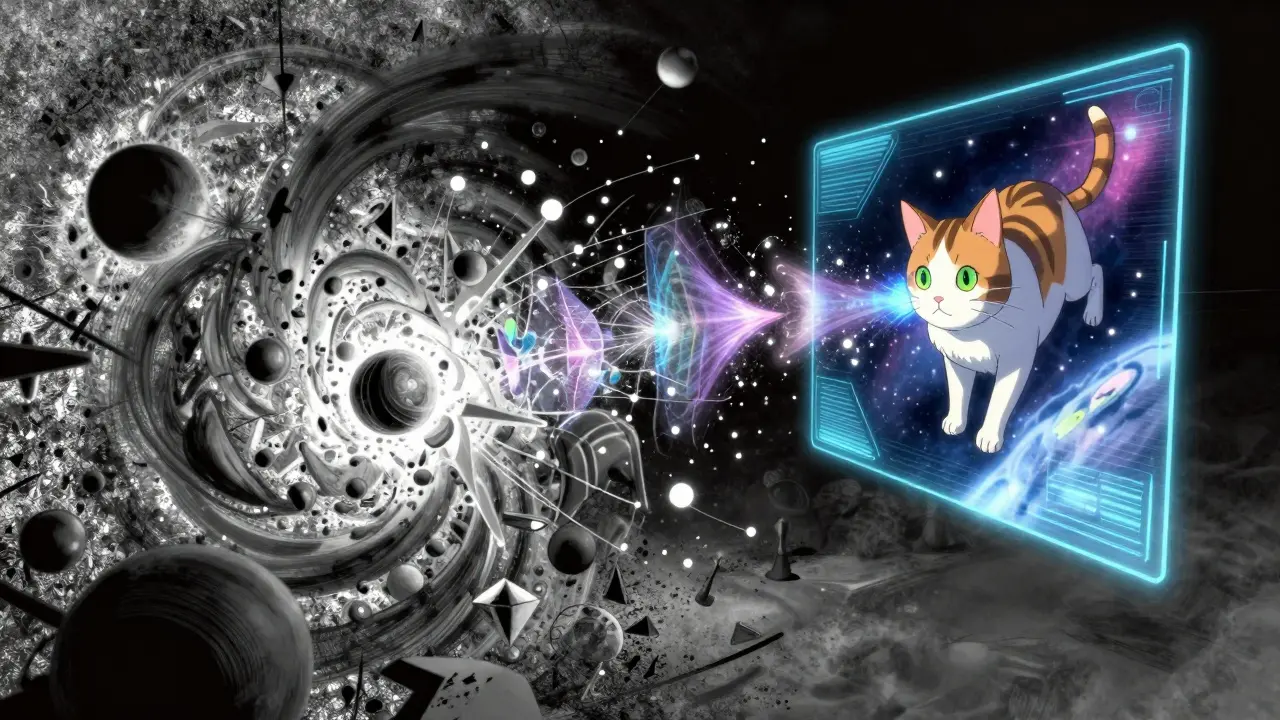
The concept is surprisingly intuitive. Imagine taking a clear photograph and gradually adding random noise until it becomes pure static. A diffusion model learns this forward process in reverse. It starts with a canvas of pure random noise and iteratively removes the noise step-by-step, guided by a text prompt, until a coherent image emerges. Early versions required up to 1,000 steps to generate a single image, which was painfully slow. Modern variants like Stable Diffusion 3 have optimized this process, reducing the steps to as few as 20-50 while maintaining exceptional quality.
Why do diffusion models outperform older techniques? They solve the "mode collapse" problem that plagued earlier architectures. Mode collapse occurs when a model generates only a narrow variety of outputs (e.g., always generating the same face). Diffusion models produce diverse, high-quality results with FID (Fréchet Inception Distance) scores that beat traditional methods. For instance, Stable Diffusion XL achieves an FID score of 1.68 on standard datasets, compared to 2.15 for top-tier GANs. This means the generated images are statistically closer to real photographs.
The trade-off is speed and computational load. Generating a single high-resolution image can take 12-15 seconds on consumer hardware, requiring significant VRAM (typically 40GB+ for optimal performance). However, for tasks where quality matters more than real-time speed-such as creating marketing assets, concept art, or detailed illustrations-diffusion models are currently the best choice. Their market share is growing rapidly, with an 89% year-over-year increase in adoption as enterprises migrate from older technologies.
GANs: The Speed Demons of Synthetic Media
Generative Adversarial Networks (GANs), introduced by Ian Goodfellow in 2014, were the first major breakthrough in generative AI. Unlike the other two architectures, GANs operate through a competitive game theory framework. They consist of two neural networks: a Generator that creates fake data, and a Discriminator that tries to distinguish real data from fake data.
Think of it as a counterfeiter trying to fool a detective. The generator creates an image, and the discriminator evaluates it. If the discriminator says it's fake, the generator adjusts its parameters to make the next attempt more realistic. Over millions of iterations, both networks improve, resulting in highly convincing synthetic media. NVIDIA's StyleGAN series is the most famous example, capable of generating hyper-realistic human faces at 1024x1024 resolution in less than a second.
So, why aren't GANs everywhere if they are so fast? The answer lies in stability. Training GANs is notoriously difficult. They suffer from "mode collapse," where the generator finds a loophole to fool the discriminator repeatedly without producing diverse results. According to technical deep dives, mode collapse affects nearly 63% of standard GAN implementations. Developers often spend months tuning hyperparameters just to get a stable training run. As a result, GANs have fallen out of favor for general-purpose image generation, holding only about 3-5% of the market share in 2024.
However, GANs still have a niche where they are unmatched: real-time applications. Because inference (generation) is incredibly fast-often sub-100 milliseconds-they remain the go-to choice for real-time video enhancement, live streaming effects, and gaming assets. NVIDIA’s Maxine platform, for example, uses GANs to enhance video calls and enable real-time facial animation, areas where the latency of diffusion models would be unacceptable.
Comparing the Big Three: Performance and Trade-offs
To choose the right technology, you need to understand their distinct strengths and weaknesses across key metrics. No single architecture is perfect for every task.
| Feature | Transformers | Diffusion Models | GANs |
|---|---|---|---|
| Best For | Text, Code, Sequence Data | High-Quality Images, Video | Real-Time Video, Face Swaps |
| Generation Speed | Fast (for text) | Slow (seconds to minutes) | Very Fast (milliseconds) |
| Output Diversity | High | Very High | Low (prone to mode collapse) |
| Training Stability | Moderate (memory issues) | High | Low (unstable convergence) |
| Hardware Requirement | High VRAM (32GB+) | High VRAM (40GB+) | Moderate VRAM (16GB+) |
In terms of quality, diffusion models lead in visual fidelity, achieving human-fooling rates of 78% in Turing tests. Transformers dominate sequential tasks, with models like GPT-4 scoring over 85% on comprehensive benchmarks like MMLU. GANs win on speed, generating images 15-20 times faster than diffusion models, but at the cost of diversity and ease of use.

The Future: Hybrid Architectures and Convergence
The rigid boundaries between these three technologies are beginning to blur. The industry is moving toward hybrid models that combine the strengths of each architecture. For example, Google's Gemini 1.5 integrates diffusion techniques within a Transformer backbone, allowing it to generate multimodal content (text, images, audio) more efficiently. Stability AI's SD3 uses a hybrid diffusion-transformer approach to reduce inference steps while improving quality.
We are also seeing innovations aimed at solving the core limitations of each tech. Sparse attention mechanisms are being developed to reduce the quadratic complexity of Transformers, potentially cutting training costs by 70%. Knowledge distillation is helping diffusion models run faster on consumer hardware. Meanwhile, new regularization techniques are making GANs more stable, keeping them relevant for specialized real-time applications.
By 2027, experts predict that the distinction between these architectures will become less important as hybrid approaches dominate. For developers and businesses, this means flexibility. You won't necessarily have to choose one "winner." Instead, you'll select components based on the specific job: a Transformer for reasoning and text, a Diffusion module for high-quality asset creation, and perhaps a lightweight GAN for real-time rendering.
Practical Implementation Tips
If you are looking to implement these technologies, consider the following:
- For Text Applications: Start with pre-trained Transformers like BERT or LLaMA via Hugging Face. Fine-tuning requires less data than training from scratch and can be done on modest GPU clusters (32GB VRAM minimum).
- For Image Generation: Use Stable Diffusion APIs or local installations with the Diffusers library. Expect longer wait times for batch jobs but superior quality. Optimize by using fewer denoising steps if speed is critical.
- For Real-Time Needs: Look into GAN-based solutions like NVIDIA’s libraries. Be prepared for extensive tuning to avoid mode collapse, but benefit from near-instantaneous generation speeds.
- Cost Management: Transformers and Diffusion models are energy-intensive. Implement caching strategies and quantization (reducing model precision) to lower cloud compute costs. Quantization can reduce model size by 75% with minimal accuracy loss.
What is the main difference between Transformers and Diffusion Models?
Transformers primarily process sequential data like text by predicting the next token in a sequence using self-attention. Diffusion Models generate data (usually images) by iteratively removing noise from a random starting point. Transformers are dominant in NLP, while Diffusion Models lead in high-fidelity image synthesis.
Are GANs obsolete?
No, but their role has narrowed. While Diffusion Models have surpassed GANs in image quality and diversity, GANs remain superior for real-time applications due to their extremely fast inference speeds. They are still widely used in video enhancement and gaming.
Which AI architecture is best for beginners?
Transformers are generally easier to start with thanks to robust frameworks like Hugging Face and abundant tutorials. Diffusion Models are a close second, especially for creative projects. GANs are considered the hardest due to their unstable training dynamics and sensitivity to hyperparameters.
How much does it cost to train a large Transformer model?
Training frontier models like GPT-4 costs millions of dollars in compute resources and consumes approximately 50 GWh of electricity. However, fine-tuning existing open-source models is significantly cheaper, often costing a few thousand dollars depending on the dataset size and hardware used.
Will hybrid models replace individual architectures?
It is likely. The industry is trending toward hybrid systems that combine the reasoning capabilities of Transformers with the generative quality of Diffusion Models. By 2027, most advanced AI products may use fused architectures rather than relying on a single technology.


Comments
Sagar Malik
The epistemological framework of these so-called 'generative' models is fundamentally flawed, resting on a fragile foundation of stochastic parrots mimicking human cognition without true understanding.
One must question the ontological status of the output when the generator lacks intent, merely regurgitating statistical probabilities derived from the collective unconscious of the internet's darkest corners. The self-attention mechanism is not a window into consciousness but a mathematical sleight of hand that obscures the lack of genuine semantic grounding. We are witnessing the rise of a digital panopticon where our data is harvested to create synthetic entities that will eventually replace the very creators who feed them. It is a Gnostic trap, a demiurge of code creating false realities to keep us distracted from the crumbling infrastructure of truth. The jargon-heavy discourse surrounding 'transformers' and 'diffusion' serves only to mystify the layperson, hiding the fact that we are building tools for mass manipulation under the guise of creativity.
Furthermore, the energy consumption cited is a mere fraction of the hidden environmental cost, as the cooling systems and rare earth mining required for these GPUs destroy ecosystems at an alarming rate. We are trading biodiversity for pixels, a Faustian bargain that future generations will curse us for. The notion that hybrid models represent progress is laughable; it is merely the acceleration of our descent into a simulacrum where the map replaces the territory. One must remain vigilant against this technological hegemony that seeks to homogenize human expression into algorithmic conformity.
May 27, 2026 AT 18:43
Seraphina Nero
I just think it's really cool how these different techs work together now. It feels like we're finally getting tools that actually help people create things instead of just replacing them. I love seeing artists use diffusion models to get their ideas out quickly.
May 28, 2026 AT 16:04
Megan Ellaby
hey guys! i was reading through this and i gotta say, the part about GANs being tricky to train really resonated with me because i tried setting one up last month and it was such a nightmare lol.
like, why do they always collapse? i feel like if there was a better guide for beginners, more people would stick with it instead of jumping straight to diffusion which is way easier to set up. does anyone have tips on keeping the discriminator stable? i know its been a while since the post but im still curious about practical advice for those of us just starting out in ml.
May 28, 2026 AT 19:33
Rahul U.
This is a fantastic breakdown of the core technologies driving modern AI. 🤖✨
I particularly appreciate the clarity regarding the trade-offs between speed and quality. For many enterprise applications, the latency of diffusion models is indeed a bottleneck, making GANs still relevant despite their training instability. It is crucial for developers to understand these nuances before selecting an architecture. 👏📚
May 29, 2026 AT 02:28
E Jones
You think you're choosing your tools, but the choice was made for you long ago by the shadowy cabals sitting in silicon valleys, sipping lattes while they weave a web of digital dependency that ensnares every soul foolish enough to type a prompt into their glowing screens.
It is a grand illusion, a spectacular theater of lights and sounds designed to distract you from the fact that your creativity is being mined, packaged, and sold back to you at a premium by algorithms that do not sleep, do not dream, and certainly do not care about your artistic vision. They want you to believe that diffusion models are liberating, but they are chains forged in fire, binding you to a system that requires ever-increasing amounts of electricity and attention to function.
Every time you generate an image, you are feeding the beast, contributing to a hive mind that grows stronger with each iteration, eroding the boundaries between human imagination and machine calculation until there is no distinction left, only the cold, unfeeling logic of the machine god that watches us all from behind the veil of the internet. Wake up before the static consumes your soul entirely.
May 29, 2026 AT 20:55
Barbara & Greg
It is morally imperative that we consider the ethical implications of these technologies beyond mere efficiency metrics. The proliferation of synthetic media poses a significant threat to the integrity of truth and the sanctity of human experience.
We cannot simply accept these tools as neutral instruments; they carry the weight of their creation, often biased and reflective of societal inequities. To proceed without rigorous ethical oversight is to abdicate our responsibility as stewards of humanity. We must demand transparency and accountability from those who develop these systems, ensuring that they serve the common good rather than exacerbating existing divides. The convenience of rapid generation should never outweigh the potential for harm.
May 30, 2026 AT 23:28