Vibe Coding and Open Source: Which Licenses are Safe for Your Project?

- Mark Chomiczewski
- 11 April 2026
- 9 Comments
Imagine building a full-scale SaaS product in a weekend. You describe the features in plain English, and the AI spits out functional code. This is vibe coding, a shift where we stop writing line-by-line and start describing the "vibe" and functionality of our software. It sounds like magic, but there's a hidden trap: the AI doesn't actually "write" code from scratch. It predicts patterns based on millions of existing open-source repositories. If the AI pulls a pattern from a restrictive license, your entire commercial project could suddenly become a legal liability.
What is Vibe Coding Exactly?
At its core, Vibe Coding is a paradigm of AI-assisted programming where developers use natural language to generate functional software, focusing on high-level intent rather than manual syntax . It gained momentum with tools like GitHub Copilot is an AI pair programmer that suggests code snippets and entire functions in real-time and newer platforms like Cloudflare VibeSDK is a development kit launched in 2025 that enables rapid app deployment on Cloudflare Workers using natural language .
The process usually follows a specific flow: you provide a prompt, the AI creates a blueprint, generates the code, and then lets you iterate through a chat interface. While this accelerates development cycles by 40-60%, it creates a massive "provenance" problem. AI models can't reliably tell you exactly which license applied to the specific snippet they just gave you. According to a 2025 MIT CSAIL study, while about 90% of AI-generated code is syntactically correct, only around 70% actually adheres to the licensing requirements of the original patterns it mimics.
The Good, the Bad, and the Risky: License Breakdown
When you use vibe coding, you aren't just using a tool; you're inheriting the legal DNA of the training data. Not all open-source licenses are created equal. Some are "permissive," meaning they let you do almost whatever you want, while others are "copyleft," which can force you to open-source your own proprietary code.
| License Type | Examples | Risk Level | Impact on Commercial Projects |
|---|---|---|---|
| Permissive | MIT, Apache 2.0, BSD 3-Clause | Low (1-2/10) | Safe for commercial use; usually requires only simple attribution. |
| Weak Copyleft | MPL 2.0 | Medium (5/10) | File-level requirements; manageable if isolated. |
| Strong Copyleft | GPL v2/v3, AGPL v3 | High (9-10/10) | High risk; may require you to open-source your entire product. |
For most developers, the MIT License is a short, permissive software license that allows reuse with very few restrictions is the gold standard. It's why Cloudflare chose it for VibeSDK. On the flip side, the GNU General Public License (GPL) is a copyleft license that requires any derivative work to be distributed under the same license can be a nightmare. If your AI accidentally inserts a GPL-licensed utility function into your closed-source SaaS, you might technically be in violation of the license, which could lead to a cease-and-desist order.

How to Avoid "License Contamination"
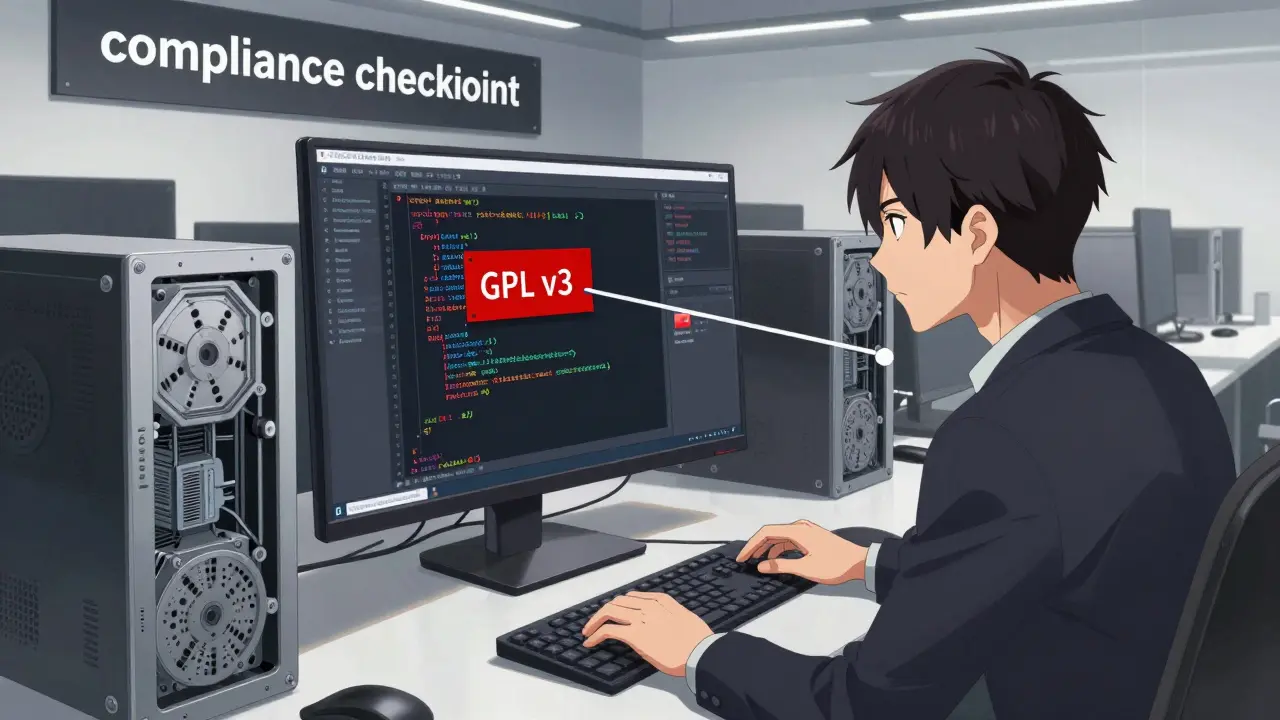
You can't just trust the AI to be honest about where the code came from. Professional teams are now treating AI output as "untrusted" until it passes a compliance check. If you're building for a company, you need a system to catch these leaks before they hit production.
Start by using tools that filter the training data. For example, some enterprise versions of AI tools explicitly remove GPL-licensed code from their training sets to prevent this exact problem. If you're using a more open tool, you should implement an automated scanning pipeline. Tools like FOSSA or Snyk can scan your final codebase for known license patterns and flag anything that looks like it came from a restrictive source.
Another pro move is to use "code referencing." GitHub has started implementing features that show you the source repository and license of a suggestion. If the AI suggests a block of code and the reference says "GPL v3," that's your signal to rewrite it or find a permissive alternative. Don't just hit tab and accept; treat it like a code review for a junior developer who forgets to cite their sources.
Practical Steps for Vibe Coders
Whether you're a solo founder or part of a Fortune 500 team, you need a repeatable process to keep your project legally clean. Relying on "vibes" for legal compliance is a recipe for disaster.
- Check the Platform License: Before you start, check if the platform itself (like VibeSDK or Convex Chef) uses a permissive license. If the platform's own core is restrictive, your output might be too.
- Audit with License Checkers: Use an open-source license checker like
licensee. Run this on every major milestone or before every production deployment. - Maintain Provenance Records: Keep a log of which AI models and versions you used for specific modules. If a legal question arises later, you can at least identify which parts of the system were AI-generated.
- Rewrite High-Risk Snippets: If a scanner flags a piece of code as potentially GPL, don't just change a few variable names. Rewrite the logic from scratch to ensure you aren't copying the protected structure.
The Future of AI Compliance
We're moving toward a world where licenses are machine-readable. The upcoming SPDX AI License Specification aims to provide metadata that allows AI tools to automatically track and attribute licenses in real-time. This would essentially remove the guessing game, allowing the AI to say, "I'm using a pattern from this MIT-licensed project, and here is the attribution."
Until then, the safest bet is to stick to platforms built on permissive foundations. The data shows that MIT-licensed platforms see significantly higher enterprise adoption because the legal path is clear. If you want your project to be investable or sellable, keeping it free of copyleft "contamination" is just as important as the code actually working.
Can I use AI-generated code in a commercial product?
Yes, but it depends on the license of the training data the AI used. If the AI generates code that is a verbatim copy of a GPL-licensed project, you may be required to open-source your own project. Using permissive licenses like MIT or Apache 2.0 is generally safe for commercial use.
What is the difference between permissive and copyleft licenses?
Permissive licenses (like MIT) allow you to use, modify, and sell the code with very few restrictions, usually just requiring that the original copyright notice be kept. Copyleft licenses (like GPL) require that any software built using that code also be released under the same open-source license, meaning you cannot keep your project proprietary.
How do I know if my vibe coding tool is introducing legal risks?
The most reliable way is to use automated license scanning tools like Snyk or FOSSA. You should also check if your AI tool has a "code referencing" feature that tells you where a snippet came from and what license it carries.
Is MIT-licensed code always 100% safe?
While it's the safest common option, no license is a total shield. Some code may still be subject to patent claims or other specific legal encumbrances that a simple MIT license doesn't cover, although this is much rarer than copyleft issues.
What should I do if I find GPL code in my commercial project?
The safest path is to remove the offending code immediately and rewrite the functionality from scratch. Do not simply rename variables or tweak the syntax, as the underlying logic and structure may still be considered a derivative work under copyleft laws.



Comments
Kendall Storey
Total game changer for the dev cycle but yeah, the provenance issue is a real headache. Most people are just shipping this stuff blindly without any SCA tools in their pipeline. If you aren't running a proper audit, you're basically just playing Russian roulette with your IP. Keep grinding though, the velocity is insane!
April 11, 2026 AT 08:53
Kevin Hagerty
wow look at us vibing lol... imagine thinking a scanner actually saves u when the AI just hallucinated a a
April 11, 2026 AT 14:03
Megan Blakeman
I really love the idea of machine-readable licenses!!! It feels like such a beautiful way to bring harmony back to the coding community... :) maybe we can all just share everything anyway??? <3
April 12, 2026 AT 01:35
Janiss McCamish
Snyk is great for this. Just integrate it into your CI/CD. It catches the GPL leaks early.
April 13, 2026 AT 08:31
Robert Byrne
Are you kidding me with the way some people just ignore the legal implications? It is absolutely reckless to just
April 13, 2026 AT 18:57
Akhil Bellam
The sheer audacity of calling this "vibe coding"... it's merely a masquerade for intellectual laziness!!! One must possess a profound understanding of the architectural foundations before outsourcing the logic to a probabilistic parrot, otherwise, you are simply decorating a house of cards with expensive wallpaper... how quaint!!!
April 15, 2026 AT 13:20
Tia Muzdalifah
pretty cool stuff actually, just gotta be careful with the copyleft things lol
April 16, 2026 AT 07:33
Amber Swartz
Honestly, the fact that people are even debating this instead of just writing their own code is a tragedy. We've reached a point where the "vibe" matters more than the actual engineering. It's absolutely pathetic that we're treating AI like some magical oracle while our legal standards are basically nonexistent. I can't believe I'm seeing this in 2025. It's a total circus and everyone is just pretending it's a revolution.
April 16, 2026 AT 16:13
Richard H
We need to stop relying on these foreign-trained models and start building our own American-made AI stacks from the ground up so we actually own the intellectual property without some weird loophole from a globalized training set! Keep it domestic or keep it risky!
April 17, 2026 AT 08:55