Vision-Language Applications with Multimodal Large Language Models: A Practical Guide

- Mark Chomiczewski
- 24 July 2026
- 0 Comments
Imagine an AI that doesn't just read your text but actually sees the screenshot you attach to it. That is the reality we are living in now. We have moved past the era of separate tools for images and text. Today, Multimodal Large Language Models (MLLMs) are AI systems that seamlessly combine image understanding with natural language processing capabilities, enabling machines to 'see' and 'read' simultaneously by processing both visual inputs and textual information within a unified framework. This shift isn't just a technical upgrade; it is a fundamental change in how we interact with digital information.
In late 2024 and early 2025, these models transitioned from experimental buzzwords to baseline requirements for enterprise AI. Open-source contenders like GLM-4.6V and Qwen3-VL are now competing directly with proprietary giants like GPT-5 and Gemini-2.5-Pro. But what does this mean for developers and businesses? It means you can build applications that interpret medical scans, analyze satellite imagery, or process legal documents with a level of contextual understanding that was impossible just two years ago.
How MLLMs Work: The Architecture Behind the Magic
To use these models effectively, you need to understand how they connect vision to language. There isn't one single way to build them. Researchers and engineers generally rely on three main architectural approaches, each with distinct trade-offs in speed and accuracy.
| Architecture Type | Key Strength | Weakness | Best Use Case |
|---|---|---|---|
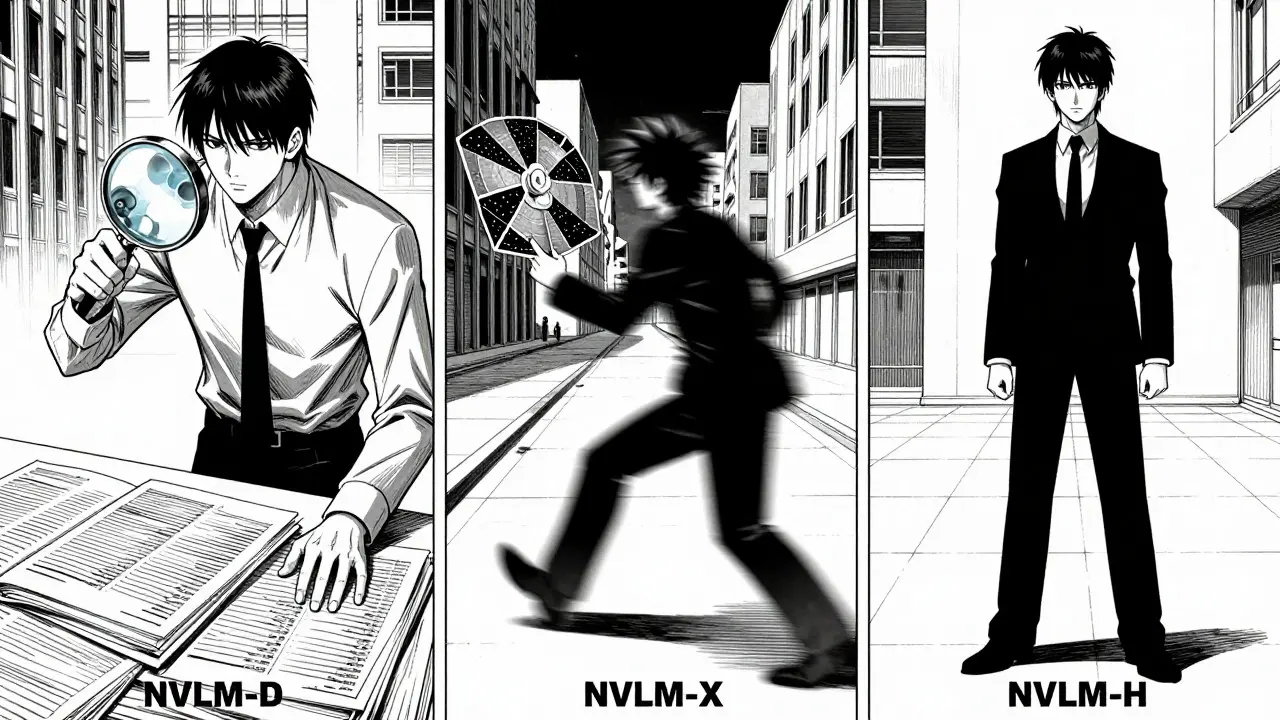
| NVLM-D (Decoupled) | High OCR Accuracy (5-8% higher) | Higher Computational Cost (25-30% more resources) | Document Processing, Legal Archives |
| NVLM-X (Cross-Attention) | Computational Efficiency (15-20% faster for high-res) | Lower OCR Accuracy (3-5% drop) | Satellite Imagery, Real-time Video Analysis |
| NVLM-H (Hybrid) | Balanced Performance | Complex Implementation | General-Purpose Applications |
The NVLM-D approach processes images through specialized pathways before passing them to the language model. This separation ensures that text within images-like handwritten notes or dense financial tables-is captured with extreme precision. On the other hand, NVLM-X integrates visual features directly into the attention mechanism of the language model. This makes it incredibly fast for processing high-resolution images, such as those used in remote sensing, but it might miss fine print details. Most general-purpose apps today use the hybrid NVLM-H approach to get the best of both worlds.
Leading Models in the 2025 Landscape
The market has shifted dramatically. While proprietary models still dominate consumer-facing apps, open-source options have become viable for enterprise deployment. As of late 2024, GLM-4.6V, released by Z.ai, became a standout example of this trend. It processes nearly 2,500 tokens per second on a single NVIDIA A100-40G GPU. More importantly, it compresses visual contexts by up to 20 times while maintaining 97% OCR accuracy at compression ratios below 10x.
This efficiency matters because context windows are expensive. GLM-4.6V supports a 128K context window, which sounds impressive until you realize that a single high-resolution image can consume 80% of that space before you even add any text instructions. Other notable players include Meta's Llama 3.2 image-text models (available in 11B and 90B parameter versions) and Qwen3-VL. For robotics specifically, the Janus architecture has shown promise by decoupling visual encoding for understanding versus generation, improving embodied AI performance by 18%.
Real-World Applications: Where VLMs Add Value
Vision-Language Models are not just academic exercises. They are solving specific, painful problems across industries. Here is where they are making the biggest impact:
- Financial Services: About 42% of firms now use VLMs for document processing. Instead of manual data entry, the AI reads invoices, extracts line items, and cross-references them with contracts, reducing errors significantly.
- Healthcare: With 31% of healthcare organizations adopting these tools, VLMs assist in analyzing medical imaging. However, caution is needed; OCR accuracy drops from 97% to 82% on handwritten medical records, making them unsuitable for critical digitization without human oversight.
- Manufacturing: Quality control systems use VLMs to inspect products on assembly lines. The ability to "see" defects and "understand" the production standard allows for real-time adjustments.
- Robotics: Native tool use in models like GLM-4.6V has reduced command interpretation errors in robotics by 37%, allowing robots to better navigate complex environments based on visual cues.
Implementation Challenges: What Developers Are Facing
Deploying a VLM is harder than deploying a text-only LLM. According to surveys of enterprise implementations, teams typically need 2+ years of computer vision experience and 1+ year working with large language models to succeed. The average time to deploy a production-ready system is 14.3 weeks.
Here are the most common pitfalls reported by developers:
- Image Preprocessing Issues: This is the top complaint, appearing in 63% of GitHub issues. If your images aren't standardized in size, format, and quality, the model's performance will degrade rapidly.
- Context Window Management: High-resolution images eat up token limits quickly. You need strategies to downscale images without losing critical detail or using vision token compression techniques (adopted by 68% of successful deployments).
- Multimodal Hallucinations: VLMs hallucinate 8-12% more often than text-only LLMs. They might describe objects that aren't there or misinterpret visual relationships. Always validate outputs against the source image.
- Computational Costs: State-of-the-art models require $12,000-$15,000 in GPU resources for scale deployment. Training a single 70B-parameter VLM consumes approximately 1,200 MWh of electricity, raising sustainability concerns.
Choosing the Right Model for Your Needs
You don't always need the biggest model. In fact, choosing the wrong one can waste months of development time. Ask yourself these questions:
Do you need extreme OCR accuracy? If you are processing legal documents or financial statements, look at NVLM-D architectures or specialized models like GOT-OCR2.0. General-purpose models might miss small fonts or complex layouts.
Is speed your priority? If you are analyzing live video feeds or satellite imagery, NVLM-X architectures offer superior computational efficiency. The slight drop in text accuracy is worth the gain in throughput.
Are you building for robotics? Consider the Janus architecture. Its decoupled pathways for understanding and generation are specifically tuned for embodied AI tasks, offering a measurable performance boost over generic VLMs.
What is your budget? Open-source models like GLM-4.6V and Qwen3-VL are cost-effective if you have the engineering talent to fine-tune and deploy them. Proprietary APIs from OpenAI or Google are easier to start with but can become prohibitively expensive at scale due to token costs.

Regulatory and Ethical Considerations
As these models become more powerful, regulations are catching up. The EU AI Act, specifically Article 14a, addresses multimodal systems starting in January 2025. It requires transparency in cross-modal decision-making for high-risk applications. This means if your VLM helps decide on a loan application based on scanned documents, you must be able to explain how the visual data influenced the outcome.
Ethically, the risk of bias is higher in multimodal systems. An image dataset might underrepresent certain demographics, leading to skewed interpretations. Ensure your training data is diverse and audit your model's outputs regularly for fairness.
Future Trends: What to Expect in 2026 and Beyond
The trajectory for Vision-Language Models points toward specialization and efficiency. By 2026, experts predict that 60% of new models will focus on specific modalities like medical imaging or industrial inspection rather than being generalists. We also expect a 50% reduction in vision token requirements, making these models cheaper and faster to run.
Gartner analysts project that VLMs will be embedded in 85% of enterprise AI systems requiring visual understanding by 2027. The integration with robotics frameworks will deepen, with 73% of researchers prioritizing embodied AI applications. As hardware improves and algorithms become more efficient, the barrier to entry will lower, but the need for expert implementation will remain high.
What is the difference between a VLM and a traditional LLM?
A traditional Large Language Model (LLM) processes only text. A Vision-Language Model (VLM) combines a vision encoder (like ViT) with a language model to process both images and text simultaneously. This allows the AI to answer questions about visual content, not just written text.
Which GPU is required to run GLM-4.6V?
GLM-4.6V performs optimally on high-end GPUs like the NVIDIA A100-40G or H100. These cards provide the necessary VRAM and compute power to handle the model's 70+ billion parameters and large context windows efficiently.
Are open-source VLMs as good as proprietary ones?
In specific domains like document processing, open-source models like GLM-4.6V rival or exceed proprietary systems. However, proprietary models like GPT-5 and Gemini-2.5-Pro still lead in complex video understanding and general reasoning tasks, showing 12-15% higher accuracy on benchmarks like VideoMME.
What is the main challenge in deploying VLMs?
The primary challenges are computational cost and context management. High-resolution images consume vast amounts of tokens, and the hardware requirements for inference are significant. Additionally, managing multimodal hallucinations requires robust validation pipelines.
How do I reduce token usage for images?
Use vision token compression techniques. Models like GLM-4.6V support compressing visual contexts by up to 20x. Also, implement modality-specific preprocessing pipelines to resize and optimize images before sending them to the model.