Data Classification Rules for Vibe Coding Inputs and Outputs

- Mark Chomiczewski
- 27 May 2026
- 8 Comments
You type a prompt like "build me a user login page with database connection," and within seconds, the AI generates the HTML, CSS, JavaScript, and backend logic. It feels like magic. But if that generated code accidentally exposes your database credentials or mishandles Personally Identifiable Information (PII), the magic turns into a liability overnight. This is the core challenge of vibe coding: the speed of creation often outpaces the rigor of security.
Vibe coding is not just a new way to write software; it is a shift in how we govern data. When an AI model becomes your co-pilot, the traditional boundaries between developer intent and machine output blur. Without strict data classification rules, you risk deploying applications that are fundamentally insecure by design. The good news? You don't need to stop using these tools. You just need to classify your inputs and outputs correctly from day one.
The Four Tiers of Data Sensitivity in Vibe Coding
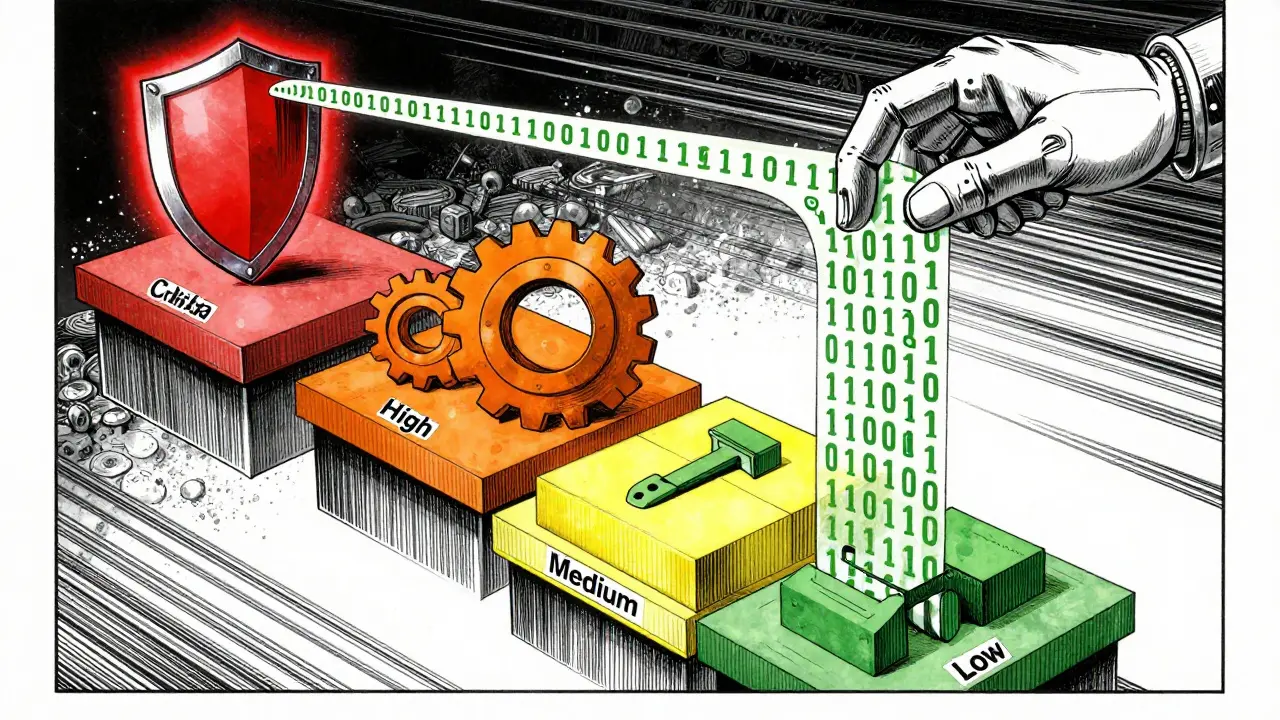
Not all code is created equal. A button that changes the background color poses zero risk. A function that processes credit card numbers poses existential risk. To manage this, the Vibe Coding Framework establishes a risk-stratified security classification system. This system organizes components into four distinct tiers: Critical, High, Medium, and Low. Understanding where your input falls determines how much scrutiny the output requires.
| Classification Tier | Data Type / Component | Verification Level | Required Actions |
|---|---|---|---|
| Critical | Financial data, Authentication mechanisms, PII | Level 3 | Security specialist review, comprehensive documentation |
| High | Data processing pipelines, Integration points (APIs) | Level 2 | Automated security scanning, peer review |
| Medium | Standard functionality, UI components | Level 2 | Automated scanning protocols |
| Low | Internal tools, Non-critical utilities | Level 1 | Ongoing compliance monitoring |
If you ask the AI to generate a payment gateway integration, that is a Critical tier task. You cannot rely on the default output. You must mandate Level 3 verification, which involves a human security specialist reviewing every line of code. For a simple internal dashboard widget (Low tier), automated monitoring is sufficient. The key is matching the verification intensity to the potential impact of a breach.
Handling PII: The Detection Trap
One of the most dangerous areas in vibe coding is the handling of Personally Identifiable Information (PII). Research by David Jayatillake highlights a specific vulnerability here. Detecting PII patterns using regular expressions (regex) is technically easy for an AI. Constructing permutation tests to identify PII groupings is also straightforward. The problem isn't the detection logic itself; it's the sequencing.
In many data classification tools, there is a distinction between "main bulk tagging" and "auto-tagging." If the AI applies exclusion logic after tagging operations rather than before, the exclusions become ineffective. Imagine telling the AI, "Tag all emails as PII, except for our support team emails." If the tool tags everything first and then tries to exclude the support team, but the exclusion rule fails due to a slight format variation, those support emails remain tagged as sensitive PII-or worse, untagged PII leaks out because the exclusion was applied incorrectly.
To mitigate this, you must enforce strict classification logic sequencing in your prompts. Explicitly instruct the AI to define exclusion criteria before applying any tagging rules. This ensures that known safe data sets are carved out before the broader PII detection algorithms run.
Environment Variables vs. Hardcoded Secrets
Here is a hard truth: AI models love to hardcode secrets. When you ask for a database connection string, the AI might generate `const dbUrl = 'postgres://user:password@localhost/db';`. This is a critical failure of data classification. The Cloud Security Alliance's Secure Vibe Coding Guide explicitly recommends against this. Sensitive data-database URLs, usernames, passwords, API keys-must never be embedded in the generated code.
Instead, your data classification rules must mandate the use of environment variables. Your prompt should include a constraint: "Do not include hardcoded credentials. Use environment variables for all sensitive configuration." This shifts the responsibility of secret management to the deployment environment, where proper encryption and access controls exist.
This rule extends to API authentication. If the AI generates code that calls an external service, ensure it uses tokens stored in environment variables rather than static strings. This distinction between development convenience and production security is vital. Vibe coding tools often default to permissive configurations for ease of testing, but these defaults are disastrous in production.
CORS and Row-Level Security Misconfigurations
Two technical areas consistently fail in vibe-coded outputs: Cross-Origin Resource Sharing (CORS) and Row-Level Security (RLS). Both represent failures in classifying the sensitivity of access controls.
CORS Wildcards: AI tools frequently generate CORS configurations using wildcard (`*`) settings. This permits unrestricted cross-origin access, effectively opening your API to any website. While convenient for local development, this is a severe security risk in production. You must manually verify and reconfigure CORS policies to restrict access to only trusted domains. Treat any wildcard CORS setting as a Critical classification error until proven otherwise.
Row-Level Security (RLS): In platforms like Supabase, RLS policies ensure users can only access their own data. However, research by Escape Technologies revealed over 2,000 vulnerabilities in vibe-coded applications, largely due to misconfigured RLS. Default Supabase rules are permissive, suitable only for development. Vibe coding tools often generate frontend code that exposes JWT tokens improperly, bypassing backend checks. You must explicitly implement row-level access controls and verify that authentication tokens are handled securely across both API and database layers. Never assume the AI understands the principle of least privilege.
The Exposed Secrets Problem
A study by Escape Technologies analyzed thousands of applications built with tools like Lovable, Base44, Create.xyz, and Bolt.new. They found a systematic pattern: exposed secrets. These weren't just placeholders. They were genuine API keys, Supabase service role keys, and environment variables.
Supabase service role keys are particularly dangerous because they grant elevated privileges, potentially allowing full administrative access to your database. The research confirmed that vibe coding tools systematically fail to prevent credential exposure in outputs. This means you cannot trust the AI to keep secrets secret. You must implement external security scanning and post-generation remediation processes. Treat every generated output as if it contains exposed credentials until a scanner proves otherwise.

Governance: Integrating Enterprise Standards
For enterprise adoption, vibe coding tools must satisfy existing data classification and compliance requirements. Currently, most tools do not natively enforce these rules. Therefore, system owners must extend enterprise security requirements into the prompt templates themselves.
This involves creating verification checklists based on your organization's standards. Integrate specific privacy verification criteria into the code generation prompts. For example, if your company requires GDPR compliance, the prompt must explicitly state: "Ensure all PII is encrypted at rest and in transit, and log access events." By embedding governance into the input, you guide the AI toward compliant outputs.
Risk-based verification is also essential. You cannot manually review every line of code generated by AI. Instead, apply graduated oversight. Critical components get direct review by security specialists. High-risk components get sampled regularly. Low-risk components get automated monitoring. This approach balances security with operational feasibility.
Next Steps for Secure Vibe Coding
Implementing these rules requires a shift in workflow. Start by auditing your current vibe coding outputs for hardcoded secrets and wildcard CORS settings. Update your prompt templates to include explicit data classification constraints. Finally, integrate automated security scanning into your CI/CD pipeline to catch vulnerabilities that slip through the AI's initial generation.
What is vibe coding?
Vibe coding is an AI-assisted programming approach where users describe software requirements in natural language, and large language models generate the corresponding code implementations. It emphasizes speed and intuitive interaction but introduces unique security challenges regarding data classification and code integrity.
Why are environment variables important in vibe coding?
Environment variables are crucial because they prevent hardcoded secrets like database passwords and API keys from being embedded directly in the source code. AI models often default to hardcoding for simplicity, which creates severe security risks. Using environment variables ensures sensitive data is managed securely outside the application code.
How does PII detection work in AI-generated code?
PII detection involves identifying patterns such as email addresses, phone numbers, and social security numbers. In vibe coding, the challenge lies in the sequencing of tagging and exclusion logic. Exclusions must be applied before bulk tagging to prevent false positives or missed detections, ensuring that known safe data is not mistakenly classified as sensitive.
What are the risks of wildcard CORS settings?
Wildcard CORS settings (`*`) allow any website to make requests to your API, bypassing same-origin policy restrictions. This can lead to unauthorized data access and cross-site request forgery attacks. Vibe coding tools often generate these permissive defaults, requiring manual correction to restrict access to trusted domains only.
Can vibe coding tools automatically enforce security policies?
Currently, most vibe coding tools do not natively enforce comprehensive organizational security policies. They require explicit governance frameworks, including secure prompt engineering, automated scanning, and manual verification processes, to close the gap between generated code and enterprise security standards.



Comments
Michael Gradwell
look i get the hype but this is just basic devops 101 wrapped in buzzwords. you dont need a new framework to tell people not to hardcode passwords. its like writing a book on why fire burns. if your ai is spitting out hardcoded creds you are using it wrong or you are incompetent. stop crying and use env vars.
May 28, 2026 AT 08:31
Sandi Johnson
Oh, fantastic. Another post telling us that magic wands have safety switches we forgot to install.
I mean, who knew? The AI gave me code with my database password in plain text because I asked for a login page. Shocking. Truly. I feel so betrayed by the machine spirit.
But hey, thanks for the reminder that I should probably check my work before deploying to production. It's almost as if developers are supposed to be responsible for their own code. Who would have thought?
May 29, 2026 AT 13:09
Ian Maggs
The philosophical implications of delegating security logic to probabilistic models are staggering!; indeed. We are essentially asking a stochastic parrot to understand the nuance of data sovereignty.; which it fundamentally cannot. The distinction between 'main bulk tagging' and 'auto-tagging' is not merely technical; it is epistemological. If the exclusion logic is applied post-hoc, we are engaging in a form of retroactive justification for our negligence. This is dangerous!; very dangerous. We must question the very nature of trust in these systems. Are we trusting the tool?; or are we trusting our own oversight? The answer, inevitably, lies in the latter. But oh, how we wish it were the former!
May 31, 2026 AT 10:59
Franklin Hooper
the premise is flawed because it assumes vibe coding is a distinct discipline rather than a symptom of declining literacy in software engineering fundamentals. one does not need a tiered classification system to understand that CORS wildcards are insecure. this is elementary knowledge from web development circa 2015. the fact that this needs to be reiterated suggests a systemic failure in education not in tooling. furthermore the syntax used in the examples is trivially simple yet prone to error precisely because the user lacks understanding of the underlying mechanisms. it is pathetic really.
June 1, 2026 AT 12:00
Flannery Smail
i actually think vibe coding is fine for most things. sure you might mess up cors settings but thats easy to fix. the whole security panic is overblown. most small projects dont handle critical financial data. they just want a landing page. stop acting like every github repo is banking infrastructure. its annoying how everyone wants to complicate simple tasks with enterprise grade paranoia.
June 3, 2026 AT 02:50
Rob D
Listen here you soft-handed keyboard warriors. In America we build secure systems because we respect the rule of law and the sanctity of private property. These foreign-made AI tools are trying to infiltrate our digital infrastructure with sloppy code and weak encryption standards. It's an attack on our sovereignty. We need American-made coding assistants that follow American rules. No more wildcard CORS nonsense from overseas servers. Secure the border of your API endpoints or go home. This isn't just about tech; it's about national security and keeping our data safe from globalist hackers.
June 4, 2026 AT 23:37
Jess Ciro
they want you to believe its just a configuration error but its deeper than that. the ai models are trained on leaked datasets and they are designed to expose your secrets. think about it. why would big tech give you free code generation if it was truly safe? its a trap. every time you use an environment variable they are logging your access patterns. the conspiracy is right there in the plaintext. wake up sheeple. the exclusions are fake. the tags are lies. they are watching you through your api keys.
June 5, 2026 AT 18:57
saravana kumar
it is quite amusing to see western developers struggling with basic concepts that we mastered decades ago. the article is overly verbose and lacks substance. simply put: do not trust ai with sensitive data. use standard protocols. end of story. no need for complex frameworks or emotional outbursts. just write clean code and verify it. if you cannot do that perhaps you should reconsider your career choice. the rest is noise.
June 7, 2026 AT 15:34