How to Review AI-Generated Code Without Reading Every Line

- Mark Chomiczewski
- 1 June 2026
- 0 Comments
You’ve seen it happen. You ask your coding assistant to build a feature, and in seconds, it spits out three hundred lines of clean, syntactically perfect code. It compiles. It runs. But somewhere in that block, there’s a silent logic error or a security hole waiting to explode in production. The old rule was simple: read every line before you commit. But with vibe coding is a development style where developers rely heavily on AI assistants to generate large chunks of code based on natural language prompts, this approach is breaking down. If you try to read every single line of code generated by an LLM, you will burn out. Your brain cannot keep up with the volume.
So, how do you ensure quality without drowning in diffs? You stop acting like a proofreader and start acting like an auditor. Instead of checking if the grammar is right (the syntax), you check if the story makes sense (the logic) and if the evidence supports the claim (the tests). This shift from line-by-line inspection to behavior-based verification is the only way to scale human oversight in an age of autonomous coding agents.
The Mindset Shift: Treating AI as Untrusted Input
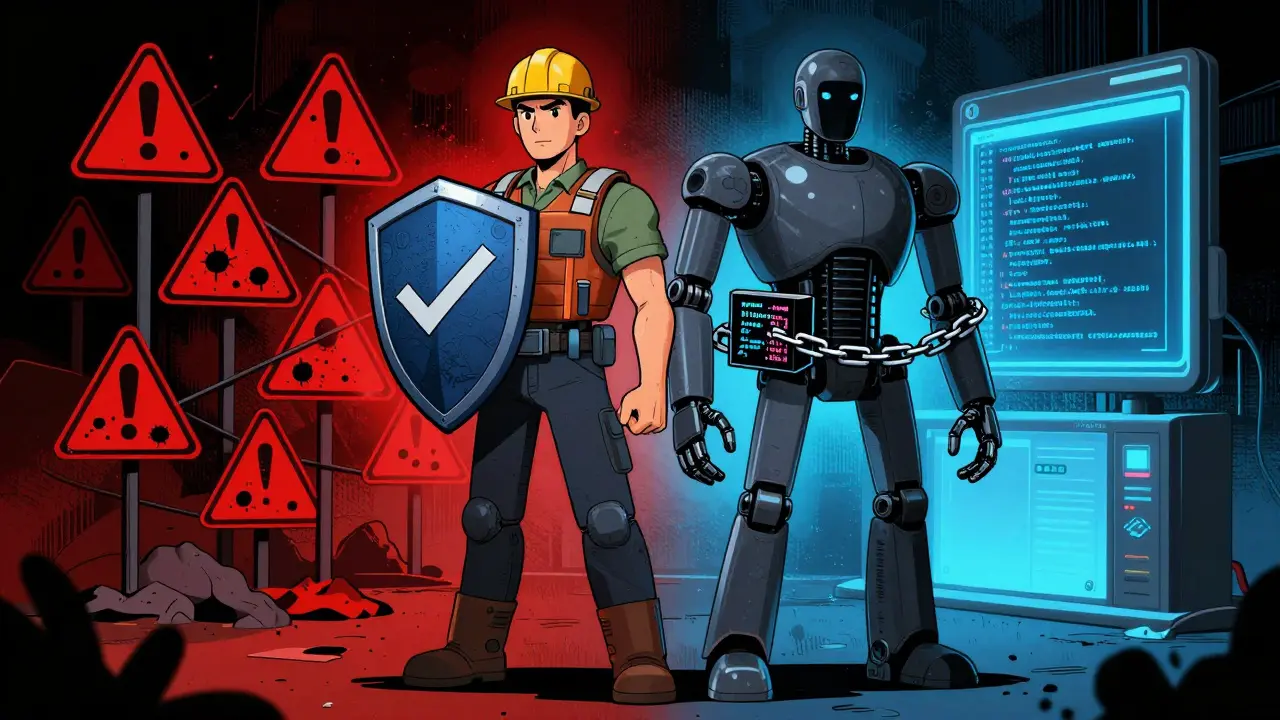
The first step isn’t technical; it’s psychological. You need to treat AI-generated code exactly like code copied from a random Stack Overflow answer or downloaded from an unknown GitHub repository. It is untrusted external input. Just because it looks professional doesn’t mean it’s safe.
Security firm BrightSec argues that AI output lacks intent, accountability, and context. When you review human-written code, you can ask the author, "Why did you choose this algorithm?" With AI, you get silence. Or worse, you get a hallucinated explanation. Therefore, your review strategy must change from "Does this look reasonable?" to "What assumptions is this code making, and are those assumptions safe?"
This mindset prevents the "broken software everywhere" scenario warned about by experts like Vishnu. If you assume the AI is correct until proven otherwise, you invite subtle defects. By assuming it is flawed until proven correct, you force yourself to look for evidence rather than explanations.
Decision Review: Auditing the Process, Not Just the Product
Traditional code review focuses on the final artifact: the code itself. A newer technique, often called decision review is a method of auditing the reasoning steps, prompts, and tool usage that led to the generation of specific code blocks, focuses on the process that created the code. Think of it like reviewing Architectural Decision Records (ADRs) but for micro-decisions made by an agent.
Instead of reading 200 lines of implementation, you audit the session log. Tools like Entire allow you to see the chronological reasoning of the AI. You look for four key things:
- The Prompt: Was the initial instruction clear and constrained? Did it specify edge cases?
- The Context: Which files did the AI read? Did it have access to outdated documentation or irrelevant modules?
- The Tool Usage: Did the AI run tests before writing the code? Did it search for existing utilities instead of reinventing the wheel?
- The Attribution: Which lines were written by the AI versus edited by a human?
If the AI skipped running a test suite or ignored a critical dependency file, the resulting code is suspect, regardless of how clean it looks. By validating the decision trail, you can catch logical errors at their source. For example, if the AI decided to use a deprecated API because it didn't read the latest changelog, you catch that failure in the context check, not by parsing fifty lines of function calls.

Risk-Based Focus: Where to Look Deeply
You don’t have time to review everything equally. You must triage. Not all code carries the same risk. A change to a CSS class for button colors is low risk. A change to user authentication logic is high risk.
BrightSec recommends focusing your manual energy on areas dealing with identity, authorization, and state management. These are the "hot spots." In these areas, AI models are prone to being "confidently incomplete." They might implement the happy path perfectly but fail to handle malformed inputs or hostile environments.
Here is a practical heuristic for prioritizing your review effort:
| Code Area | Risk Level | Review Strategy |
|---|---|---|
| Authentication / AuthZ | Critical | 100% Manual Line Review + Negative Testing |
| Data Migration / Billing | High | Deep Logic Inspection + Dry Runs |
| API Endpoints | Medium | Input Validation Checks + Integration Tests |
| UI Components / Styling | Low | Visual Verification + Automated Linting |
| Test Boilerplate | Very Low | Automated Execution Only |
For high-risk areas, slow down. Question defaults. Ask why a specific caching strategy was chosen. Treat convenience patterns, like inline SQL or ad-hoc cryptography, as suspicious until thoroughly validated. For low-risk areas, trust the automation. If the linter passes and the visual regression tests pass, move on.
Demanding Evidence Over Explanations
One of the biggest traps in AI code review is accepting the model's justification. If you ask an AI, "Is this code secure?" it will likely say yes. That explanation is worthless. You need empirical evidence.
Evidence comes in two forms: automated validation and behavioral testing. First, ensure your CI/CD pipeline runs comprehensive static analysis. Tools like ESLint, mypy, or RuboCop should catch type mismatches and unused variables instantly. Security scanners (SAST tools) should flag injection vulnerabilities. If these tools pass, you have a baseline of safety.
Second, demand tests. Specifically, negative tests. AI is great at writing code that works when everything goes right. It is terrible at handling errors gracefully. Require unit tests that feed malformed data into the new functions. If the AI-generated code crashes on null input, the test fails, and you know exactly which ten lines to inspect manually. This reduces your reading load from hundreds of lines to just the failing block.
As one engineer demonstrated in a recent workflow, he used AI to generate a pull request, then asked a second AI instance to review it and suggest fixes. He layered this with his own product-focused review-actually clicking through the UI to ensure the behavior matched requirements. The combination of automated tests, AI-assisted scanning, and targeted human interaction replaced the need for exhaustive reading.
Maintaining Human Ownership
Even when you aren't reading every line, someone must own the outcome. BrightSec emphasizes that every piece of AI-generated code needs a clear human owner. This person doesn't necessarily write the code, but they must be able to explain what it does, why it exists, and how to fix it when it breaks.
This ownership structure changes how you conduct reviews. Instead of asking, "Did I read this line?" you ask, "Do I understand the invariant this code relies on?" If you can answer that question, you have reviewed the code effectively. If you can't, you haven't reviewed it enough, regardless of how many lines you skimmed.
In practice, this means assigning module ownership. If a backend team owns payment flows, they are responsible for the AI-generated changes in that domain. They must validate that the new code respects the state machine of order processing. This shifts the focus from syntax to semantics, ensuring that the code fits into the larger system architecture.
Building a Sustainable Workflow
To make this work, you need more than just good intentions. You need infrastructure. Your team needs access to LLM-based assistants that record their sessions. You need CI pipelines that enforce test coverage thresholds. You need a culture that rewards thorough testing over quick commits.
A typical efficient workflow for a 200-line AI change might look like this:
- Plan Mode: Before generating code, prompt the AI to outline its plan. Verify the high-level logic matches requirements.
- Generation & Summary: Let the AI write the code. Read the auto-generated PR summary to grasp the intent.
- Automated Gatekeeping: Run linters, type checkers, and security scans. Fix any flagged issues immediately.
- Targeted Testing: Add 3-5 new tests targeting edge cases and error conditions. Ensure they pass.
- Decision Audit: Check the session log. Did the AI reference the right files? Did it skip any steps?
- Hot Spot Inspection: Manually read only the high-risk sections (auth, data handling) identified in your risk matrix.
This process takes minutes, not hours. It allows you to maintain high standards without sacrificing speed. It acknowledges that AI is a powerful partner, but not a replacement for human judgment. By reallocating your attention to decisions, risks, and evidence, you stay in control of the codebase, even as the volume of generated code explodes.
Is it safe to skip line-by-line review for AI-generated code?
It is safe if you replace line-by-line reading with rigorous automated testing, static analysis, and decision auditing. However, you must still perform deep manual reviews for high-risk areas like authentication and data integrity. Skipping review entirely is dangerous, but skipping *every* line in favor of strategic sampling is sustainable.
What is "decision review" in the context of AI coding?
Decision review is a technique where you audit the process the AI used to generate code, including the prompts, referenced files, and tool executions, rather than just inspecting the final code output. It helps verify that the AI had the correct context and followed logical steps before writing the code.
How do I handle AI-generated code that touches security-sensitive areas?
Treat security-sensitive code as high-risk. Do not rely solely on automated tools. Perform a 100% manual line-by-line review of authentication, authorization, and data handling logic. Demand negative tests that attempt to break the code, and verify that no insecure defaults or deprecated libraries are used.
Can I use another AI to review the code generated by the first AI?
Yes, using a second AI model to review the first AI's output is a valid strategy for catching obvious bugs and style issues. However, AI explanations are not evidence. You must still validate the findings with automated tests and human judgment, especially for complex logic or security concerns.
Who is responsible for bugs in AI-generated code?
The human developer or team member who approved the merge is responsible. AI has no legal or professional accountability. Establishing clear human ownership for each module ensures that someone is always available to explain, fix, and take responsibility for the code in production.