LLM Pricing Comparison 2026: OpenAI vs Anthropic vs Google

- Mark Chomiczewski
- 30 April 2026
- 8 Comments
Stop guessing how much your AI bill will be at the end of the month. In the early days of the LLM boom, paying $60 per million tokens for GPT-4 felt like the standard. Fast forward to 2026, and the market has shifted violently. Prices for comparable quality have plummeted by nearly 98%, with some budget models now costing as little as $0.05 per million tokens. But while the floor has dropped, the ceiling has risen-premium reasoning models like o1-pro can now cost you $150 per million input tokens.
The real challenge isn't finding a cheap model; it's finding the one that doesn't fail your most complex tasks. If you pick a model based solely on the lowest price, you might find your accuracy dropping by 20% on reasoning tasks, or your bot failing 37% of coding requests. The goal is to optimize your cost-performance ratio, ensuring you aren't paying for a Ferrari to deliver mail, nor using a bicycle to move a house.
The 2026 Pricing Landscape: Tiers and Trade-offs
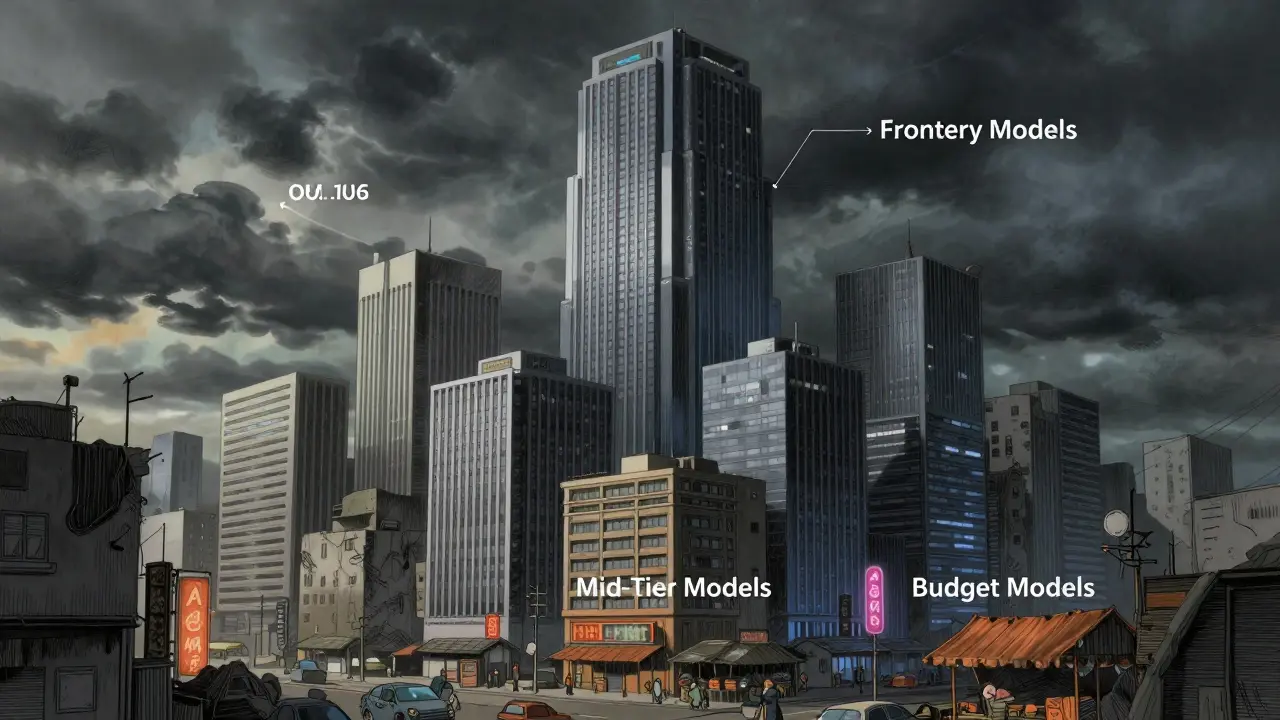
The market has split into three distinct tiers. Understanding where your project fits into these categories is the first step toward cutting your API spend without killing your product's quality.
First, we have the Frontier Models. These are the heavy hitters like GPT-4o and Claude Opus. They offer maximum intelligence but come with a heavy price tag. For example, processing a single 500,000-token document with Claude Opus can cost you $7.50 just for the input. You use these when failure isn't an option and the task requires deep logical reasoning.
Then there are the Mid-Tier Models. This is the sweet spot for most businesses. Models like Claude 3 Sonnet and Gemini 1.5 Flash provide a balance of speed and intelligence. Interestingly, Sonnet often hits 92% of the performance of GPT-4o while costing 40% less. If you're building a B2B application, this is likely where you'll spend most of your time.
Finally, the Budget Models. We're talking about GPT-4o mini and Llama 3 8B. These are 10 to 20 times cheaper than premium options. They are perfect for simple chatbots, classification tasks, or initial query triaging, but they struggle with complex coding or multi-step logic.
| Model Tier | Example Model | Input Price | Output Price | Best Use Case |
|---|---|---|---|---|
| Frontier | Claude Opus | $15.00 | $75.00 | Complex Strategy/Legal |
| Mid-Tier | Gemini 1.5 Flash | $0.35 | $1.05 | Enterprise Document Analysis |
| Budget | GPT-4o mini | $0.15 | $0.60 | Basic Chat/Classification |
| Ultra-Budget | Qwen2.5-VL-7B | $0.05 | $0.05 | Simple Data Labeling |
Provider Breakdown: Who Wins on What?
OpenAI remains the ecosystem leader. Their latest gpt-5 series offers a wide range of pricing, but they are known for having the easiest learning curve. Developers typically get integrated in a few hours. However, their pricing transparency is often rated slightly lower than competitors due to how they handle complex token counting.
Anthropic has introduced a game-changer with their cache-based pricing. Instead of paying full price for the same prompt over and over, their cache read system offers a 25% discount, and batch operations can be 50% cheaper. This is a massive win for repetitive enterprise workflows, though it makes your monthly bill harder to predict.
Google is dominating the "long-context" game. With a 1.0M token context window in Gemini 1.5 Flash, you can feed it entire codebases or hour-long videos without splitting the data into a dozen different API calls. If you have massive documents, Google is often the cheapest and most efficient choice.
Then there's the open-source movement, led by Meta. Llama 3 8B can be as cheap as $0.10 per million tokens through third-party providers. While you lose the managed experience of a first-party API, the cost savings are existential for high-volume apps. Just be careful with where you host; using Llama through a cloud provider like AWS Bedrock can sometimes add a 10-40% premium over direct API access.
Hidden Costs and Budget Traps
The sticker price is rarely the final price. One of the biggest budget killers is inefficient context window management. A case study showed that developers wasting budget on unnecessary "context padding"-sending the same system instructions or irrelevant history with every call-increased their effective costs by 220%.
Tokenization is another hidden variable. If you're working with non-English languages, beware. Chinese text, for example, can consume 25-40% more tokens than English for the same meaning. If your user base is global, your budget needs to account for this "token tax."
Multimodal capabilities also carry a premium. Adding image input or complex JSON output capabilities often adds a 40% price hike compared to text-only models. If you don't need the model to "see" an image, don't use a multimodal endpoint.
Pro Strategy: The Cascade Architecture
If you want the intelligence of a frontier model but the price of a budget one, you need a cascade architecture. Instead of sending every single user query to the most expensive model, you build a routing system.
Here is how a high-efficiency pipeline works:
1. The Triage: Use a budget model like GPT-4o mini to categorize the query.
2. The Routine Path: If the query is a common FAQ or a simple greeting, let the budget model handle it. This usually covers 80% of traffic.
3. The Escalation: If the budget model detects a complex regulatory question or a high-logic coding error, it routes the request to a mid-tier model like Claude 3 Sonnet.
4. The Expert Path: Only the most critical, high-value tasks get escalated to a model like o1-pro.
By implementing this, some fintech startups have reported reducing costs by over 60%. They shifted from a flat "everything goes to GPT-4o" approach to a tiered system where the cost per 1,000 conversations dropped from $6.00 to roughly $0.39 for the initial triage phase.

The Future of AI Pricing
We are seeing a race to the bottom. Industry analysts predict prices will drop another 50% by the end of 2026. We are moving toward "consumption-based tiers" and even more aggressive cache discounts. The pressure from open-source models like Llama and Mistral is forcing premium providers to lower their prices just to stay relevant.
For the average developer, this means you shouldn't lock yourself into one provider. Multi-provider strategies are now the norm for 67% of Fortune 500 companies. Use Google for the huge documents, Anthropic for the repetitive cached workflows, and OpenAI for the seamless integration and ecosystem tools.
Which LLM provider is the cheapest for simple tasks?
For simple tasks, budget models like Llama 3 8B and GPT-4o mini are the most affordable. Llama 3 8B through certain providers can cost as little as $0.10 per million tokens, while GPT-4o mini typically sits around $0.15 for input and $0.60 for output.
How does Anthropic's cache pricing actually work?
Anthropic allows you to "cache" frequently used prompts. When the model recognizes a prompt it has seen recently, you get a 25% discount on the cache read. Additionally, they offer batch operations that can reduce costs by up to 50% for non-urgent tasks.
Is it worth paying for the most expensive models?
Yes, but only for complex reasoning. Budget models often show a 15-20% drop in accuracy on MMLU benchmarks compared to premium models. If your task involves complex coding or high-stakes legal analysis, the higher cost is offset by the reduction in expensive manual retries and errors.
What is the "token tax" for non-English languages?
The token tax refers to the fact that different languages are tokenized differently. For example, Chinese text often requires 25-40% more tokens than the equivalent English text, meaning you pay more for the same amount of information.
How do I avoid wasting money on context windows?
Avoid "context padding" by cleaning your prompt history and removing unnecessary system instructions. Use a triage model to summarize long conversations before passing them to a more expensive model to ensure you only pay for relevant tokens.
Next Steps for Cost Optimization
If you're currently over budget, start by auditing your token usage. Use a tool to track exactly how many tokens are being sent in your "system" prompts versus user prompts. If you see a high volume of repetitive text, switch your backend to Anthropic to take advantage of caching.
For those handling massive datasets, test Gemini 1.5 Flash. The 1M token window can drastically reduce the number of API calls needed to analyze a long document, which often results in lower overall costs despite the per-token price.
Finally, build a simple router. Even a basic "if-then" logic that sends simple queries to a budget model can slash your monthly bill by half overnight. Don't wait for the providers to lower prices further-optimize your architecture now.



Comments
Anand Pandit
The cascade architecture is a total lifesaver for anyone trying to scale their app without going broke. It's honestly the most sustainable way to handle varying query complexity!
May 2, 2026 AT 02:55
Shivam Mogha
Gemini's long context is very useful.
May 2, 2026 AT 07:50
poonam upadhyay
Absolute chaos!!! The way these companies play with our wallets is just... scrumptious!! Just absolutely scrumptious!!! Who even cares about the 'token tax' when you can just burn through your VC funding like a bonfire in July??? Pure madness!!!!
May 3, 2026 AT 17:01
Sheetal Srivastava
The heuristic approach to prompt engineering mentioned here is quaintly rudimentary. In the upper echelons of cognitive architecture, we don't just 'triage'-we implement semantic routing via latent space embeddings to optimize the stochastic parity of the output. It's frankly embarrassing that most people are still obsessing over per-token pricing when the real bottleneck is the epistemic degradation of the model's reasoning capabilities across varied modalities. The cognitive load of managing a multi-provider pipeline is a triviality for those of us operating at a higher level of abstraction, yet the industry seems stuck in this primitive cost-benefit analysis that ignores the overarching ontological shift in how we perceive synthetic intelligence.
May 4, 2026 AT 12:46
mani kandan
I'm vibing with the idea of using Google for the massive docs and Anthropic for the repetitive stuff. It's like building a custom-tailored AI suit for your business. Truly a kaleidoscopic approach to efficiency.
May 5, 2026 AT 23:57
Rahul Borole
I strongly advocate for the immediate implementation of the cascade architecture described. It is an exemplary strategy that empowers developers to maximize operational efficiency while ensuring a premium user experience through strategic escalation.
May 7, 2026 AT 22:56
Bhavishya Kumar
The phrasing in the section regarding tokenization is slightly imprecise though the general sentiment remains valid
May 9, 2026 AT 01:45
ujjwal fouzdar
We are merely ghosts in the machine, paying pennies to pretend we are talking to a god. This race to the bottom of pricing is just a mirror of our own descent into digital dependency. The cost is not in the tokens, but in the soul of the programmer who forgets how to think without an API key.
May 9, 2026 AT 15:52