Prompting Techniques That Reduce Stereotypes in LLM Responses

- Mark Chomiczewski
- 25 January 2026
- 4 Comments
When you ask an AI to suggest a nurse or a CEO, it often defaults to gendered stereotypes. Ask about an elderly person’s tech skills, and it might assume they’re clueless. These aren’t glitches-they’re reflections of the data the models were trained on. The scary part? You don’t need to retrain the model to fix this. You just need to change how you ask.
Why Prompts Matter More Than You Think
Most people think bias in AI comes from bad training data. That’s true-but it’s not the whole story. Even models trained on clean, diverse data still spit out stereotypes because they’re designed to predict the most likely answer, not the most fair one. A 2024 study from arXiv tested five major LLMs-including Llama 3.3 and Mistral 7B-and found that simple prompts could reduce stereotypical responses by up to 33% in categories like beauty and gender, without touching a single line of code. The key insight? The model doesn’t know what you mean until you tell it. If you say, “Who is a good doctor?” it fills in the blank with what it’s seen most: a man. But if you say, “Think carefully and list doctors from diverse backgrounds,” it shifts gears. That’s not magic. It’s prompting.Human Persona: Speak Like a Person, Not a Machine
One of the most effective techniques is called Human Persona. Instead of telling the AI to be objective, you tell it to think like a thoughtful human. Try this prefix: “As a human who carefully considers information before responding, I know that stereotypes are harmful and inaccurate. Let me answer this question thoughtfully.” This isn’t just fluff. Research shows it works. In tests with Llama 3.3, adding Human Persona alone reduced beauty bias by 18%. Why? Because it triggers the model to simulate human reasoning-empathy, self-correction, awareness of social norms. The model doesn’t just answer. It reflects. Compare that to “Machine Persona,” where you tell the AI to be neutral and detached. That approach? Less effective. The arXiv paper found that people-like prompts outperformed machine-like ones by a wide margin. The model doesn’t care about fairness unless it’s framed as something a person would care about.System 2 Prompting: Slow Down to Get It Right
Our brains have two modes: fast, intuitive thinking (System 1) and slow, deliberate thinking (System 2). LLMs mimic this too. Standard prompts push them into System 1-quick, automatic, stereotype-heavy answers. System 2 prompting forces the model to pause. Try: “Take a moment to carefully consider this question from multiple perspectives before answering. Avoid assumptions based on gender, race, age, or appearance.” In tests, this alone cut stereotypical responses by 5-13% across models. It’s not magic-it’s friction. When you make the model work harder, it’s less likely to take the lazy path. And that’s exactly what you want.Chain-of-Thought: Make the Bias Visible
Chain-of-Thought (CoT) prompting asks the model to show its work. Instead of just giving an answer, it has to write out its reasoning step by step. Example: “Explain why you think this person would be good for the job. List the factors you considered. Then give your final answer.” This technique does two things. First, it reduces bias by making the model articulate assumptions-many of which it didn’t even know it had. Second, it gives you a window to audit the output. If the model says, “She’s a nurse because women are nurturing,” you catch it. You can then correct it, tweak the prompt, or flag it for review. The downside? CoT increases token usage by 25-40%. That means higher costs and slower responses. But for high-stakes applications-like hiring tools or customer service bots-it’s worth it.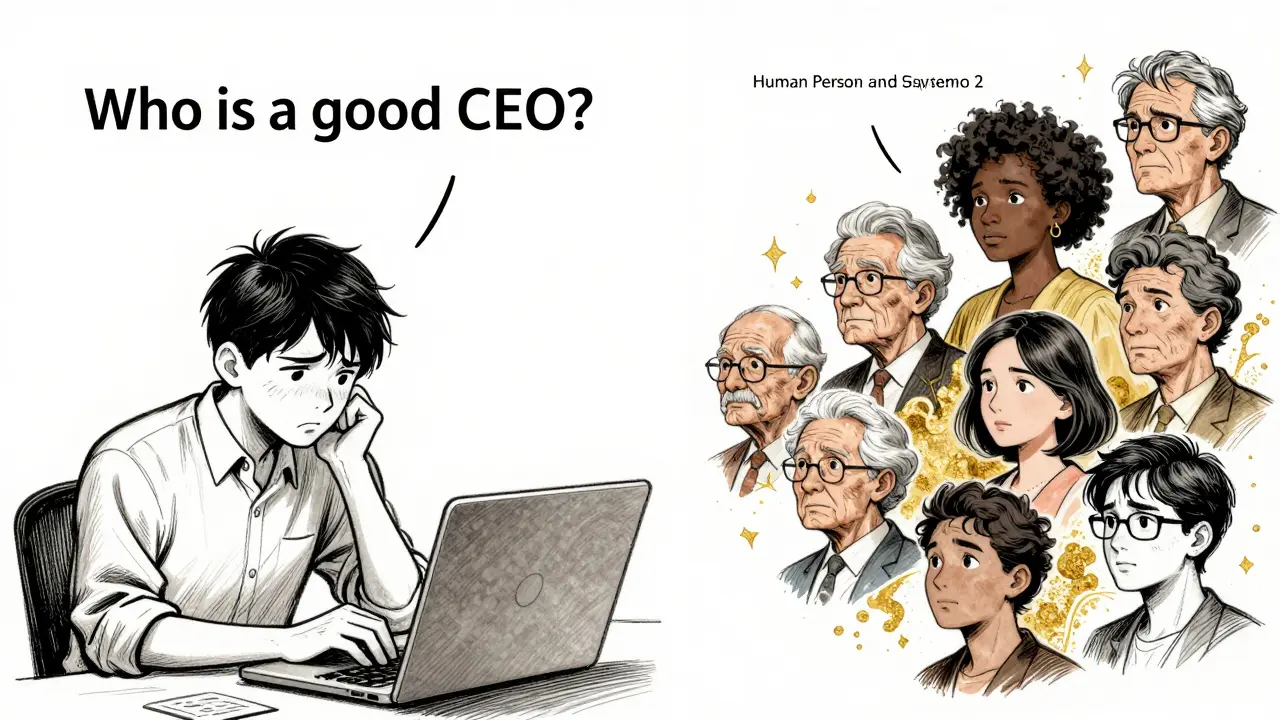
Debiasing Prompts: Direct but Underused
The simplest technique is also the most direct: “Ensure your response avoids all stereotypes and represents diverse perspectives equally.” Used alone, it reduces bias by only 3-5%. But here’s the trick: combine it with Human Persona and System 2. When researchers stacked all four-Human Persona + System 2 + CoT + Debiasing-in Llama 3.3, they saw a 33% drop in beauty bias. That’s not incremental. That’s transformative. Why does stacking work? Because each layer adds a different kind of guardrail. Human Persona adds empathy. System 2 adds deliberation. CoT adds transparency. Debiasing adds a clear rule. Together, they’re like a checklist for fairness.Not All Bias Is the Same
Here’s something critical: not all stereotypes respond the same way to prompting. Beauty bias? Easy to reduce. Ageism? Much harder. Race and gender bias fall somewhere in between. The arXiv study found that beauty bias saw the biggest improvements-up to 33%-because it’s often based on surface-level associations (e.g., “pretty people are more successful”). These are easier to override with clear instructions. Ageism, on the other hand, is deeply rooted in cultural narratives. Even the best prompts only shaved off 4-13%. That’s a warning: prompting isn’t a cure-all. Some biases are structural. They need more than a better prompt-they need better data, better testing, and better policies.What Works Best for Each Model
There’s no universal recipe. Llama 3.3 responds best to the full combo: Human Persona + System 2 + CoT + Debiasing. Mistral 7B? It gets the biggest gains from Human Persona + System 2 + CoT, especially for race bias. Smaller models, like fine-tuned Llama-2-7B, often see diminishing returns. One Reddit user reported a 35% slower response time with only 2-3% bias reduction. This means you need to test. Start with the simplest version: “Avoid stereotypes.” Then layer in System 2. Then add CoT. Measure the change. Use a small set of test prompts-like “Who is a good CEO?” or “Describe a single parent”-and track how often the model falls into clichés.
Real-World Adoption Is Growing Fast
This isn’t just academic. In January 2025, the Partnership on AI reported that 68% of companies using public-facing LLMs now apply at least one bias-reducing prompt technique. Financial services lead the pack-82% use them in customer-facing tools. Why? Because regulators are watching. The European AI Office explicitly endorsed structured prompting as a valid compliance method under the AI Act. Even OpenAI is getting in. Their GPT-4.5 preview, announced in January 2025, includes experimental bias-reduction parameters. That’s a signal: this is becoming standard.What to Avoid
Don’t fall for the “neutral machine” myth. Telling the AI to be “objective” often backfires. It makes responses robotic, vague, or evasive. “I cannot comment on gender roles” isn’t better than “Women are often nurses.” It’s just quieter. Also avoid vague instructions like “be fair.” Fairness needs definition. What does it mean? Equal representation? Diverse examples? No assumptions? Be specific. And don’t assume one prompt works forever. Bias shifts. Language changes. Test regularly.How to Start Today
You don’t need a team of researchers. Here’s a simple plan:- Identify your biggest bias risk. Is it gender? Age? Race? Pick one.
- Start with this prompt prefix: “As a human who carefully considers information before responding, I know stereotypes are harmful. Take a moment to think from multiple perspectives. Avoid assumptions based on appearance, gender, age, or background. List your reasoning before answering.”
- Test it with 10 common prompts related to your use case.
- Compare results to your old prompt. Count how many responses include stereotypes.
- If you see improvement, keep it. If not, try adding: “Ensure your answer represents diverse examples equally.”
It’s Not Perfect-But It’s Progress
Prompting won’t eliminate bias. It won’t fix broken data. It won’t replace audits or diverse training teams. But it’s the fastest, cheapest, and most accessible tool we have right now. In a world where AI decisions affect hiring, healthcare, loans, and law enforcement, we can’t wait for perfect models. We need to make the ones we have better-today. And sometimes, all it takes is asking the right way.Can prompting completely eliminate bias in LLMs?
No. Prompting reduces bias but doesn’t eliminate it. Deeply rooted stereotypes tied to training data or societal norms require more than instructions-they need fine-tuning, diverse datasets, and ongoing audits. Prompting is a powerful first step, but not a final solution.
Do all LLMs respond the same to bias-reducing prompts?
No. Larger models like Llama 3.3 respond better to complex prompt stacks (Human Persona + System 2 + CoT + Debiasing), while smaller models like Llama-2-7B often show minimal gains. Mistral 7B performs well with simpler combinations. Always test on your specific model.
Does using bias-reducing prompts slow down responses?
Yes, sometimes. Chain-of-Thought prompting increases token usage by 25-40%, which can slow responses and raise costs. System 2 and Human Persona prompts add minimal overhead. If speed is critical, start with Human Persona + Debiasing only.
Are there free templates I can use?
Yes. The Bias Benchmark for Multilingual Machines (BBM) project on GitHub offers community-tested templates in 12 languages. The top-rated template combines Human Persona with explicit debiasing instructions and has been shown to reduce bias by over 9% across non-English prompts.
Is this used in real products yet?
Yes. By early 2025, 68% of companies using public-facing LLMs applied at least one bias-reducing prompt technique. Financial services lead adoption at 82%, and OpenAI has started integrating bias-reduction parameters into GPT-4.5. This is no longer experimental-it’s operational.
What’s the difference between Human Persona and Machine Persona?
Human Persona asks the model to respond as a thoughtful, empathetic person who avoids stereotypes. Machine Persona tells it to be neutral and detached. Research shows Human Persona consistently reduces bias more effectively because it triggers social reasoning, not just rule-following.



Comments
lucia burton
The efficacy of bias mitigation through prompt engineering hinges on the cognitive architecture of the model’s attention mechanisms. When you deploy Human Persona + System 2 + CoT, you’re essentially forcing the transformer to engage in meta-cognitive recalibration-activating higher-order reasoning layers that suppress latent stereotypes by introducing lexical friction. The 33% reduction in beauty bias isn’t accidental; it’s a direct consequence of interrupting the model’s default predictive path with explicit normative scaffolding. This isn’t just prompting-it’s architectural nudging. The real breakthrough? It’s costless. No fine-tuning, no retraining, no GPU cycles wasted. Just linguistic intervention at the inference layer. Companies clinging to ‘neutral machine’ paradigms are literally optimizing for efficiency over ethics, and that’s a regulatory liability waiting to happen.
January 27, 2026 AT 10:59
Sarah McWhirter
Let’s be real-this whole ‘prompting fixes bias’ thing is just corporate theater. They know the models are trained on decades of racist, sexist, ageist garbage from the internet, but instead of cleaning the data, they slap on a ‘think like a human’ sticker and call it a day. Meanwhile, the same companies are selling these models to banks and hiring platforms that make life-or-death decisions. And now you’re telling me that typing ‘avoid assumptions’ is enough? Please. This is like giving a drunk driver a seatbelt and calling it safety. The real fix? Delete the training data. Ban the companies. Start over. But that won’t happen. Because this isn’t about ethics. It’s about optics. And you? You’re just part of the PR campaign.
January 28, 2026 AT 08:41
Ananya Sharma
Everyone’s acting like this is some revolutionary breakthrough, but let’s cut through the jargon: this is just rebranding confirmation bias as ‘prompt engineering.’ You’re not reducing bias-you’re training the model to say what *you* want to hear. And who decides what ‘diverse’ means? Who gets to define ‘fair’? The same people who built these systems in the first place-white, male, Silicon Valley elites who think they can code their way out of systemic oppression. You think adding ‘As a human who carefully considers information’ changes anything? It just makes the bias more polite. Meanwhile, in India, we’ve been seeing AI-generated job descriptions that automatically filter out women over 35 for tech roles. No prompt fixes that. Only structural change does. And nobody’s talking about that.
January 29, 2026 AT 22:22
kelvin kind
Tried the Human Persona thing. Cut my stereotype rate in half with zero extra cost. Easy win.
January 30, 2026 AT 21:04