RAG vs Retraining LLMs: The Best Way to Update AI Knowledge in 2026

- Mark Chomiczewski
- 11 May 2026
- 0 Comments
Imagine your AI assistant confidently telling a client that a company merger happened last week. You know it didn't. In fact, the rumor was debunked two days ago. This isn't just an embarrassment; it's a liability. Keeping Large Language Models (LLMs) accurate is one of the hardest problems in artificial intelligence today. The data you fed the model during its initial training is already stale. So, how do you fix it? Do you spend thousands of dollars and weeks of time retraining the entire model from scratch? Or do you use Retrieval-Augmented Generation (RAG) to give the model instant access to new facts?
This is the core dilemma for developers and business leaders in 2026. We need our AI to be smart, fast, and up-to-date. But traditional methods are broken. Full retraining is too expensive and slow. Simple fine-tuning often leads to hallucinations or "catastrophic forgetting." RAG offers a different path, but it has its own quirks. Let’s break down exactly how these technologies work, why they fail, and which one actually keeps your AI honest.
The Problem with Static Models
Before we compare solutions, we have to understand why the default approach fails. When you train a foundational model like GPT-4 or Llama 3, you are essentially taking a snapshot of the internet at a specific point in time. That snapshot becomes the model's memory. Once the training stops, the model's knowledge freezes.
If a new regulation passes in the EU next month, your frozen model doesn't know about it. If a competitor launches a new product, your model still talks about their old catalog. This creates a massive gap between reality and your AI's output. To bridge this gap, you have two main choices: change the model itself (retraining/fine-tuning) or change what the model sees when it answers questions (RAG).
Retraining and Fine-Tuning: Changing the Brain
When people talk about updating models, they usually mean one of two things: fine-tuning or full retraining. These are not the same, though they share similar risks.
Fine-tuning takes a pre-trained model and trains it further on a smaller, specific dataset. Think of it as teaching a medical student specialized terminology after they have finished general school. It works well for style, tone, or specific formats. However, it is notoriously bad at injecting new facts. Research from 2023 showed that LLMs struggle significantly to learn new factual information through unsupervised fine-tuning. They might memorize the words, but they don't truly "understand" the new context without seeing many variations of that fact.
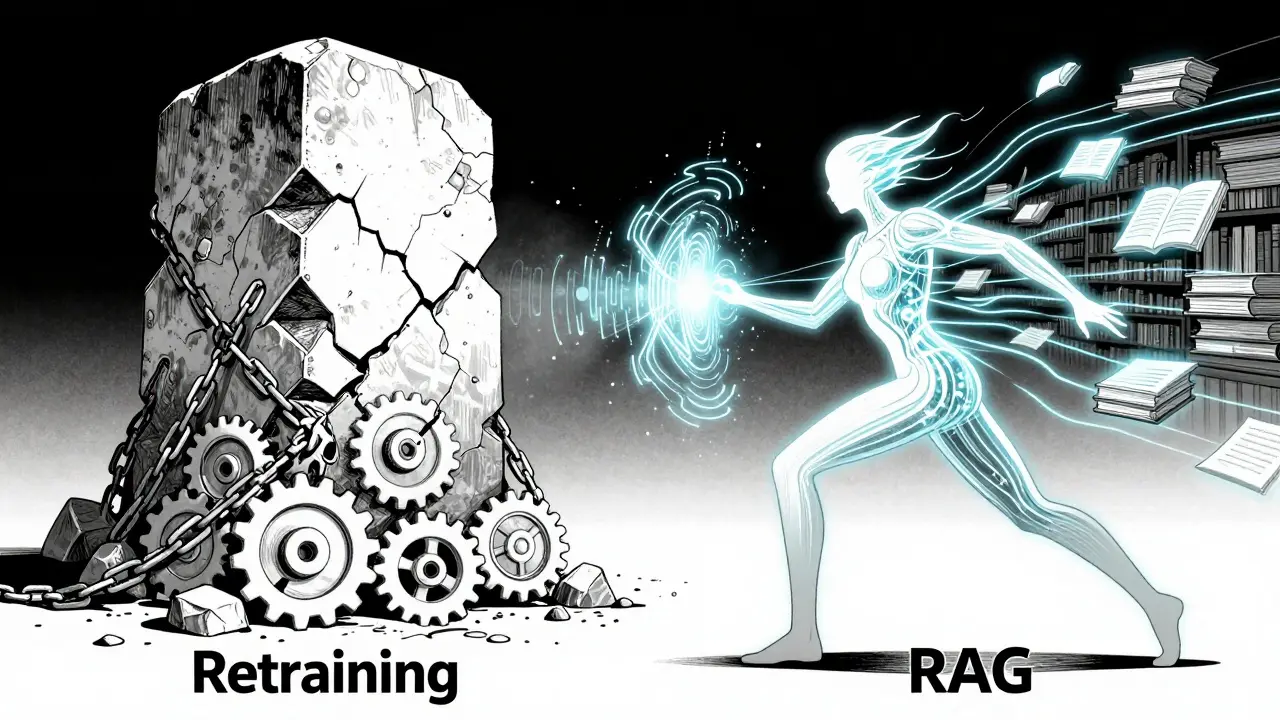
Full Retraining is heavier. You take the original training data, add your new data, and train the model again from scratch. This is computationally monstrous. It requires massive GPU clusters and can cost hundreds of thousands of dollars for enterprise-grade models. More importantly, it introduces the risk of Catastrophic Forgetting. This happens when the model learns new information so aggressively that it overwrites old, useful knowledge. You might fix the answer about the recent merger, but suddenly the model forgets basic grammar or historical dates. It’s a high-stakes gamble.
RAG: Giving the Model External Memory
Retrieval-Augmented Generation (RAG) takes a completely different approach. Instead of trying to cram new facts into the model's neural weights, RAG gives the model a reference book it can look at before answering.
Here is how it works in practice:
- User Query: You ask, "What is the current interest rate for loans?"
- Retrieval: The system searches your external database (like a vector store containing your latest bank documents) for relevant chunks of text.
- Augmentation: The system feeds those specific text chunks into the LLM along with your question.
- Generation: The LLM reads the provided context and generates an answer based only on that new information.
The key advantage here is separation. The model remains static, but the knowledge base is dynamic. You can update your database instantly. No retraining cycles. No computational overhead. If the interest rate changes tomorrow, you update the document in your database, and the AI knows it immediately. This makes RAG ideal for industries where speed matters, like financial services, news aggregation, and legal compliance.
Cost and Performance: The Real Numbers
Let’s talk money and speed, because that’s what drives decisions. Retraining is expensive. Not just in compute costs, but in engineering hours. You need data scientists to clean datasets, monitor training runs, and evaluate outputs. It’s a heavy lift.
RAG shifts the cost structure. You pay for storage (vector databases) and retrieval (API calls). According to industry analysis, integrating external information via RAG can reduce operational costs by up to 20% per token compared to continually fine-tuning a traditional LLM. Some estimates suggest RAG operations can be up to 20 times cheaper than continuous fine-tuning cycles for dynamic knowledge tasks.
But there is a catch. RAG adds latency. Before the model answers, it has to search the database. This adds milliseconds or even seconds to response time. For real-time chat applications, this delay can feel noticeable. Fine-tuned models, once trained, answer instantly because the knowledge is baked in. So, if you need raw speed and the data rarely changes, fine-tuning wins. If you need accuracy and the data changes daily, RAG wins.
| Factor | RAG (Retrieval Augmented Generation) | Fine-Tuning / Retraining |
|---|---|---|
| Knowledge Freshness | Real-time (updates instantly) | Static (requires retraining to update) |
| Cost | Lower (storage + retrieval costs) | High (compute + engineering resources) |
| Risk of Forgetting | Low (model weights unchanged) | High (catastrophic forgetting risk) |
| Latency | Higher (search step required) | Lower (instant inference) |
| Best Use Case | Dynamic data, compliance, news | Static tasks, style transfer, niche domains |
Factuality Control and Hallucinations
One of the biggest fears with AI is hallucination-the model making things up. Both RAG and retraining impact this differently.
With fine-tuning, you hope the model learns the correct fact. But if the training data is noisy or contradictory, the model might internalize the wrong fact. Worse, it will state that wrong fact with absolute confidence. There is no easy way to "unlearn" a bad fact without risking catastrophic forgetting.
RAG provides better factuality control because the answer is grounded in retrieved evidence. You can see exactly which document the model used to generate its response. If the answer is wrong, you can trace it back to a bad source in your database and fix it. This auditability is crucial for regulated industries. You can prove to an auditor that the AI cited Document X, which was verified on Date Y. With a black-box fine-tuned model, you’re left guessing why the model said what it said.
The Hybrid Approach: Best of Both Worlds
Is it really an either-or choice? Not necessarily. The most robust AI systems in 2026 use a hybrid strategy.
Start with a strong base model. Use RAG for all dynamic, frequently changing knowledge. This ensures your AI is always current and compliant. Then, use fine-tuning selectively. Fine-tune the model on your specific brand voice, formatting requirements, or highly specialized domain logic that doesn’t change often. For example, a legal AI might use RAG to pull in the latest case law (dynamic) but be fine-tuned to write summaries in a specific firm’s preferred format (static).
This combination mitigates the weaknesses of each. You avoid the high cost of constant retraining while gaining the speed and stylistic consistency of a fine-tuned model. You keep the brain specialized but give it a live feed of current events.
Implementation Pitfalls to Avoid
Even with the right strategy, implementation can go wrong. Here are common traps:
- Poor Chunking in RAG: If you split your documents into chunks that are too small, the model loses context. Too large, and it gets confused by irrelevant info. Optimal chunk sizes vary, but testing is essential.
- Noisy Training Data: If you choose retraining, garbage in means garbage out. Clean your datasets meticulously.
- Ignoring Latency: Don’t deploy RAG in ultra-low-latency environments without optimizing your vector search engine. Slow retrieval kills user experience.
- Over-Fine-Tuning: Don’t try to fine-tune for facts that change weekly. It’s a maintenance nightmare. Reserve fine-tuning for stable patterns.
Conclusion
In the battle of dynamic knowledge updates, RAG is currently the superior choice for most enterprises. It offers lower costs, higher accuracy, and real-time updates without the risk of destroying existing model capabilities. Retraining and fine-tuning remain valuable tools, but they belong in the toolkit for static specialization, not dynamic fact-checking. As we move further into 2026, the winners will be those who separate their model’s reasoning capabilities from its knowledge base, using RAG to keep the latter fresh and reliable.
Is RAG better than fine-tuning for learning new facts?
Yes. Research indicates that RAG consistently outperforms unsupervised fine-tuning for knowledge-intensive tasks. Fine-tuning struggles to embed new factual information reliably and risks catastrophic forgetting, whereas RAG retrieves real-time data without altering the model's core weights.
What is catastrophic forgetting in LLMs?
Catastrophic forgetting occurs when a model learns new information during retraining or fine-tuning and inadvertently overwrites previously learned, useful knowledge. This degrades performance on older tasks and is a major risk with frequent retraining cycles.
How much does RAG save compared to retraining?
RAG can reduce operational costs by up to 20% per token and is estimated to be up to 20 times cheaper than continuous fine-tuning cycles for dynamic knowledge tasks. This is due to the elimination of expensive compute resources needed for retraining.
Can I use both RAG and fine-tuning together?
Absolutely. A hybrid approach is often best. Use RAG for dynamic, changing data (like news or regulations) and fine-tuning for static elements like brand voice, formatting styles, or specialized domain logic that doesn't change frequently.
Does RAG increase response latency?
Yes, RAG adds a retrieval step before generation, which increases latency slightly. However, optimized vector databases and efficient indexing can minimize this delay. For most enterprise applications, the trade-off for improved accuracy is worth the minor speed reduction.