Agentic Systems vs Vibe Coding: Choosing the Right Autonomy Level for Your Team

- Mark Chomiczewski
- 29 June 2026
- 0 Comments
You are staring at a blank terminal. The deadline is tomorrow. Do you want an AI that waits for your every command, suggesting code line by line? Or do you want one that takes the wheel, writes the tests, runs the build, and fixes its own errors while you grab coffee? This is the central tension in software development today. We have moved past simple autocomplete. We are now choosing between two distinct philosophies of machine assistance: vibe coding and agentic systems.
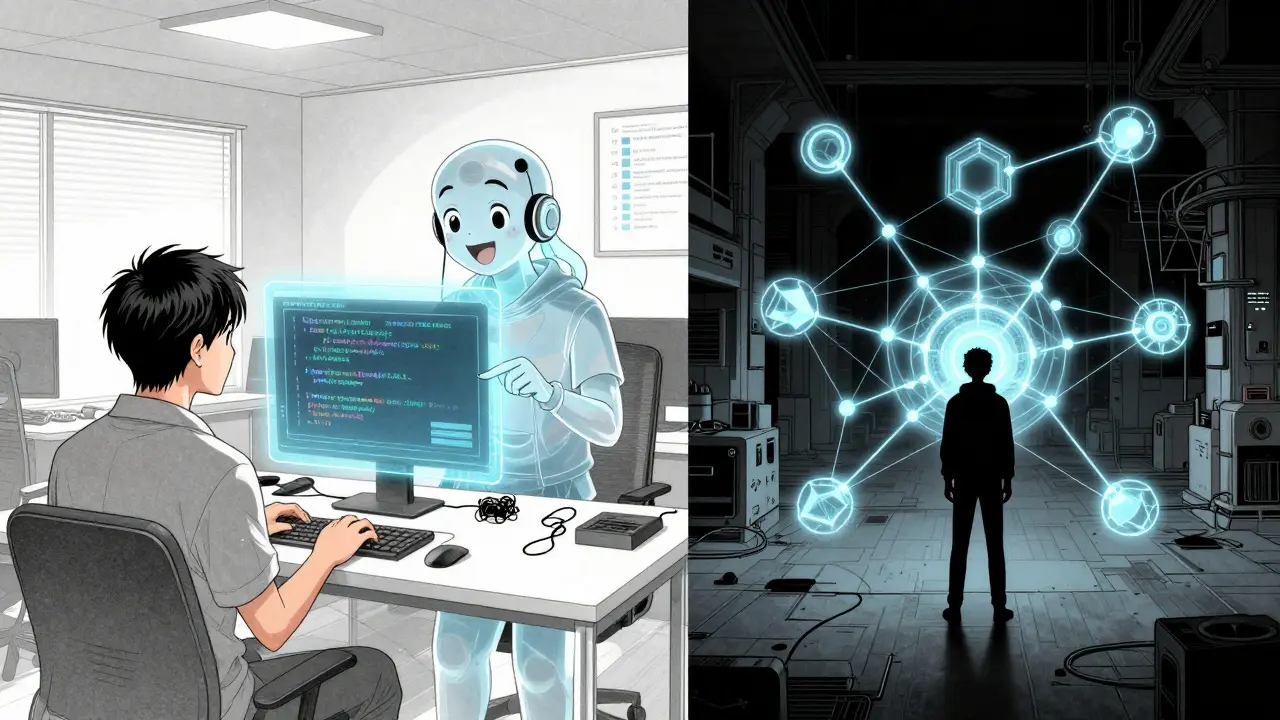
Vibe coding feels like having a brilliant, hyper-fast intern sitting next to you. It is conversational, intuitive, and keeps you firmly in the driver's seat. Agentic systems, on the other hand, act more like a junior developer you assign a task to. They plan, execute, and iterate with minimal input from you. Neither is inherently "better." One is not the future; both are the present. The mistake most teams make in 2026 is trying to use one tool for every job. That leads to frustration, buggy code, or wasted money.
To choose the right autonomy level, you need to understand what each approach actually does under the hood, where it breaks, and which problems it solves best. Let’s break down the reality of these tools based on current industry data and real-world usage patterns.
What Is Vibe Coding?
Vibe coding is a human-in-the-loop development paradigm where developers interact with AI through natural language prompts to generate code iteratively. The term gained massive traction after Microsoft’s internal studies showed a 55% boost in efficiency using tools like GitHub Copilot. VentureBeat called it "the era of vibing with AI," highlighting how creativity and productivity blend when the friction of syntax disappears.
In practice, vibe coding operates inside your existing Integrated Development Environment (IDE) like VS Code or Cursor. You describe what you want in plain English-"Create a React component for a user login form with validation"-and the AI suggests code. You accept, reject, or tweak it. You remain the architect. The AI is the scribe.
This approach relies on moderate autonomy. The system does not decide *how* to solve the problem; it responds to your direction. It uses smaller, faster models (typically 7B-13B parameters for local implementations) to keep latency low, often responding in 2-5 seconds. This speed preserves your creative flow. You don’t wait minutes for a response; you stay in the zone.
The biggest advantage here is control. Because you review every line before it enters your codebase, errors are caught immediately. According to Sourcedesk.io’s analysis of 500 beginner projects, vibe coding has a 92% success rate for simple CRUD applications. It is perfect for rapid prototyping, learning new frameworks, and building Minimum Viable Products (MVPs). If you need to go from concept to running demo in under 30 minutes, vibe coding is your friend.
What Are Agentic Systems?
Agentic systems are autonomous AI frameworks capable of planning, executing, testing, and iterating on software tasks with minimal human intervention. While vibe coding is a conversation, agentic coding is a delegation. You give the agent a goal-"Refactor this legacy Java module to Kotlin and ensure all unit tests pass"-and it figures out the steps.
These systems use larger, more powerful models (30B+ parameters) equipped with specialized planning modules. They decompose complex tasks into subtasks. An agentic workflow might look like this: the Planner agent outlines the strategy, the Coder agent writes the implementation, the Reviewer agent checks for bugs, and the Tester agent runs the suite. Frameworks like CrewAI and OpenAI’s Model Context Protocol (MCP) coordinate these agents, often using shared memory systems like ChromaDB to maintain context across long sessions.
The result is high autonomy. Tools like Devin 2.0 achieve task completion rates of 68-73% on SWE-bench benchmarks, compared to 41-52% for vibe coding approaches. This makes them superior for large-scale refactoring, CI/CD maintenance, and handling codebases with 10,000+ lines of code. In an enterprise case study by Apiiro.com, agentic systems handled codebase modifications with 78% accuracy, whereas vibe coding struggled at 43% due to lack of holistic context.
However, this power comes with risk. Agentic systems can suffer from "silent failures." Because they operate autonomously, an incorrect implementation might proceed undetected until later stages. Rocket.new’s incident analysis found that silent failures accounted for 37% of production issues in early agentic implementations. You are trading control for scale.
Comparing Autonomy, Speed, and Risk
Choosing between these paradigms isn't just about preference; it's about matching the tool to the task. Here is how they stack up against each other in key areas.
| Feature | Vibe Coding | Agentic Systems |
|---|---|---|
| Autonomy Level | Moderate (Human-in-the-loop) | High (Goal-driven execution) |
| Best Use Case | Rapid prototyping, greenfield apps, learning | Large-scale refactoring, CI/CD, legacy modernization |
| Response Time | 2-5 seconds | Minutes to hours (complex workflows) |
| Risk Profile | Low (Immediate human review) | Higher (Risk of silent failures) |
| Hardware Needs | Standard workstation (8GB+ RAM) | Robust infrastructure (16GB+ RAM, GPU preferred) |
| Learning Curve | 3-5 days | 3-4 weeks |
Notice the trade-off in risk. Vibe coding presents lower risk because you see every change. Agentic coding carries higher risk because the AI makes decisions you didn't explicitly approve. Forrester’s Mark Grannan warned that over-reliance on agentic coding without proper oversight contributed to 22% of the 1,450 production incidents analyzed in Q4 2025, particularly in financial services where regulatory compliance requires transparent decision trails.
When to Use Which Approach
If you are building a new feature from scratch, vibe coding is likely your best bet. Developers report achieving proficiency in vibe coding within 3-5 days. Tools like Lovable abstract away syntax requirements, allowing even non-developers to build simple applications. A Reddit user, u/code_crusader, reported building a working MVP in 2 hours using Cursor that would have taken two days previously. The catch? The code quality required significant cleanup before production. Vibe coding produces "spaghetti code" 30-40% of the time if not carefully reviewed.
Conversely, if you are maintaining a sprawling legacy system, agentic systems shine. An enterprise developer on HackerNews described using Devin 2.0 to automate 73% of their Java-to-Kotlin conversion. However, they had to implement rigorous validation gates after the agent introduced subtle race conditions in 12% of converted modules. This highlights a critical rule: agentic systems excel at repetitive, well-defined tasks but struggle with ambiguity. The arXiv paper by Sapkota et al. notes that agentic systems fail 62% of the time when specifications lack precision, compared to 29% for vibe coding where humans can clarify through conversation.
Here is a quick decision guide:
- Choose Vibe Coding if: You are exploring ideas, building a prototype, learning a new language, or need immediate feedback on small snippets. You value creative flow and control.
- Choose Agentic Systems if: You are refactoring large codebases, updating dependencies, generating boilerplate tests, or performing routine CI/CD tasks. You value speed and consistency over creative exploration.
The Rise of Hybrid Workflows
The binary choice between vibe and agentic is fading. The most effective teams in 2026 are adopting hybrid pipelines. Gartner forecasts that 68% of development teams will use a "human-prompted → agent-executed → human-reviewed" model by the end of 2026. This approach combines the creative steering of vibe coding with the execution power of agentic systems.
For example, you might use vibe coding to design the architecture and write the initial logic for a new module. Once the structure is defined, you hand off the implementation details-like writing unit tests or generating documentation-to an agentic system. Finally, you review the output manually before merging. This mitigates the risk of silent failures while leveraging the speed of automation.
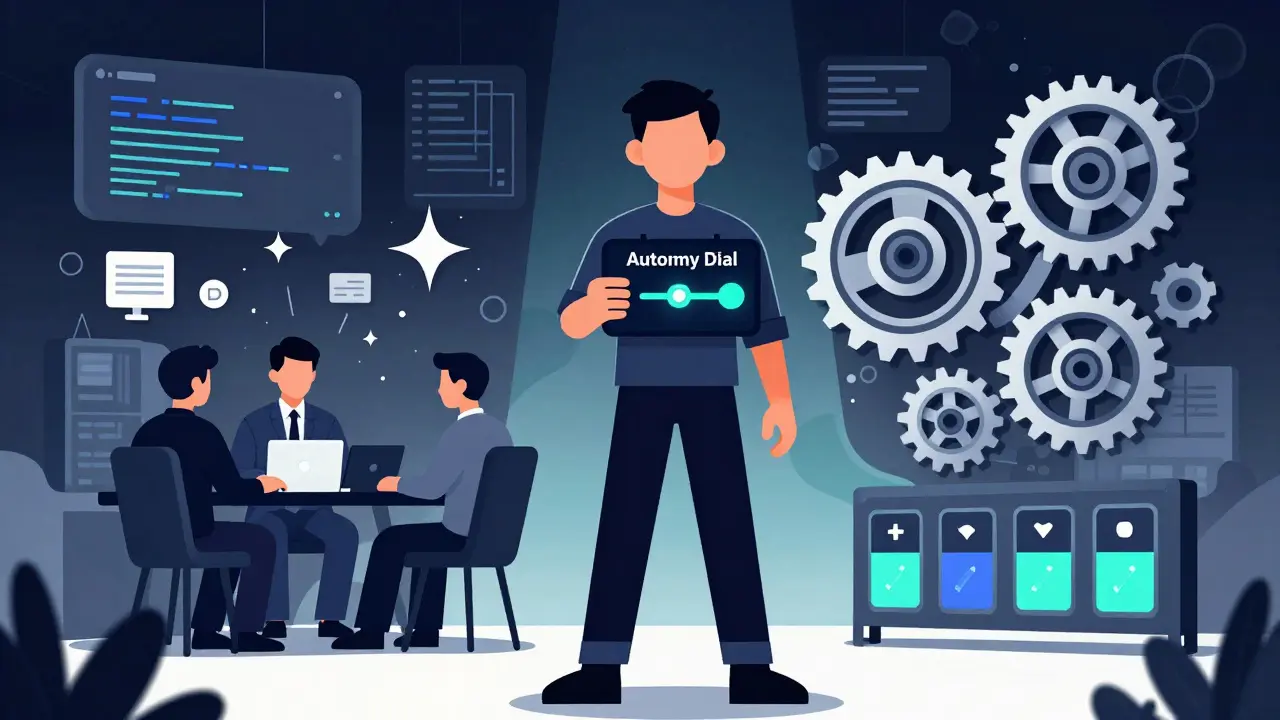
Tools are catching up to this need. GitHub released Copilot Agent in January 2026 with an "autonomy dial" feature. This allows developers to adjust autonomy levels from 0-100% based on task criticality. For low-risk tasks, you can set it to 100% and let the agent run wild. For critical security modules, you drop it to 20%, requiring approval for every step. Devin 2.1 introduced "swarm validation," where multiple agents independently verify critical code changes, adding a layer of safety to autonomous work.
Practical Implementation Tips
Whether you lean toward vibe or agentic, success depends on how you manage the interaction. Here are proven practices from top-performing teams.
For Vibe Coding Teams:
- Prompt Hygiene: Limit prompts to 500 characters with clear acceptance criteria. Vague prompts lead to vague code. Instead of "Make this better," say "Refactor this function to reduce cyclomatic complexity below 10."
- Code Reviews: Never skip manual review. Treat AI-generated code as untrusted third-party contributions. Assume bugs exist until proven otherwise.
- Context Management: Keep your project files organized. Vibe coding tools rely on local context. If your file structure is messy, the AI’s suggestions will be too.
For Agentic System Teams:
- Autonomy Gates: Implement checkpoints where the agent must seek approval at critical decision points. Don’t let it deploy to production without human sign-off.
- Validation Protocols: Run automated tests after every agent action. If the test suite fails, halt the process immediately. This prevents cascading errors.
- Clear Specifications: Agentic systems fail with ambiguity. Provide detailed, precise instructions. Define edge cases and expected behaviors explicitly.
Future Outlook and Skill Preservation
As these tools become more powerful, a legitimate concern arises: skill atrophy. Microsoft’s internal studies show a 23% decline in low-level debugging proficiency among teams using high-autonomy agentic coding for six months or more without structured skill maintenance. If you let the AI handle everything, you forget how to fix things when it breaks.
Regulatory bodies are also taking notice. The EU’s January 2026 AI Act requires "human-in-the-loop" verification for all autonomously generated code in critical infrastructure. This limits the autonomy of agentic systems in sectors like healthcare and finance. Expect similar regulations globally as the technology matures.
The future isn't about replacing developers. Ranjan Sapkota, lead author of the arXiv review paper, argues that successful AI software engineering relies on harmonizing these strengths within a unified, human-centered lifecycle. The creative core of software development remains fundamentally human. Vibe coding will persist for innovation-driven work, while agentic systems will handle routine maintenance. Your job as a developer is shifting from writing code to orchestrating intelligence. Choose the right tool for the job, stay vigilant, and keep your skills sharp.
Is vibe coding suitable for enterprise-level applications?
Vibe coding is excellent for prototyping and internal tool development within enterprises, with 89% of Fortune 500 companies using it for such purposes. However, for large-scale production code, it requires rigorous human review to avoid "spaghetti code" and technical debt. It is less suitable for complex, multi-module refactoring where agentic systems perform better.
What are the hardware requirements for running agentic systems locally?
Agentic systems typically require robust infrastructure, including 16GB+ RAM and GPU acceleration, due to their reliance on larger 30B+ parameter models. Most enterprises opt for cloud-based implementations costing $29-$99/month based on usage tiers, rather than hosting locally, to manage computational demands.
How do I prevent silent failures in agentic coding?
Implement "autonomy gates" where the agent seeks approval at critical steps. Use swarm validation, where multiple agents verify changes independently. Always run automated test suites after every agent action and halt processes on failure. Detailed, precise specifications also reduce ambiguity-related errors.
Can beginners use agentic systems effectively?
Beginners can use agentic systems, but the learning curve is steep (3-4 weeks) compared to vibe coding (3-5 days). Effective use requires understanding system architecture and validation protocols. Without this knowledge, beginners risk introducing subtle bugs that are hard to debug due to the "black box" nature of autonomous agents.
What is the "autonomy dial" feature in modern AI coding tools?
The autonomy dial, introduced by GitHub Copilot Agent in 2026, allows developers to adjust the level of AI independence from 0-100%. At 0%, the AI acts as a passive suggestion engine. At 100%, it executes full workflows autonomously. This enables hybrid workflows, balancing control and speed based on task criticality.