How to Score Third-Party Risk for AI Coding Vendors

- Mark Chomiczewski
- 16 June 2026
- 0 Comments
You probably didn't think twice before letting a developer install that new AI coding assistant. It speeds up work, fixes bugs, and feels like magic. But have you stopped to ask who owns the code your team writes? When you use tools from AI coding vendors, such as GitHub Copilot or Tabnine, you are handing over snippets of proprietary source code to external servers. If those vendors get hacked, or if their models leak data, your intellectual property is gone. This is why third-party risk scoring has moved from a nice-to-have compliance checkbox to a critical survival skill for modern engineering teams.
Traditional vendor risk management focused on whether a supplier had an ISO 27001 certificate. That’s not enough anymore. You need to know how they train their models, what guardrails stop them from stealing your logic, and how quickly they can shut down a compromised plugin. This guide breaks down exactly how to build a scoring framework that protects your codebase without slowing down your developers.
Why Traditional Vendor Checks Fail with AI Tools
For years, companies relied on static questionnaires to vet suppliers. You sent a PDF, they filled it out, and six months later, you got a score. The problem is that AI moves faster than paperwork. An AI coding tool might update its underlying large language model (LLM) overnight. It might change its data retention policy. Or it might introduce a new feature that sends telemetry data back to headquarters in ways you never approved.
When we talk about Third-Party Risk Management (TPRM), we usually mean checking for financial stability or basic cybersecurity hygiene. But with AI, the risks are different. We aren't just worried about a server being down; we are worried about data leakage via training data. If a vendor uses your company's private code to train their public model, your secrets become part of the public knowledge base. Standard SOC 2 reports often don't capture these specific AI behaviors, leaving a massive blind spot in your security posture.
The Core Dimensions of AI Vendor Risk Scoring
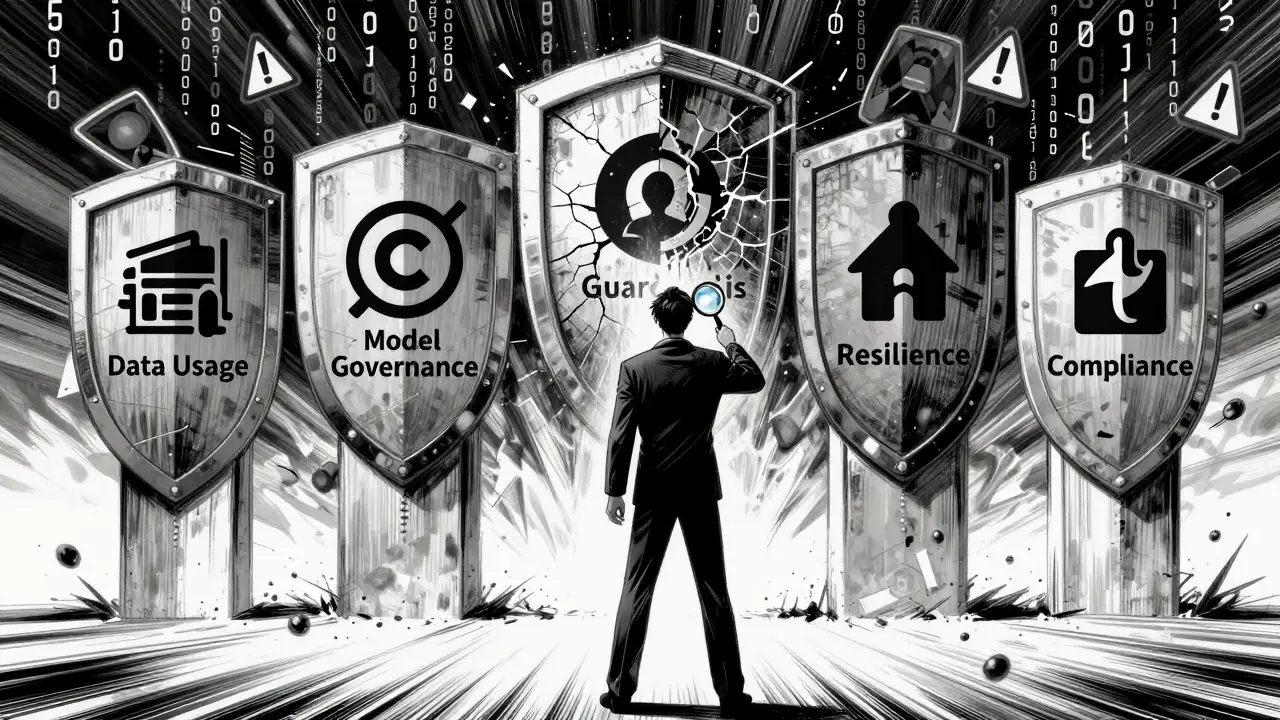
To accurately score an AI coding vendor, you cannot rely on a single number. You need a multi-dimensional approach that looks at both traditional security and unique AI risks. Think of this as building a profile for each vendor based on five key pillars.
- Data Usage and Training Practices: This is the biggest red flag. Does the vendor use customer code to improve their models? A high-risk vendor will say "yes" or be vague. A low-risk vendor provides clear opt-out mechanisms and guarantees that your data is isolated or ephemeral.
- Model Governance and Transparency: Can the vendor explain where their model comes from? Are they using open-source foundations or proprietary black boxes? Do they have processes to detect bias or hallucinations in generated code? Lack of transparency here increases the risk of introducing vulnerable code into your production environment.
- Code-Level Guardrails: Security shouldn't just be at the network level. Does the vendor offer features that prevent sensitive patterns-like API keys or passwords-from being sent to their cloud? Tools that integrate with your local IDE should have client-side filtering capabilities.
- Operational Resilience: What happens if the AI service goes down? More importantly, what happens if the AI starts generating malicious code due to a prompt injection attack? The vendor needs a plan to roll back models or disable features instantly.
- Regulatory Alignment: With regulations like the EU AI Act coming into force, vendors must comply with strict rules on high-risk AI systems. If the vendor doesn't have a compliance roadmap, they pose a legal risk to your organization.
Gathering Evidence: Beyond the Questionnaire
If you want accurate scores, you need better data. Relying solely on a vendor's self-assessment is risky because they have an incentive to look good. Instead, combine multiple evidence sources to create a holistic view.
Start with standard documents like SOC 2 Type II reports and ISO 27001 certificates. These prove the basics of their security program. Then, layer on AI-specific evidence. Look for NIST AI Risk Management Framework (AI RMF) alignment statements. Check if they have published Model Cards, which describe the model's intended use, limitations, and training data sources.
Don't ignore technical telemetry. If you are deploying these tools at scale, monitor how they behave in your environment. Do they access repositories they shouldn't? Are there unusual spikes in outbound traffic when the AI tool is active? Integrating this real-time usage data with your risk score gives you a dynamic picture rather than a stale snapshot.
| Evidence Type | What It Proves | Limitations |
|---|---|---|
| SOC 2 Report | Basic security controls, access management, and physical security. | Does not cover AI-specific risks like model bias or data training practices. |
| Model Card / Technical Whitepaper | Model architecture, training data origins, and known limitations. | May be outdated or lack detail on recent updates. |
| Penetration Test Results | Vulnerabilities in the vendor's web interface or API endpoints. | Does not test the AI model itself for prompt injection or jailbreaking. |
| Usage Telemetry | Actual behavior of the tool within your network (e.g., data exfiltration attempts). | Requires significant infrastructure to collect and analyze. |
Building Your Scoring Methodology
Once you have your data, how do you turn it into a score? You don't need complex machine learning algorithms to start. A weighted scoring model works well for most organizations. Assign weights to the five dimensions mentioned earlier based on your business priorities.
For example, if you are a fintech company, Data Usage might carry a weight of 40%, while Operational Resilience carries 20%. For a startup focused on speed, resilience might be higher. Calculate a raw score for each dimension (e.g., 0-100), apply the weights, and sum them up to get a composite risk score.
Set clear thresholds. A score above 80 might mean "Approved for General Use." A score between 60 and 80 could mean "Approved with Restrictions" (e.g., no access to core banking code). Below 60 means "Prohibited." This tiered approach allows you to manage risk without blocking innovation entirely.
Integrating Scores into Your Workflow
A risk score sits useless in a spreadsheet if it doesn't trigger action. Integrate your scoring system with your procurement and development workflows. When a new AI tool is requested by a dev team, the request should automatically pull the latest risk score from your governance platform.
If the score is too high, the system should block the installation or require manual approval from CISO-level leadership. If the score drops over time due to a new vulnerability discovered in the vendor's model, your system should alert you immediately. This continuous monitoring is crucial because AI vendors evolve rapidly. A vendor that was safe last month might be risky today after a poor model update.

Common Pitfalls to Avoid
As you build this program, watch out for these common mistakes:
- Ignoring the Human Element: AI can automate data collection, but humans must interpret context. An automated system might flag a vendor as high-risk because they use a newer, less-documented LLM, even if their internal controls are robust. Keep experienced engineers in the loop for final decisions.
- One-Time Assessments: Treating vendor risk as a one-off event during onboarding is dangerous. AI models change, policies shift, and threats emerge. Schedule quarterly re-evaluations or set up continuous monitoring feeds.
- Over-Reliance on Certifications: A SOC 2 certificate is necessary but not sufficient. It tells you the vendor has good doors and locks, but it doesn't tell you if they are selling the contents of your house. Always dig deeper into AI-specific controls.
Next Steps for Implementation
Start small. Pick your top three AI coding vendors and run them through this scoring framework manually. Document the questions you asked, the evidence you gathered, and the scores you assigned. Use this process to refine your weights and criteria. Once you have a working model, automate the data collection where possible and expand to all vendors. Remember, the goal isn't to eliminate all risk-that's impossible-but to understand it clearly so you can make informed decisions about how to protect your code.
What is the difference between traditional TPRM and AI vendor risk scoring?
Traditional TPRM focuses on general security, financial stability, and compliance standards like ISO 27001. AI vendor risk scoring adds specific dimensions related to artificial intelligence, such as model training data practices, prompt injection vulnerabilities, algorithmic bias, and the potential for intellectual property leakage through generated code.
How often should I re-score my AI coding vendors?
Ideally, you should move towards continuous monitoring. However, if continuous monitoring isn't feasible, conduct formal re-assessments at least quarterly. AI models and vendor policies can change rapidly, making annual reviews insufficient for managing current risks.
Which frameworks should I use to assess AI vendors?
Key frameworks include the NIST AI Risk Management Framework (AI RMF) for governance and risk categories, and the OWASP Top 10 for Large Language Model Applications for technical security vulnerabilities. Combining these with standard IT security frameworks like SOC 2 provides a comprehensive view.
Can I trust automated AI risk scoring tools?
Automated tools are excellent for aggregating data and identifying obvious red flags, but they should not replace human judgment. AI scoring engines can miss nuanced contexts or misinterpret complex contractual clauses. Always have security experts review high-risk assessments and exceptions.
What is the biggest risk associated with AI coding assistants?
The biggest risk is intellectual property leakage. If an AI vendor uses your proprietary code to train their public models, your competitive advantage could be exposed to competitors. Additionally, insecure generated code can introduce vulnerabilities directly into your production systems.